Why a Power Company Wants to Pay $20 Billion for Design Software
In Schneider Electric's talks to buy PTC, the deal matters less than the direction: power, automation, industrial data and design software merging into one operating stack.
The question that matters more than $20 billion
Schneider Electric does not just sell transformers. It is an energy management and industrial automation company. It distributes power in data centers and factories, and it connects UPS systems, cooling and automation. If PTC joins the group, its business would reach past physical equipment and up into product design.
PTC's Creo is CAD software. Its Windchill is PLM software. Together they cover a Digital Thread that links a product's design information, parts structure, change history, and manufacturing and service data. For AI to act in a factory or a data center, sensor data is not enough. It also needs context: what this machine is, how it was designed, and which parts it is made of.
| Figure | What it measures |
|---|---|
| $20B | Reported deal size for PTC |
| About 28% | Simple premium to PTC's roughly $15.6B market cap |
| About 7.3x | Simple deal price against 2026 expected revenue of up to $2.75B |
What Schneider is assembling: a software stack for the real world
Add AVEVA and Cognite and the direction gets clearer. Schneider took full ownership of AVEVA in 2023. In 2026 it agreed to buy Cognite, an industrial data and AI company, for $3.1 billion.
- Design: PTC. CAD, PLM and product lifecycle data.
- Industrial Data: Cognite. Connects industrial data into context AI can understand.
- Operations: AVEVA. Process and operations software, industrial software and digital twins.
- Control: Schneider. Industrial automation and field control.
- Power: Schneider. Power distribution, UPS, energy management and data center infrastructure.
Schneider itself described the Cognite deal as a way to strengthen "Industrial AI" capability that links the physical and digital worlds. So if the PTC deal goes through, it reads more naturally as a strategy to link industrial data and execution across a longer lifecycle than as diversification into unrelated software assets.
Physical AI is not only about robots
Physical AI usually calls humanoid robots to mind first. But for a single robot to move in a factory, power, equipment, product design data, safety rules, production processes and maintenance information all have to move with it.
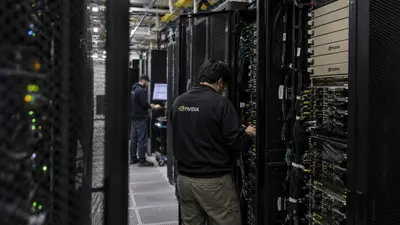
If Nvidia supplies the compute and intelligence infrastructure for AI, the territory Schneider wants to widen looks closer to a Physical Infrastructure Operating Layer. That is not an official Schneider business name. It is an analytical frame for linking these deals. The point: the further AI moves off the screen, the more it matters which real-world equipment it can understand and move safely, not just what it can think.
Why pay 7.3 times revenue?
The roughly $20 billion is about 28% above PTC's current market cap of about $15.6 billion. Against 2026 expected revenue of up to $2.75 billion, the simple price-to-revenue multiple is about 7.3x. This is a rough calculation made before adjusting for acquired debt and cash, so it differs from a precise EV/Sales figure.
The message is still clear. An industrial company would consider a high price not only for the software revenue itself but for the high switching costs of software embedded deeply in customers' design data and workflows. CAD and PLM sit inside a manufacturer's core engineering process and are hard to replace. If Schneider can sell software and AI services to its power and automation customers, it could raise revenue per customer and the durability of those relationships at the same time.
Insight Times Editorial Desk