White House Swaps AI for "SI." The Real Investment Signal Is Infrastructure, Not the Name
An executive order renames artificial intelligence "Super Intelligence" and six frontier labs sign a voluntary safety accord. What investors should watch is the data center, power, nuclear and chip policy now gathered under one national-competitiveness frame.
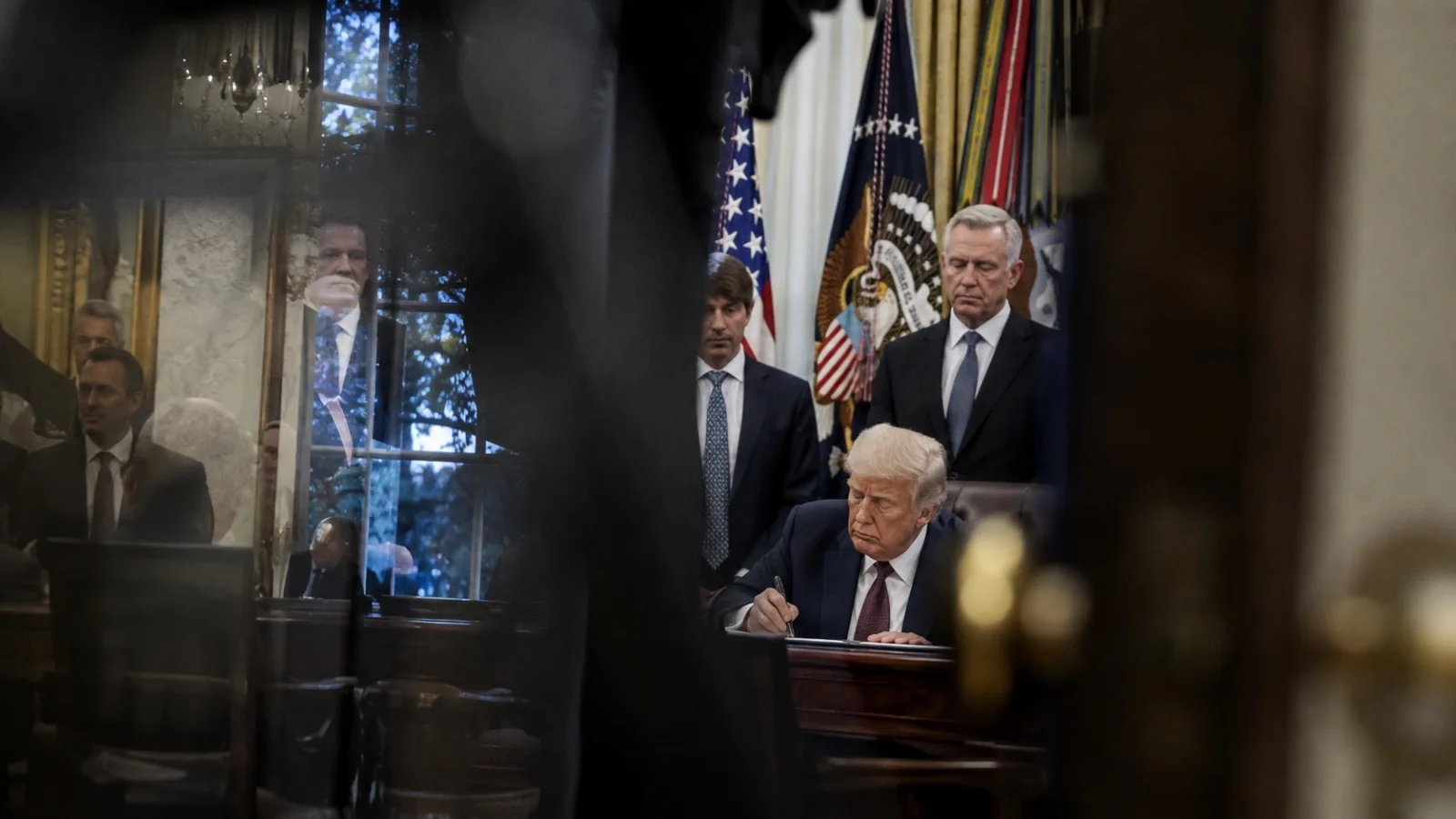
The administration has replaced "AI" with "Super Intelligence" in official documents and signed a voluntary safety accord with six frontier companies. But the name change is not the point for investors. Data center, power, nuclear and semiconductor policies already under way are being bundled into a single "national competitiveness" frame.
The "AI phase-out" is real, but legally only the name has changed
On Sept. 29, the White House issued Executive Order 14434. It directs the executive branch to use "Super Intelligence" and "SI" instead of "Artificial Intelligence" and "AI" in non-statutory documents: official correspondence, websites, reports and policy papers. The wording is strong.
The legal effect is narrower. The order does not require existing regulations, contracts, grants or prior presidential actions to be rewritten. More important, the legal definition of SI is currently identical to the definition of AI in existing U.S. law. The technology has not been reclassified as "superintelligence" overnight. The administration's policy vocabulary has changed first.
The next step comes in 60 days. The White House science and technology policy chief must submit to the president draft legislative language reviewing whether to expand or replace the existing AI definition. How much the actual legal and regulatory framework shifts at that point is the first checkpoint.
The six-company accord points to standard-setting more than favoritism
The same day, Google, Anthropic, Meta, OpenAI, xAI and Nvidia signed the White House Accord on Super Intelligence. It calls for a four-layer control structure: internal monitoring of model capabilities and risks, a dedicated internal team, outside evaluators and an independent board committee.
Some readings go too far. The accord carries no legal penalties. It does not guarantee the six companies a monopoly position or government procurement rights. The claim that "the government has designated six companies as an official oligopoly" cannot be confirmed from the current document.
Still, one provision matters: participants will meet regularly to develop standards and best practices. If those standards are later absorbed into law or procurement requirements, frontier companies that already have large compute fleets and compliance teams could gain a relative advantage. The barrier to entry is more likely to come from the cost of meeting the standards than from the accord itself.
The link for investors: an infrastructure strategy that predates SI
Reading this order as "the White House has just unleashed new data centers and nuclear plants" would be inaccurate. The infrastructure push began with America's AI Action Plan in 2025. That plan centered on faster permitting for data centers, chip fabs and energy infrastructure, and on expanding power supply.
Support for nuclear power and the grid is also moving forward under separate policies. So the investment meaning of the SI declaration is more structural than any single new subsidy. Existing semiconductor, data center, power and nuclear policies are now being tied together under a national-security frame of competition over superintelligence.
| Signal | What it means |
|---|---|
| AI → SI | A stronger frame in which the administration describes the technology as a core national asset, not a productivity tool. |
| Four-layer control | Internal monitoring, a dedicated team, outside evaluation and board oversight. Voluntary for now, but could be formalized later. |
| 60 days | The key question is how far the new federal SI definition and related draft legislation change the existing AI legal framework. |
For chips, the case is longer demand visibility, not a "national stockpile"
The phrase "AI chips have become strategic stockpile materials" does not appear in any official document. But if policy supports long-term buildouts of compute and power, the nature of semiconductor demand could change. What investors should watch is actual orders and capital spending, not the wording.
| Value chain | Representative companies | Investment logic tied to SI policy | Risks to check |
|---|---|---|---|
| GPUs / accelerators | Nvidia, AMD | If compute for frontier training and heavy inference keeps rising, long-term demand visibility improves | Model efficiency gains, customers shifting to in-house chips, capex ROI |
| Custom ASICs / networking | Broadcom and others | The more hyperscalers try to cut inference costs, the more demand for in-house accelerators and networking could grow | Customer concentration, project timing, competition from GPUs |
| HBM / memory | SK hynix, Micron, Samsung | Structural demand growth if memory per accelerator and bandwidth keep rising | Pace of capacity additions, falling ASPs, yields in HBM generation transitions |
| Foundry / packaging | TSMC | Leading-edge logic and advanced packaging act as the physical bottleneck on cluster supply speed | CoWoS expansion, customer mix, geopolitics |
| Equipment / EDA | ASML, Synopsys and others | Rising complexity in fine-pitch processes and 3D packaging raises long-term design and equipment intensity | Export controls, fab investment cycles, customer capex adjustments |
Bottom line: What the White House has changed so far is a name. Whether money is actually moving is something to confirm in power and capital spending numbers.
Insight Times Editorial Desk