Memory and Equipment Stocks Outran Nvidia as AI Money Moved Toward Capacity
A 5.344% intraday spike in the 10-year yield was absorbed by chips, not by Big Tech broadly. SK hynix, Micron and equipment makers led, a sign the AI trade is spreading from GPUs to expansion.

Indexes rose, but this was not a risk-on tape
U.S. stocks opened uneasy on Oct. 1. The 10-year Treasury yield climbed as high as 5.344%, renewing pressure on growth-stock valuations, and indexes started lower. Yields then retreated quickly, and equities recovered their losses.
The close hides some of that. The Nasdaq gained just 0.04%. The VIX edged up to 16.39. Brent crude stayed above $102. The two pressures, rates and oil, did not go away. Falling yields in the afternoon simply revived buying power in certain sectors.
AI gains spread from compute to capacity
The most telling number was not Nvidia's. Nvidia rose 1.09%, while SK hynix gained 5.08% and Micron 3.03%. Sandisk rose 2.75%. Lam Research (+3.53%) and Applied Materials (+3.50%) were also strong.
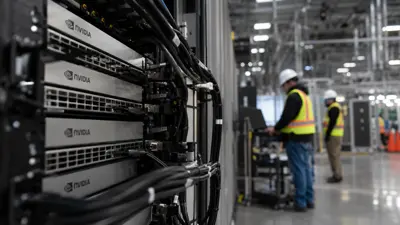
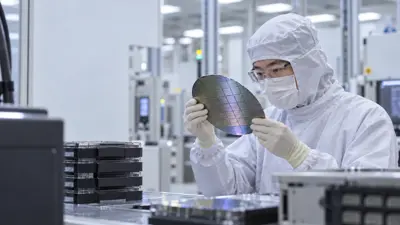
The order matters. More AI servers require more than GPUs. HBM sits next to the GPU, and servers also take more DRAM and high-performance storage. When memory supply tightens and prices and profitability improve, memory makers look to add capacity. The next place that money goes is chip equipment for etching, deposition and inspection.
Micron's strong results and guidance the day before reinforced the logic. It also said long-term customer commitments had grown to $32 billion. What the market bought on Oct. 1 was less generic "AI optimism" than visibility: the idea that shortages of parts and capacity for AI infrastructure could turn into real orders and pricing.
The chain the market is pricing
- AI server buildout: rising compute demand
- HBM, DRAM and SSDs: memory demand and pricing
- Capacity expansion: capital spending resumes
- Equipment orders: etch, deposition and more
The market was selective within semiconductors
Not every chip stock rose. Broadcom fell 2.15% and Qualcomm fell 1.06%. Memory and equipment names were strong. Nvidia, TSMC and AMD rose, but by smaller margins.
That split makes it hard to call this a simple chip rally. Investors appeared to be choosing the companies that stand to get revenue and orders most directly from current data-center expansion, rather than buying the single word "AI." It likely explains why memory and equipment stocks, with more leverage to an industry recovery and buildout, moved more than GPU leaders whose expectations are already largely priced in.
Yields and oil remain a ceiling
The good news has limits. A 10-year yield of 5.24% is still very high. The intraday touch of 5.344% also suggests the market is probing for a new top in long-term rates. If yields push back above 5.30%, multiple pressure on richly valued growth stocks could resume quickly.
Brent above $100 is a burden too. Higher oil helps energy companies, but across the economy it weighs on inflation, consumer spending power and corporate costs. That helps explain why gains were modest even after stocks turned positive.
Key stocks
| Stock | Close | Change | Link the market saw |
|---|---|---|---|
| SK hynix | $193.50 | +5.08% | HBM, memory |
| Lam Research | $340.10 | +3.53% | Memory expansion equipment |
| Applied Materials | $529.30 | +3.50% | Chip equipment |
| Micron | $1,097.39 | +3.03% | DRAM, HBM |
| Sandisk | $1,787.69 | +2.75% | Storage |
| Nvidia | $230.86 | +1.09% | GPUs |
| Broadcom | $343.64 | -2.15% | Networking, custom chips |
The day suggests AI investment money is spreading to memory and equipment. The next thing to check is actual orders.
Insight Times Editorial Desk