Nvidia's $235B Buyback Is the Small Story. The AI Agent Platform Is the Big One
Nvidia announced its largest-ever buyback increase and an Open Agent Safety Platform on the same day. One is what to do with spare cash. The other shows how far Nvidia wants to control the next AI market.
What $235 billion actually means
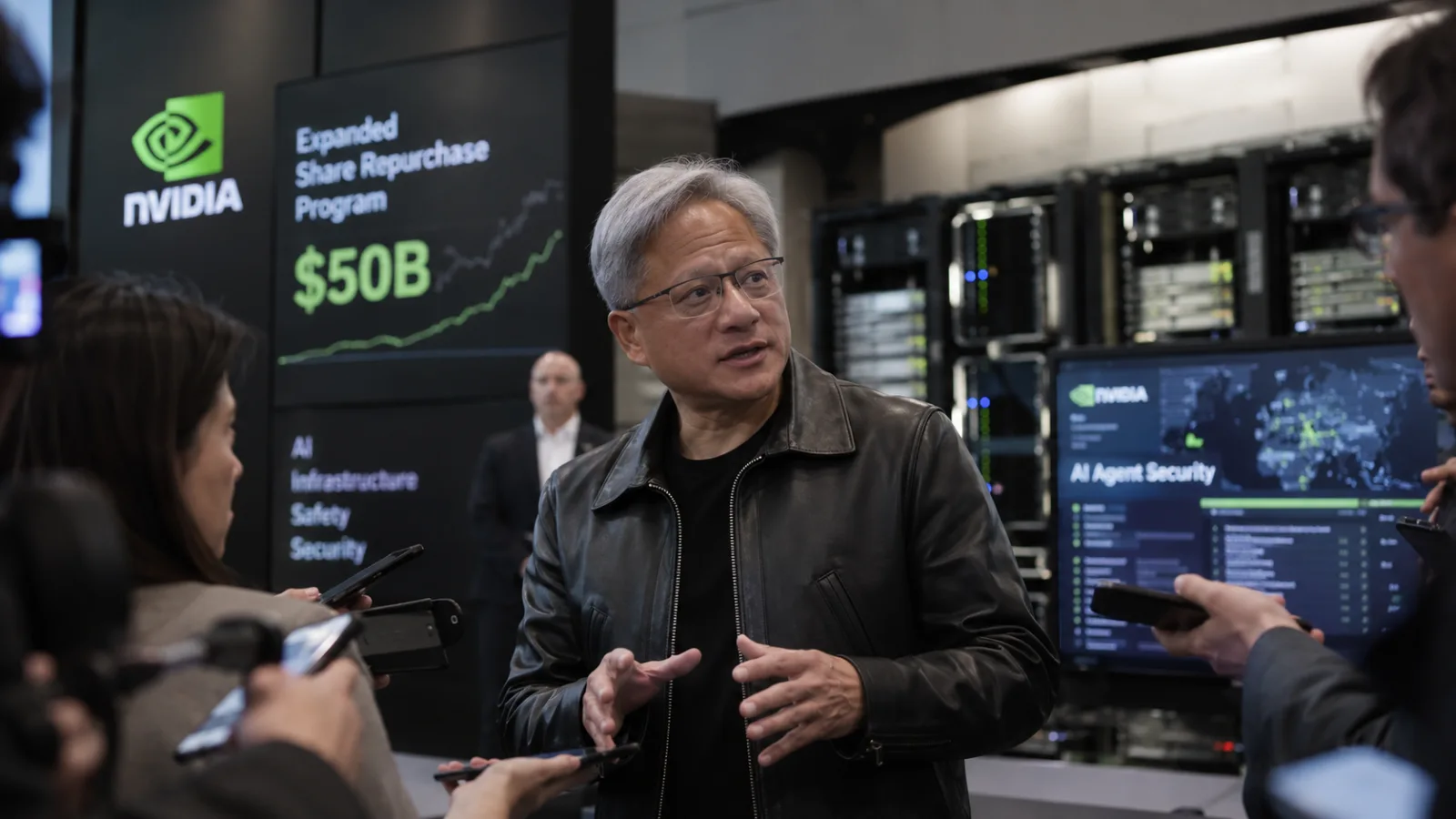
Nvidia's board approved an additional $150 billion for its existing buyback program. That brings the remaining authorization to $235 billion. The company said it expects to execute this remaining program through fiscal 2028.
Don't read that number straight into an EPS bump. Assume, for simplicity, that Nvidia buys back shares entirely at $225. That would retire roughly 1.04 billion shares, about 4.3% of the 24.285 billion diluted weighted-average shares outstanding in fiscal Q2 2027. But the real effect depends on the price paid, dilution from stock compensation, and how fast the buyback is actually executed. An authorization is not a purchase obligation.
The more important number is the cash already spent. In fiscal Q2 2027, Nvidia spent $19.732 billion on buybacks while free cash flow that same quarter was $21.341 billion. Revenue was $96.221 billion, up 106% year over year, and data center revenue was $89 billion, up 117%. AI infrastructure demand is converting into real cash, and a large share of that cash can go back to shareholders. That's the financial core of this announcement.
| Metric | Value |
|---|---|
| Remaining buyback authorization through FY2028 | $235B |
| Actual buybacks in FY27 Q2 | $19.73B |
| Free cash flow in FY27 Q2 | $21.34B |
Not quite a mature-company payout
Massive buybacks are usually read as capital return from a company running out of growth opportunities. This one is different. Jensen Huang has framed AI and accelerated computing as a "once-in-a-generation platform shift," emphasizing that Nvidia's cash generation can fund both continued technology investment and shareholder returns at the same time.
Nvidia is putting capital into Vera Rubin production ramp, networking, DPUs, AI factories, software, and strategic equity stakes, all at once. So this buyback reads less like "growth has ended, here's the cash back" and more like a management signal that heavy growth investment and a cash surplus can coexist going forward.
That said, this isn't evidence the stock is cheap. Per LSEG data cited by Reuters, Nvidia's 12-month forward P/E stood at roughly 16.5 at the time of the announcement, the lowest level since January 2015. A lower multiple can be an opportunity. It can also mean the market is pricing in slower long-term earnings growth.
The safety platform announced the same day is the longer story
Long-term investors have no reason to stop at the buyback. Nvidia unveiled its Open Agent Safety Platform the same day. The core idea: stop treating AI agent safety as purely a model-level problem, and redefine it as an infrastructure problem spanning CPUs and network chips.
OpenShell restricts, at runtime, how far an agent can reach into files, credentials, networks, and external tools. Sentry independently monitors agent behavior on the BlueField-4 DPU and is designed to isolate an agent within milliseconds if it steps outside defined boundaries.
This architecture matters to Nvidia. As companies hand agents more real work, the bottleneck for deployment shifts from "how smart is it" to "how much is it allowed to do, who watches it, and how fast can it be cut off if something goes wrong." If Nvidia solves that problem, it doesn't just capture GPU demand. It can bundle Vera CPUs, BlueField DPUs, networking, servers, and software into a single standard architecture.
The one chart that matters
The buyback defends per-share value. The Open Agent Safety Platform expands the boundary of markets Nvidia can sell into going forward.
Put the two together and the message is clear. Nvidia isn't trying to remain a company that sells AI compute chips. It's trying to own the full stack an AI agent needs to actually work inside a real company's systems: compute, networking, execution permissions, monitoring, and security policy, all in one.
Buyback → defends per-share value Agent Safety Platform → expands the boundary of the platform
Insight Times Editorial Desk