OpenAI Leaves the Chatbot Behind: DevDay 2026 and the Fight Over Digital Labor
The new model mattered less than Dots, ChatGPT Space, plugins and the Marketplace. OpenAI wants to run agents that keep doing work people hand off, and to control distribution, payment and security around them.
The real story is "digital labor"
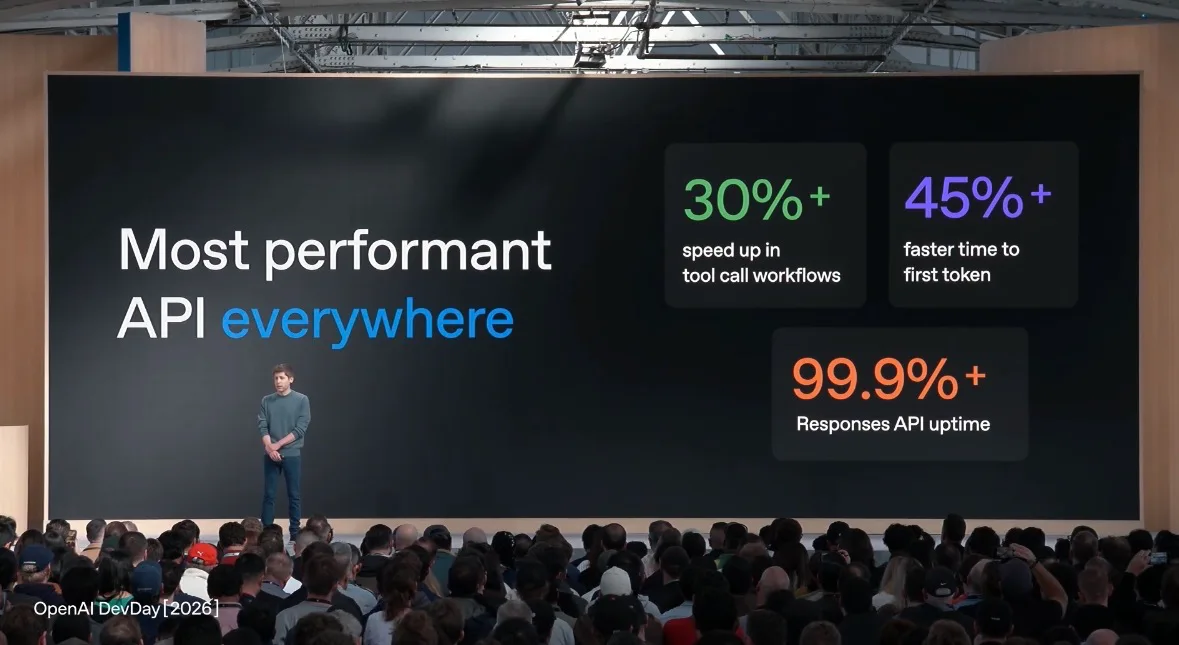
OpenAI unveiled more than 20 products and features at DevDay 2026. Investors need to remember only three names: Dots, ChatGPT Space and the expanded plugins.
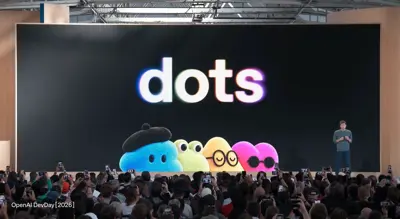
Dots is an always-on agent built on GPT-6 Astra. It has its own cloud computer, connects to more than 4,000 apps, learns from user feedback and runs several tasks in parallel. It can be called from Slack and Microsoft Teams as well as ChatGPT. It is rolling out first to Pro and Business Premium. Enterprise, Edu and Healthcare customers can test it only after an administrator switches it on.
This matters because it changes how AI consumption is measured. People do not question a chatbot all day. An agent can research, fix code, update documents and operate apps while the user sleeps or sits in meetings. If it works, AI usage could grow faster than human screen time.
ChatGPT widens into app store, workspace and identity
ChatGPT Space is a team area where people, ChatGPT and Dots share the same knowledge and work product. Pages supports writing, research, charts and image generation. Shared slides can be edited by several people and agents at once, then exported to PowerPoint or Google Slides.
OpenAI also opened a plugin extension that lets developers build complete interactive apps inside ChatGPT. It added a recommendation and search system and MCP Events. Add 1.2 billion weekly ChatGPT users, and developers can reach customers inside ChatGPT without asking them to install a separate app.
Sign in with ChatGPT goes a step further. In 16 initial partner tools, users can link their ChatGPT account and, where eligible, their ChatGPT plan usage. In the OpenAI Marketplace, companies can spend part of their existing OpenAI commitments on approved partner software.
OpenAI is aiming at more than model sales. Who logs in, what data is used, which agent does the work and which software gets the money would all sit inside ChatGPT.
An opportunity for SaaS, and a risk of becoming the back end
The structure collides head-on with Microsoft 365, Google Workspace, Notion, Slack, Salesforce and ServiceNow. It would be an overreach to say OpenAI intends to replace them all. For now the strategy looks more like adding an intelligent work layer on top of existing systems.
For investors, the key question is not whether a product has AI features. It is who owns the data, approvals and records that an AI agent must pass through. Systems that hold regulatory records and core customer data stay strong in an agent era. Software whose value was the screen and repetitive data entry may face pricing pressure.
| Area | Signal from the event | Opportunity | Key risk |
|---|---|---|---|
| AI chips and data centers | Always-on agents, fast inference | More use of accelerators, memory, networking, power and cooling | In-house chips, price competition, overinvestment, customer concentration |
| Microsoft | Teams integration, expanded Space and Pages | Leverage enterprise customers and Azure | Growing overlap between 365 Copilot and ChatGPT |
| Salesforce, ServiceNow, HubSpot | Early Marketplace partners | New distribution channel | Ceding the customer relationship to ChatGPT |
| Palo Alto, CrowdStrike | Security partners | Demand for controlling agent permissions and actions | Platform-bundled security |
| AWS | Bedrock Managed Agents, powered by OpenAI | More OpenAI consumption inside AWS data, security and billing | A multimodel strategy also dilutes OpenAI's exclusivity |
Model prices fall, but total cost of work matters more
GPT-6.1 Sol's API price is $2 per million input tokens, $10 per million output tokens and $0.10 for cached input. OpenAI says it delivers performance close to GPT-6 Astra on complex coding, computer use and professional work at one-fifth of Astra's standard input and output prices.
Falling prices weigh on a model vendor's revenue per unit. Companies, in turn, can run more agents for longer on the same budget. The question is whether usage grows faster than token prices fall.
A more useful figure than any benchmark is the total cost of finishing one task. A cheap model that errs often and needs constant human review has poor economics. A somewhat pricier one that finishes the job in one pass can be more productive.
- $2 / $10: GPT-6.1 Sol price per million input / output tokens
- 300 tok/s: maximum generation speed of GPT-6 Astra Ultrafast in Codex
- 1.2B: ChatGPT weekly users, as stated by OpenAI
Speed and security become separate products
Ultrafast is a premium speed tier of up to 300 tokens per second, up to 8 times faster in Codex and up to 6 times faster in the API. It shows the AI market splitting into service tiers that combine cost, intelligence and latency, rather than a single model price list.
Private Intelligence follows the same logic. It bundles safety review based on Zero Data Retention with Private Inference, which is due in preview this fall, and turns enterprise data protection into a product feature. In finance, health care, government and large corporations, performance alone does not open a contract. Storage, access rights, auditability and inference data protection must be settled.
When AI moves from reading to operating external systems, the cost of an accident rises. The hidden infrastructure of the agent era is therefore not only GPUs but identity, permissions, audit logs and behavioral controls.
Commercialization is fast, but a good business is not yet proven
According to Reuters, OpenAI's annualized recurring revenue is near $70 billion, and enterprise revenue has doubled since July. The figure should not be read as "third-quarter revenue up 70% from the prior quarter." The report means the revenue run rate has risen more than 70% since the start of the third quarter.
On March 31, OpenAI raised $122 billion in committed capital at a post-money valuation of $852 billion. On September 29, reports said it aims to raise at least $30 billion more at a valuation of about $1.4 trillion. Talks are still under way.
These numbers show the speed of growth, not profitability. Cash flow after inference costs, data-center contracts, talent, depreciation and the cost of safety incidents is a separate matter. Fast growth is not the same as a good business, and a good business is not the same as a good stock.
Insight Times Editorial Desk