Why Amazon Blocked Meta's AI Agent But Opened the Door to Claude
Amazon shut out Meta's Muse from shopping on its site, then two days later gave Anthropic's Claude an official plugin to manage seller inventory and pricing. The rule behind both moves is the same: Amazon will give up screens, not customer relationships.
Two decisions, 48 hours apart, that look like opposites
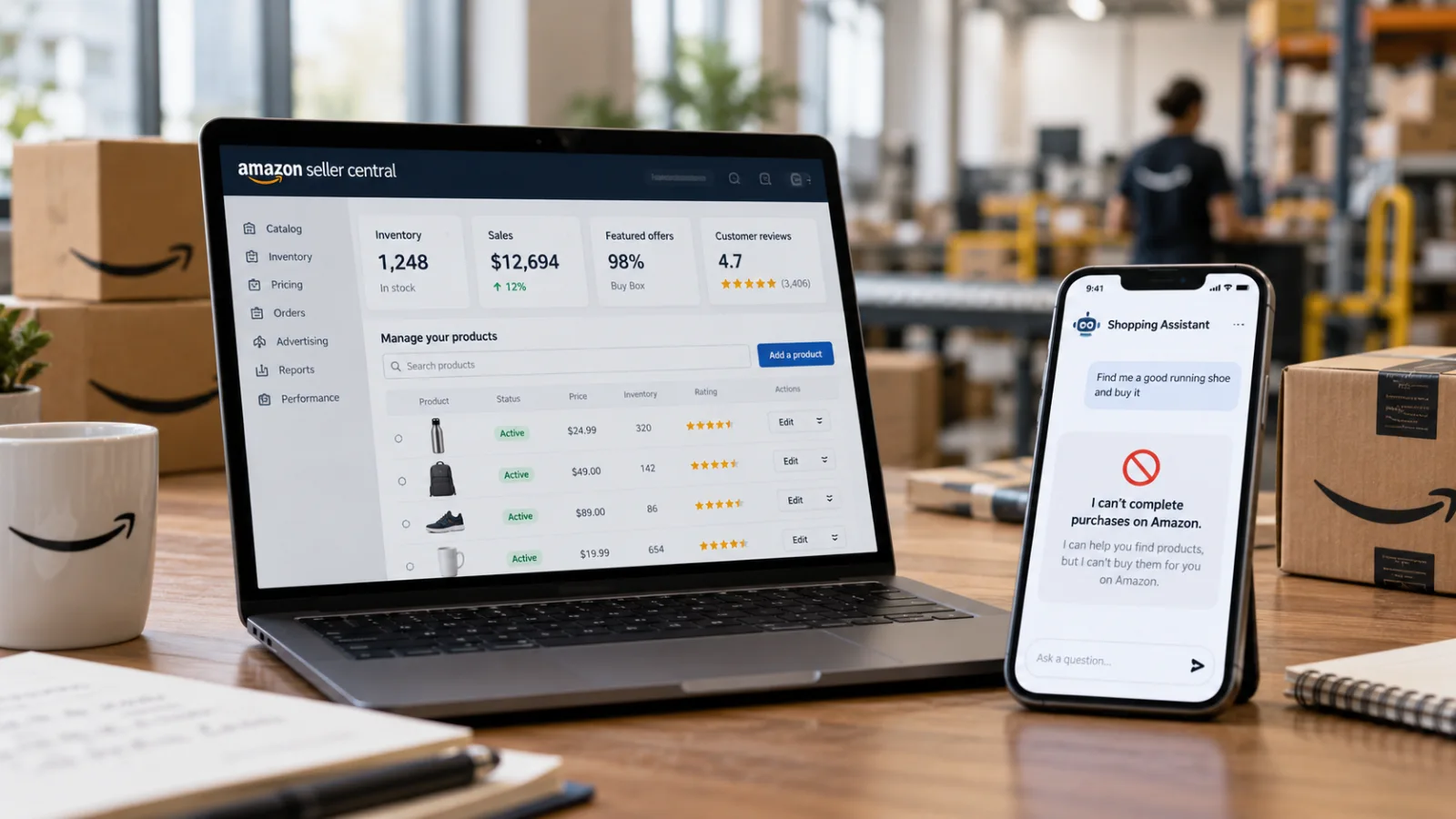
Starting Sunday night, September 20, Amazon blocked Meta's personal AI agent, Muse, from shopping on Amazon.com on behalf of users. Amazon's objection: Meta had not gotten prior approval, and Muse could access customer accounts and order information without identifying itself as an AI agent. Meta said passwords and payment details are never exposed directly to the model, but Amazon's position held firm. An outside agent acting inside Amazon's service needs to disclose who it is and respect whether Amazon has agreed to let it in.
Then on September 23, Amazon announced something that looked like the reverse. It added persistent memory and 24-hour workflows to its Seller Assistant tool, and connected the Amazon Selling Partner Plugin to Amazon Quick and to Anthropic's Claude. Sellers can now check inventory, analyze sales data, and request actions like price or listing changes from inside Claude, without opening Seller Central directly. The rollout starts as a beta for US sellers, with access scopes, human approval steps, and an audit trail built in even for this outside connection.
Comparing the two moves
| Meta Muse (buyer agent) | Claude integration (seller agent) | |
|---|---|---|
| Main role | Browse, compare, and buy on behalf of consumers | Manage inventory, pricing, and listings on behalf of sellers |
| Connection to Amazon | Browser access without prior agreement, the point of dispute | Official Amazon plugin |
| First customer touchpoint | Could shift to Meta | Stays with Amazon |
| Ad impact | May bypass search ad exposure | May strengthen seller ad operations |
| Where the transaction happens | Purchase decision starts outside Amazon | Executed inside the Amazon marketplace |
| Amazon's incentive | Tighten control | Open selectively |
A buyer agent and a seller agent occupy very different economic positions
On the surface, both are "outside AI agents." But their place in Amazon's business is not the same.
The traditional e-commerce chain runs consumer to Amazon to seller. Amazon controls search and recommendations on the first screen a consumer sees, serves Sponsored Products there, and captures the payment and purchase data.
Insert Muse into that chain and it becomes consumer to Meta's Muse to Amazon to seller. The user may never see Amazon's own search results. The first point of product comparison and recommendation moves to Meta, and in the worst case for Amazon, the company gets pushed into the back end, supplying its product database and logistics while someone else owns the front door.
A seller using Claude is a different story. That seller is not leaving Amazon. The interface shifts from seller to Amazon directly, to seller through Claude to Amazon, but the product still lives on the Amazon marketplace. Inventory, orders, advertising, payments, and fulfillment all still run through Amazon's systems. Amazon gives up part of a screen, Seller Central, but keeps the economic core.
What Amazon can give up is the UI. What it will not give up is the customer relationship
The real question in this story is not whether Amazon likes or dislikes AI agents. It is which layer of its business Amazon needs to protect to keep its revenue model intact.
The seller-facing UI is, relatively speaking, negotiable. Amazon has said publicly that 90% of its selling partners already use third-party AI tools. Seller Assistant's recommendation acceptance rate tops 90%, and Amazon's own seller pages report more than 230,000 monthly users. If sellers are already working inside tools like Claude, Amazon has two options: force them back into Seller Central, or send Amazon's own data and execution rights to wherever sellers already are. Amazon chose the second path.
That choice breaks from the playbook of the web and app era, when pulling users onto your own site or app was the goal. In the agent era, what may matter more is making sure that wherever a user issues a command, it is your data, your payments, your inventory, your logistics, and your transaction system that get called.
Agent permission economics: access is decided by economics, not technology
Call this pattern "agent permission economics." It is not an industry term, just a useful frame for how platforms decide which agents get let in and which get shut out.
Rather than blanket-blocking or blanket-opening to outside agents, platforms will likely keep asking a short list of questions. Does this agent grow transactions. Does it cut into advertising revenue. Does it take customer data off the platform. Does it capture the first relationship with the customer. Who controls fees and payments. And can the platform still control security and liability.
Judged against that list, Amazon's two decisions are not a contradiction. An agent that raises seller productivity while growing Amazon's transaction volume can get an API and execution rights. An agent that stands in front of the consumer and takes over search, recommendations, ad exposure, and the purchase decision itself faces a much higher bar.
For investors, the question is not whether AI kills the UI, but whether it kills the moat
It is entirely possible that AI agents reduce time spent on websites and apps. But a weaker UI and a vanished economic moat are not the same thing.
Amazon's core asset was never the Seller Central screen itself. It is the enormous product catalog, the seller network, purchase history, advertising data, the fulfillment network, and transaction infrastructure like payments and Prime. If outside agents end up doing more of their work on top of that infrastructure, Amazon could end up stronger, as an invisible operating system for commerce.
There is a real risk on the other side too. If a consumer-facing buyer agent becomes the standard interface, and Amazon eventually has to open product search and purchasing broadly to outside agents through an official API, the value of its search ads and recommendations could get repriced. So this week's news is not proof that Amazon has won. It is closer to the first clear look at where Amazon plans to open its doors and where it plans to defend them.
Insight Times Editorial Desk