S&P 500 Flat, 10-Year Yield at 5.16%: 5% Rates Split AI Winners From Losers
Headline indexes barely moved, but underneath, Meta jumped 4.50% and AMD gained 2.38% while Arm sank 7.88% and Oracle fell 3.47%, as the market judged AI names less on growth and more on how fast that growth becomes cash flow.
MARKET BRIEFING
The headline numbers were quiet. The action underneath was not.
| Index | Level | Change |
|---|---|---|
| S&P 500 | 7,704.13 | -0.02% |
| Nasdaq | 26,939.37 | +0.01% |
| Dow | 51,349.98 | -0.31% |
| Russell 2000 | 2,835.57 | -0.11% |
All four major US indexes closed near flat. On the surface, it looked like a nothing day. But before the open, weekly initial jobless claims came in at 197,000, down 1,000 from the prior week. Another sign that the labor market is not cracking easily.
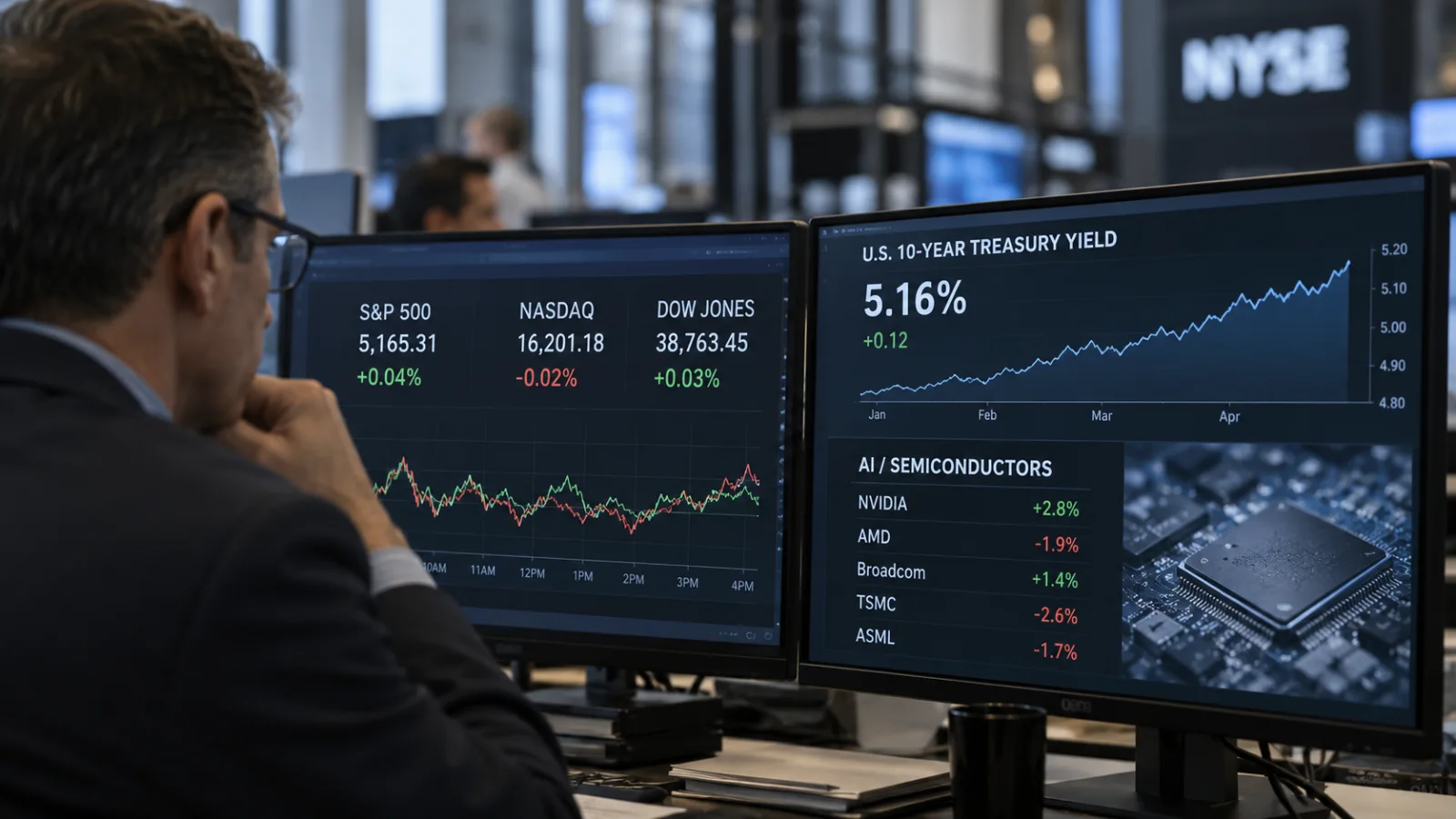
The catch is that markets right now are less worried about recession than about inflation and long-term rates staying stuck at a higher level. Resilient hiring supports hopes for a soft landing, but it also gives the Federal Reserve less reason to cut rates quickly. That logic showed up at the long end of the curve, pushing the 10-year Treasury yield up toward 5.16%.
Add to that a move in Brent crude above $106 a barrel. Employment is holding up, oil is expensive, and long-term rates are climbing. For equities, that is not an environment where corporate earnings collapse overnight, but it is one where the case for paying up on valuation gets weaker.
How 5% rates are dividing AI stocks
Not every AI company is exposed to rates the same way. Increasingly, the market is sorting them into three camps.
| Category | Examples | What the market is pricing at 5% rates |
|---|---|---|
| Fast-monetizing platforms | Meta +4.50% | How quickly AI turns into ad efficiency and revenue |
| Supply chain with clear near-term earnings | AMD +2.38%, TSMC +1.03%, Micron +0.81% | Whether current demand and sales back up investment expectations |
| Richly valued or capital-intensive names | Arm -7.88%, Oracle -3.47% | How much of a distant growth story and heavy capex is already priced in today |
The Philadelphia semiconductor index (SOXX) was essentially flat, up just 0.06% on the day. But inside that one sector, AMD rose 2.38% while Arm fell 7.88% and Broadcom dropped 1.30%. The higher rates climb, the more closely the market scrutinizes the timing of profits and valuation, rather than the growth narrative alone, even within a single industry group.
Arm's sharp drop illustrates the pattern most clearly. Its long-term growth story did not disappear in a single day. Rather, stocks that need a high multiple to be justified are more sensitive to a rising discount rate. As the present value of future earnings falls, the gap between "a good company" and "a good stock" can widen.
Why Meta and Oracle went opposite ways
Meta rose 4.50%. Investors have been focused on how Meta's AI agents and personalization technology lift advertising, recommendations and conversion rates in commerce. Even with heavy AI spending, the bet is that monetization can show up relatively quickly through the existing ad system.
Oracle, by contrast, fell 3.47%. That is less a sign that long-term demand for AI cloud and data centers is fading, and more a repricing of how large infrastructure buildouts weigh on cash flow and the cost of financing.
The difference between the two stocks is not whether they are doing AI or not. It is the difference between a company that has to spend money first for AI, and a company that can already make more money from AI using the customers and ad assets it has. The higher long-term rates go, the more expensive the market treats that time lag.
The scorecard
| Stock | Move | What the market is saying |
|---|---|---|
| Meta | +4.50% | AI monetization is flowing directly into ad revenue |
| AMD | +2.38% | AI accelerator demand and earnings outlook are offsetting rate pressure |
| Nvidia | -0.41% | The leading AI mega-cap's lofty expectations are exposed to a rising discount rate |
| Arm | -7.88% | A high-multiple stock is showing just how sensitive it is to rates |
| Oracle | -3.47% | Data center capex and cash flow strain are being repriced |
| Tesla | -0.57% | Future growth is being discounted more, and auto financing costs are a drag |
Insight Times Editorial Desk