AI Is Starting to Solve Real Math. The Answers Are Not the Surprise
AI is moving from talking well to verifying, searching and discovering. The shift in math and science may be a bigger story than chatbots.
Why it matters that ChatGPT can solve math problems
It can sound underwhelming at first.
"Isn't this just an AI that calculates better than a calculator?"
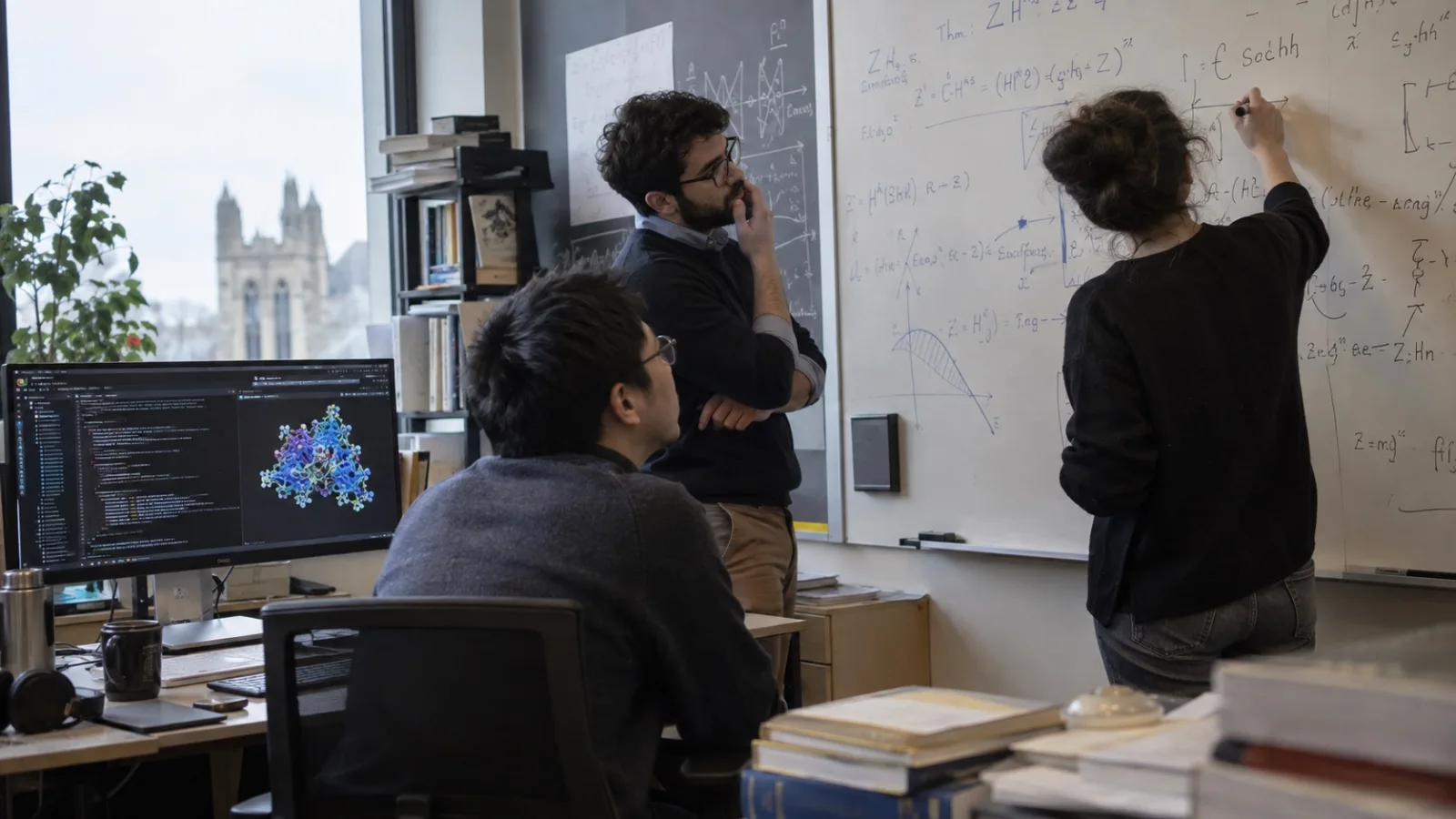
But hard math is not a calculation problem. The solver does not know the answer, and does not know where to start. A new path has to be found.
A mathematician who believes a statement is true proves it over dozens of steps. If even one step is wrong, the whole proof collapses.
That makes math an odd test for AI. Sounding plausible is not enough. The system has to keep a line of thought going and abandon wrong paths.
From an AI that talks to an AI that proves
In 2024, Google DeepMind's AlphaProof and AlphaGeometry 2 solved 4 of 6 International Mathematical Olympiad problems. They scored 28 points, silver-medal level.
One of the key tools AlphaProof used was Lean.
Lean is not hard to grasp. Think of it as a checker for math. When a person or an AI submits a proof, the computer verifies each logical step. It does not let a proof pass because it sounds good. If it is wrong, it fails.
A year later the change was bigger. In 2025, Gemini Deep Think read the problems in natural language, with no human translating them into Lean. It solved 5 of 6 and scored 35 points, gold-medal level.
Then on Oct. 6, 2026, OpenAI released several new mathematical results from an internal frontier model, along with Lean formalizations of many of the proofs. It said each result took about three hours of ChatGPT Pro-level reasoning compute on average.
What AI does in math is changing from "getting the answer right." It now explores many paths, fails, backtracks, tries again, and in the end leaves an answer in a form that can be verified.
Why this is a story about all of science
Much of science comes down to problems with far too many possible answers.
How a protein folds. Which molecule could become a drug. How to lay out a semiconductor circuit. Which combination of materials is stronger and lighter. There are too many candidates for people to test them all.
This is where AI's strength lies. It can sweep a space of candidates no person could cover in a lifetime, and narrow it to the most promising ones to test.
The best-known case is AlphaFold. The system, which predicts the three-dimensional structure of proteins, has released predictions for more than 200 million protein structures. As of 2025, more than 3 million researchers in over 190 countries had used it.
This is far from a story of AI replacing scientists. It is closer to handing an excavator to scientists who had been digging with shovels.
The more interesting scene: AI improving its own computers
Google's AlphaEvolve, unveiled in 2025, solved math and algorithm problems and also optimized real Google data centers and AI systems.
Google said AlphaEvolve found a scheduling method that recovers 0.7% of data center resources on average, and that it was put into production. It also improved a core operation used in training Gemini, making that kernel 23% faster.
In 2026, Google said, it was also used in designing the next-generation TPU and in optimizing storage systems.
That is a notable detail.
AI finds a better algorithm. The algorithm makes computers run more efficiently. Those computers then train a stronger AI.
It is too early to say AI is improving itself explosively. But a tool that has begun improving its own tools is different in kind from the old chatbot story.
Will scientists become unnecessary?
If anything, the opposite looks closer to the truth.
AI can generate candidates at enormous speed. But deciding what to ask, checking whether results hold up in nature, and spotting faulty premises still fall largely to people.
In math and science in particular, there is a wide gap between "verified" and "usable in the real world."
A mathematically elegant algorithm may fail to cut costs in an actual factory. A drug candidate found by a computer may fail in clinical trials.
So today's AI is better described as an "extremely fast research partner" than as an "automatic scientist."
Insight Times Editorial Desk