Altman Called for AI Pacing, Now Preps a Launch Blitz. The Contradiction Isn't the Point
OpenAI has teased a major release this week and a run of announcements at its September 29 DevDay, just two days after Sam Altman appeared to back the case for slowing frontier AI down. What matters for investors isn't whether his words line up. It's whether AI capital spending is shifting from massive pretraining runs toward large-scale inference and agent deployment.
'Slow down' and 'ship more' can both be true
The two statements sound contradictory, but they operate on different levels. "Pacing" isn't a pledge to release fewer already-built products. It's closer to an argument for weaving safety checks and outside evaluation into the process of building and deploying stronger frontier models. Anthropic has recently drawn a similar distinction: internal decisions that put safety first when it conflicts with speed, versus industry-wide verification mechanisms that everyone can check.
So when OpenAI unveils APIs, agents, developer tools and enterprise features all at once, that alone doesn't prove a contradiction with its safety messaging. The real test isn't how many things got launched. It's what standards govern the training and deployment of higher-capability models, and whether anyone outside the company can independently verify those standards are being met.
What matters more than DevDay's "6"
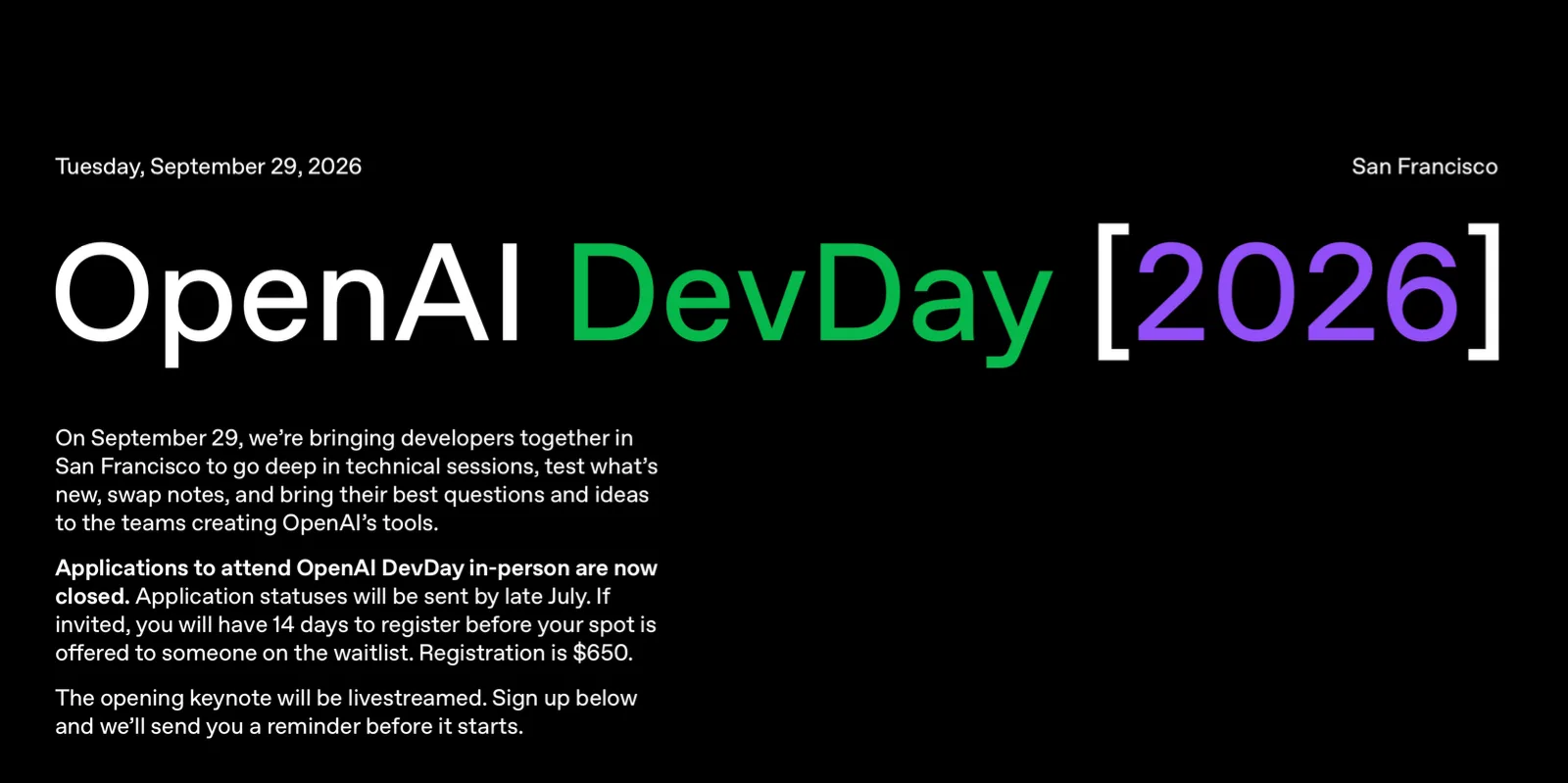
OpenAI's official site confirms only that DevDay is happening in San Francisco on September 29, with an opening keynote from Sam Altman and technical sessions centered on APIs and developer tools. Whether "ship x 6" literally means six new models has not been confirmed.
At developer conferences, the bigger economic impact often comes not from a new model's name but from pricing and integration. Delivering the same quality at a lower price, strengthening caching and batch processing, or bundling search, files, code execution and third-party app calls into a single agent workflow can sharply cut the cost of enterprise AI adoption.
When that happens, competition shifts from "who tops the benchmark" to "who delivers reliable work output at the lowest cost." For AI service providers, that shift can matter far more directly than a 5% bump in model IQ.
GPT-6 Sol isn't an investment thesis yet
Some developer communities and news reports have floated the name "GPT-6 Sol." But OpenAI's official product pages and model documentation currently show no confirmation of that name or a release timeline.
Building a case for GPU demand, OpenAI revenue, or the competitive landscape around an unconfirmed name gets the order backward. What needs checking is the official model card, API pricing, context length, inference latency, tool-use reliability, and actual deployment timing.
If OpenAI does widen its lineup of cheaper models beneath its flagship, the implication is clear. Instead of using a top-tier model for every task, companies could route collection, classification and deduplication to a cheap model, translation and structuring to a mid-tier model, and investment analysis or long-form reasoning to the high-end model. For businesses, the bigger payoff isn't performance competition but a falling cost per task.
Chip investors should watch total compute, not training-run counts
The reason AI-pacing talk has rattled semiconductor stocks is simple: the market has priced frontier-model competition as a massive capital-spending cycle in computing infrastructure. If the assumption that ever-larger models get trained ever more often starts to wobble, growth estimates for GPUs, HBM, networking and power infrastructure can slide along with it.
But a modest slowdown in training doesn't necessarily shrink total compute demand by the same proportion. Agents run far more inference than a chatbot that answers a single question once. They plan, search, read files, execute code, and retry when they fail. As the number of users and the scope of automated work grow, inference volume can rise structurally.
So investors should watch total token usage, the number of inference calls per task, how fast API unit prices fall, accelerator utilization rates, HBM content per server, network bandwidth, and data-center power consumption, rather than counting how many times a foundation model was retrained this year.
Insight Times Editorial Desk