AI Took On 372 Math Problems. Where Does Human Expertise Go Now?
OpenAI's math release shows AI can work on problems that took people a lifetime in hours. The harder question is who decides which of its answers are true.
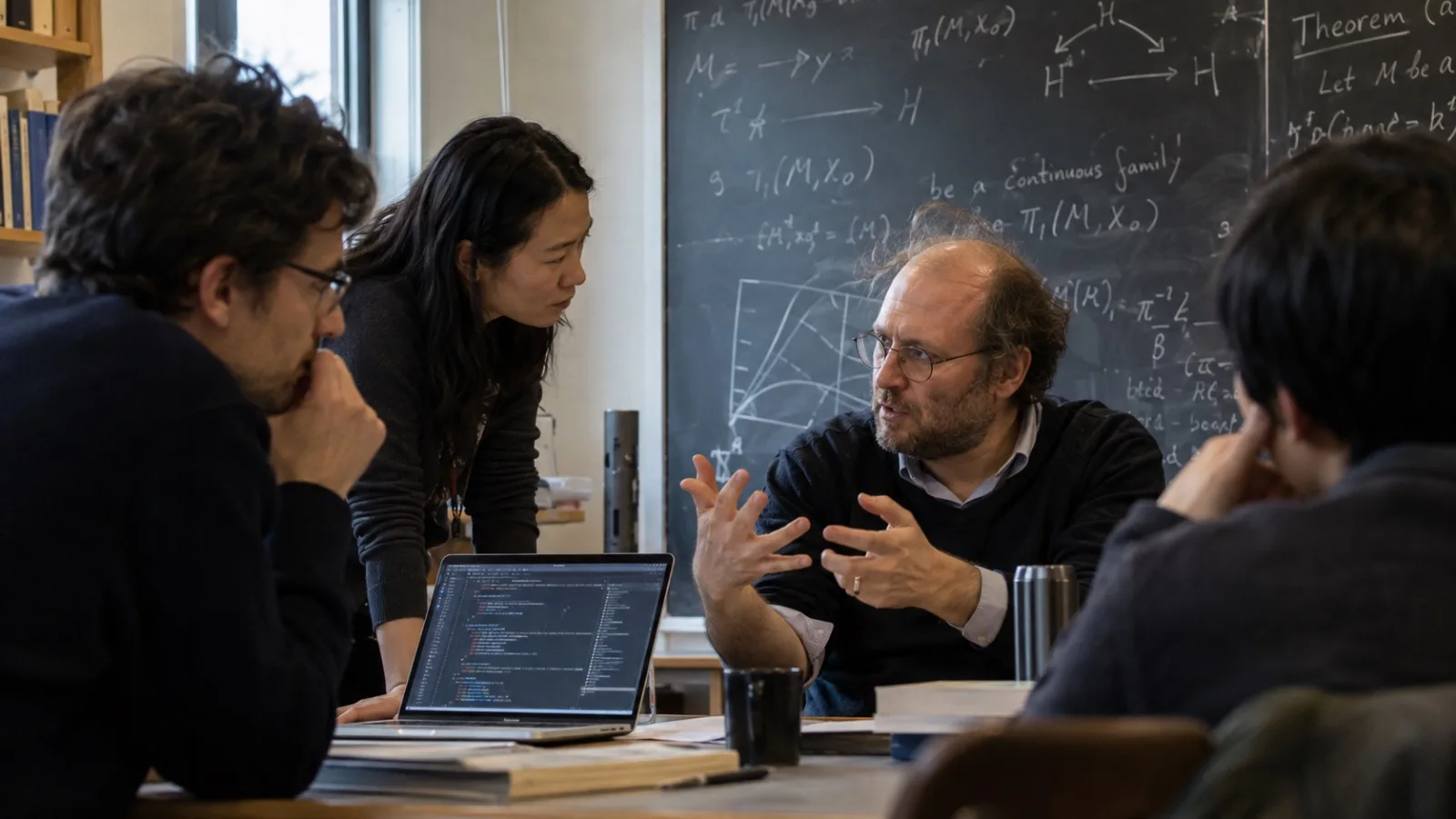
Problems mathematicians worked on for decades, approached by AI in hours
About 4,000 problems attempted. 372 bundles of research results. 719 manuscripts after retractions.
On Oct. 6, 2026, OpenAI released 722 math manuscripts generated by an unreleased model, grouped into 372 bundles of research results. The study covered about 4,000 problems. Errors were later found in three manuscripts, which were retracted, leaving 719 on the public list.
That does not mean all 372 hard problems are finally solved. The release mixes claims of new proofs, partial progress, related theorems and supporting papers.
The "average of three hours" figure is not the total research time. It is a conversion of the ChatGPT Pro reasoning compute spent on a single result.
OpenAI said about 42% of the main results come with Lean formalization. Lean is a tool that lets a computer check each logical step of a mathematical proof. But formally verifying a specific theorem is not the same as validating a whole paper. Three papers were in fact retracted, and other manuscripts were revised.
There is no reason to understate what the AI did. Nor should every result be accepted as established truth. The scarcer skill from here may be judging which of the results produced are true, important and worth using.
Mathematicians are split, and not only over pride
| Traditional "Math 1.0" | Proposed "Math 2.0" | |
|---|---|---|
| Core output | First proof of a hard problem | Broader proof and understanding |
| Researcher's role | Solve it directly | Ask questions, verify, explain, connect |
| Role of AI | Auxiliary calculation tool | Collaborative tool in research |
This table is a reconstruction based on Tao's outline. It is not an established system of academic evaluation.
The Association for Human-centered Mathematics (AHM) criticized the mass release as closer to a show of corporate technological power than to scholarship, and urged mathematicians to stop collaborating with OpenAI.
Math research does not end with getting an answer. Colleagues check the logic, build on it in later work and train younger scholars. A flood of AI output could shift the burden of verification onto universities and individual researchers.
Fields medalist Terence Tao proposed "Math 2.0" in a public lecture at Caltech on Oct. 9. The idea is to accept AI's problem-solving ability while evolving how the field operates, so that mathematical understanding, teaching and the research community survive.
It is not an argument that humans must prove things faster than AI. It is an argument for protecting the academic ground in which results are understood and built on, even if AI speeds up discovery.
In 1975, a computer scientist imagined this
In 1975, Edsger Dijkstra wrote a satirical essay, "Mathematics Inc.," picturing a firm that solves hard problems with machines, manages theorems like assets and wields influence over academia.
Fifty-one years later, math research has become a field of competition among AI companies with vast computing infrastructure. Still, the satire should not be read as evidence of any company's actual monopoly strategy. OpenAI posted its results to a public repository and announced plans to support academic workshops.
Going forward, control of compute, verification tools, research data and scholarly distribution may matter as much as the models themselves. At the same time, stronger open-source and public verification infrastructure could widen how the research gets used.
Doctors, lawyers and financial analysts face the same question
Old core skill: acquire knowledge, analyze directly, produce the right answer.
Skill likely to matter more: define the problem, use AI, verify independently, act responsibly.
Math may be a laboratory for the future of other professions. A doctor must compare an AI's diagnostic candidates with the patient's condition. A lawyer must check the grounds for a legal document against the facts of the case.
A financial analyst cannot simply accept an AI-built valuation either. Revenue assumptions, the discount rate, cash flows and competitors' responses all need direct review.
The more plausible analysis AI produces in bulk, the more the edge may come from spotting variables others missed and from stating the conditions under which one's own judgment would be wrong.
AI use raises productivity, but a habit of accepting results uncritically risks weakening one's own thinking. In education, it may help to think first without AI, then compare the AI's output with one's own reasoning.
The real question
That AI can compress a mathematician's lifetime of work into hours of compute is impressive. But the more basic question is not whether humans can think longer than AI.
When AI can produce the answer for us, can we remain people who think enough to understand that answer, doubt it and put it to use?
Competition among professionals may well be decided on that ability.
Insight Times Editorial Desk