If AI Makes China Overproduce Even More, the Next Trade War May Be About Volume, Not Tech
A People's Bank of China policy adviser warns that AI could deepen China's "strong supply, weak demand" imbalance, a dynamic that has already fueled friction over EV exports to Europe.
The problem isn't AI failing. It's AI working too well
Huang Yiping's warning sounds counterintuitive at first. AI is usually described as a technology that lifts productivity. Higher productivity is supposed to be good for an economy.
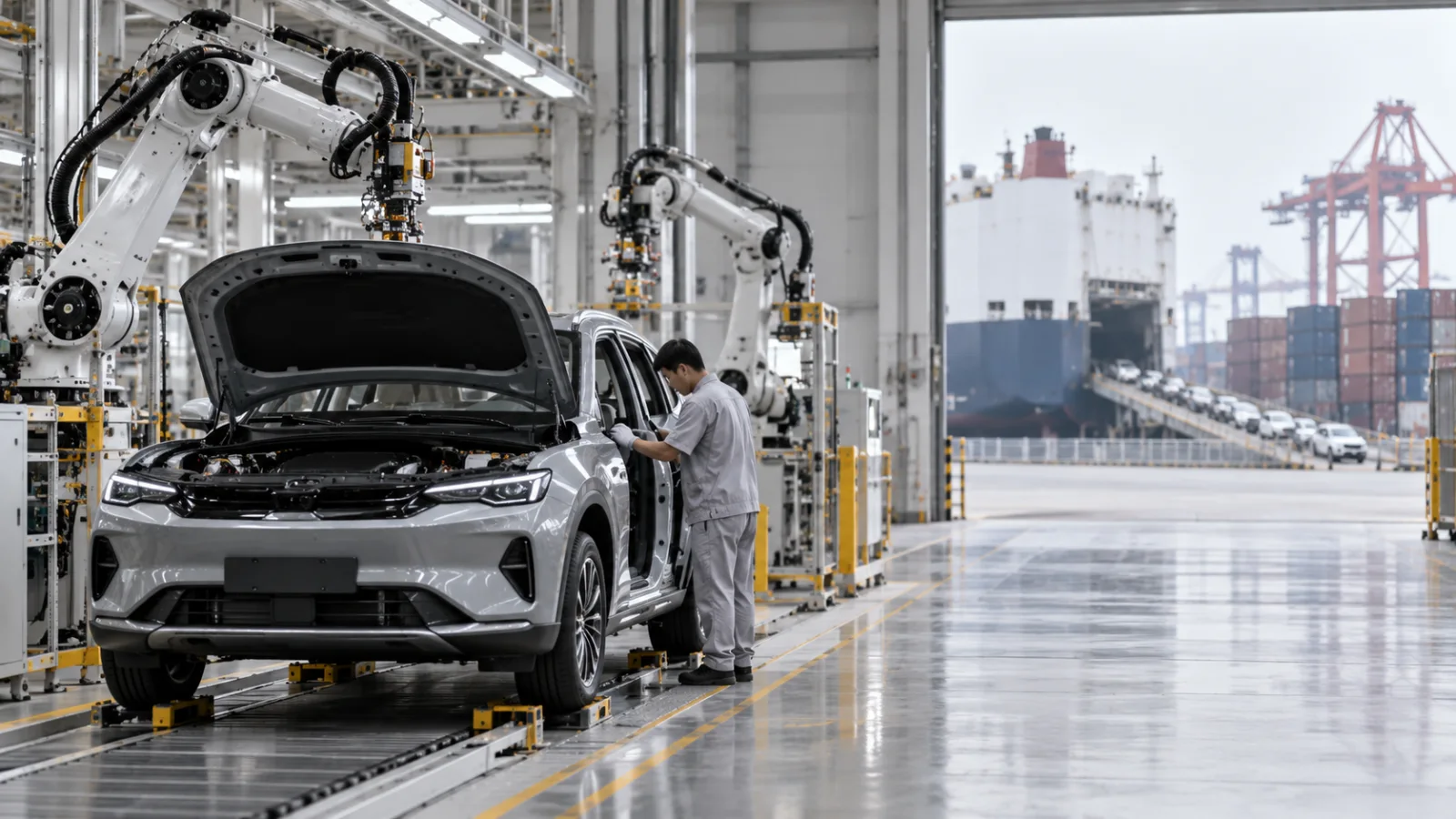
In China, the problem cuts differently. The country already has a manufacturing system built to scale up factories and equipment quickly, but household consumption and private demand have not kept pace. Layer AI on top of that economy and factories run more efficiently, robots handle more of the work, and design and quality-control costs fall. Supply capacity gets even stronger.
But if consumer income and spending habits stay where they are, demand does not grow at the same speed. What's left over gets pushed out two ways: cheaper prices and more exports.
AI productivity gains → expanded supply capacity → if domestic demand recovery lags, inventory builds and price competition intensify → exports expand → risk of trade friction abroad rises
The numbers already show a speed gap between production and consumption
| Metric | Value |
|---|---|
| Industrial output, August 2026, year-over-year | +5.2% |
| High-tech manufacturing, August, year-over-year | +16.7% |
| Retail sales, August, year-over-year | +0.4% |
The current data lays the problem out fairly clearly. According to China's National Bureau of Statistics, industrial output at firms above a certain size rose 5.2% year-over-year in August 2026, while high-tech manufacturing grew 16.7%. New-energy vehicle production climbed 21.9%. Retail sales growth for the same month, by contrast, came in at just 0.4%.
The more interesting numbers sit in exports and investment. Export deliveries from industrial firms rose 11.1% year-over-year in August. Total fixed-asset investment fell 7.2% for the January-August period, but investment in information transmission jumped 28.4%, and high-tech industry investment also increased. Investment across the broader economy is weak, but capital is concentrating in tech and digital infrastructure.
In other words, the question for China is becoming less "is there too much investment" and more "where is the investment going." Real estate and traditional investment are contracting, while AI, telecommunications and advanced manufacturing keep expanding capacity.
An imbalance inside China could become a global price war
This is where Huang Yiping's concern lands. If AI raises production speed faster than household income and consumption recover, Chinese companies have a growing incentive to route capacity they can't sell domestically into overseas markets.
That path has already shown up partly in electric vehicles. The European Union has imposed countervailing duties on Chinese-made battery electric vehicles, and in 2026 began accepting price undertakings from some manufacturers that include minimum import prices and volume caps. More recently, there has been discussion of extending similar trade scrutiny to hybrid vehicles.
Still, it would be a mistake to conclude that AI is about to flood the world with Chinese goods overnight. China's producer price index rose 3.8% year-over-year in August, driven in large part by higher commodity and energy prices. The current overcapacity debate does not mean prices are collapsing across Chinese industry broadly. It points to a narrower, structural risk: in specific strategic sectors, capacity expansion could outrun final demand.
Insight Times Editorial Desk