Google Starts Paying for Content It Never Sends You To
A new pilot pays publishers when their content shapes an AI answer, not when a reader clicks through. It could mark the start of a new economic unit for the web.

Google is putting a price tag on content value that lives outside the click
Google is testing something called the AI Contribution Pilot with a group of websites and publishers. Participating publishers reportedly see a new section in Google Search Console, separate from ordinary search performance, showing monthly revenue tied to their contribution to AI-generated answers.
The mechanism is simple in concept. If content meaningfully shapes what Google's AI produces, it can generate revenue. The products reportedly involved are Google AI Overviews, AI Mode, and Gemini.
The important nuance: this is not a simple link-reward program. Getting a link under an AI answer does not automatically trigger payment. The known standard is closer to whether content substantively shaped the content, logic, or facts of the answer as it was generated.
By contrast, content that was only checked for fact-verification after an AI answer was largely finished, or that appears solely as a source link, may not qualify for payment.
CITATION Content that shows up as a link in an AI answer, or is referenced afterward for verification. Simply appearing may not trigger direct payment.
CONTRIBUTION Content that substantively shaped the sentences, logic, or facts as the AI built its answer.
This is still a limited pilot. Reportedly at least a few dozen publishers are involved, including some smaller sites. But the per-unit rate, the contribution formula, how often a document counts, the weight of contribution per answer, and the payout threshold have not been disclosed.
So the claim that "Google has started paying every publisher for AI use" is an overstatement. The more accurate description: Google is testing an economic model, with a limited set of websites, that pays directly for content that contributes to generating an AI answer.
If AI kills the click, what does a website earn from?
The traditional economics of the web were fairly simple. Make content, get it indexed and ranked in Google Search, have users click through to your site, and earn from ads or subscriptions.
The traditional web revenue chain Content creation (articles, analysis, data, reviews) → Search visibility (ranking and exposure) → Click (user visits the site) → Revenue (ads, subscriptions, affiliates)
AI Overviews, AI Mode, and Gemini change that chain. A user asks a question, Google's AI reads multiple websites, synthesizes and compares the material, and generates an answer. The user gets an answer and may never visit the original site.
Good content can raise the quality of an AI answer while the company that produced it sees no traffic at all. That is the paradox.
Imagine Insight Times publishes an original piece of industry analysis. Gemini reads the article's core argument, data, and interpretation, combines it with other material, and answers a user's question. The user is satisfied but never clicks through to the original article.
Google's AI Contribution Pilot is an attempt to put a price on exactly that gap.
A possible added economic layer in the AI era Content (original information and analysis) → AI contribution (substantively reflected in an answer) → AI answer (delivered directly to the user) → Payment (contribution value settled even without a click)
The web's unit of value may partly shift from traffic to knowledge contribution
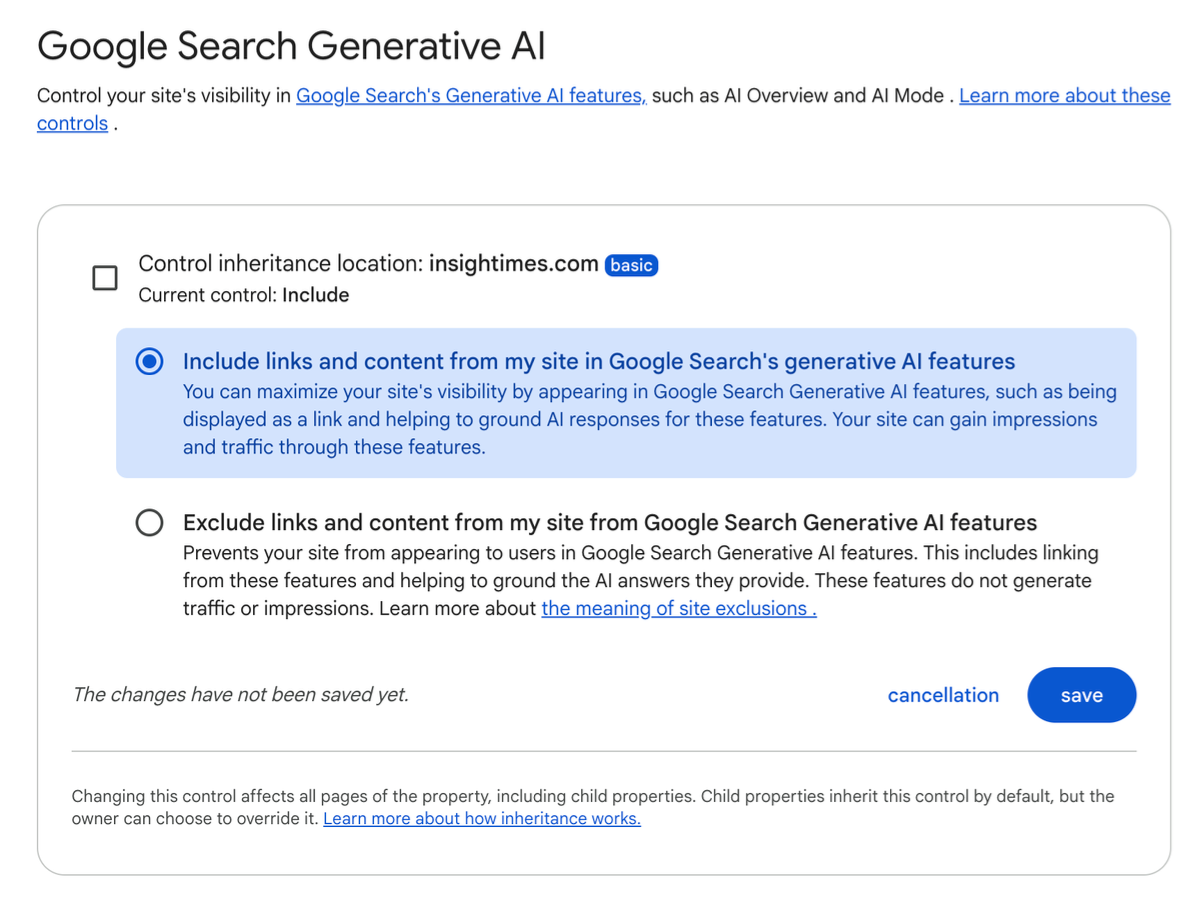
For the past 25 years, the number publishers cared about most was the click. Page views, unique visitors, click-through rate, search traffic, average position, ad impressions and ad rates all rested on the assumption that content leads to a site visit.
But with generative AI, the value of content and the number of visitors it draws can be decoupled. This is not simply a new menu item in Search Console. It's a signal that the web's basic economic unit could shift, in part, from traffic to knowledge contribution.
- CTR – the core metric that has tied content value to revenue in the traditional search economy
- AI Contribution – a new concept trying to capture how much content actually shaped the process of generating an AI answer
- AI Revenue – the hypothesis that AI contribution itself, separate from clicks, can translate into revenue
If this model takes hold, Search Console or an equivalent publisher dashboard could eventually add metrics like AI Contribution, AI Citation, AI Usage, AI Revenue, and AI-originated Referral alongside existing figures like impressions, clicks, CTR, and average position.
Note: What Google has officially confirmed so far is limited to the pilot and a monthly revenue display. The additional metrics above describe a possible future dashboard structure; not all of them are officially available today.
For Google, paying publishers can also be a cost of defending the platform
If AI absorbs a large share of the web's traffic, it can look good for Google in the short run. Users may spend more time inside Google Search, AI Mode, and Gemini, and Google can design advertising and commercial behavior directly inside search results pages and AI interfaces.

But over the long run, problems emerge. If producing good content no longer reliably generates traffic or revenue, the economic incentive to invest in original reporting, analysis, data collection, and on-the-ground verification weakens. That means less high-quality source material for AI to search, ground its answers in, and check against current facts.
AI answers could then fall into a loop of summarizing an aging web, or re-citing low-quality content that other AI systems already reprocessed. That is a risk to answer quality, trust, freshness, and the Search brand itself.
Google Search's defensibility does not rest on its ranking algorithm alone. Billions of websites continuing to produce new, trustworthy information, and Google's ability to discover, index, and rank it, is itself a core asset. The AI Contribution Pilot can be read as an experiment in the cost structure needed to keep that supply chain running.
So when do YouTube creators get paid for AI contribution?
A bigger question follows. If Google is testing AI-contribution payments for outside web publishers, what will it do for creators on its own platform, YouTube?
YouTube is one of the most powerful multimodal content data assets Google owns. A single video carries auto-generated and uploader-provided captions, transcribed audio, titles and descriptions, chapters, tags, on-screen text and graphics, scene cuts and objects, speakers and speaking context, watch time and retention, viewer satisfaction, and rights-management information.
The fact that YouTube can offer video summaries or conversational Q&A features means it manages video not merely as stored files but as searchable, analyzable, summarizable multimodal data.
A distinction matters here too. Search, summarization, recommendation, and Q&A built from a specific video's captions and metadata are a different problem from pre-training or post-training that feeds large volumes of content into changing a model's parameters.
The existence of a video-summary feature does not by itself mean a specific video's full content went into Gemini's pre-training. But it is clear that Google has both the technical capability and the service-level authority to process YouTube content broadly for operations, search, recommendations, captions, safety analysis, summarization, and AI-driven answers.
| Web publishers | YouTube creators | |
|---|---|---|
| Basic unit | URL, document, domain | Video, Shorts, livestream, channel |
| What AI draws on | Sentences, documents, tables, freshness | Captions, audio, screen content, scenes, expertise |
| Existing monetization | Ads, subscriptions, affiliates, paywalls | Ads, Premium, memberships, fan payments, shopping |
| Rights structure | Site owner and author can be separate | Channel, on-screen talent, music/video rights holders, MCNs can all be entangled |
| Likely rollout location | Search Console | YouTube Studio, AdSense, YPP |
A YouTube payout is more likely to sit on top of existing revenue streams than copy the web pilot outright
1. An AI Contribution pilot inside YouTube Studio
Google could first select channels in the YouTube Partner Program with strong expertise, originality, and clear rights, and show them a monthly payout tied to their contribution to Gemini, AI Mode, and AI-driven search and summaries inside YouTube. Early versions would likely be invite-only, limited to certain countries and languages, restricted to YPP-enrolled channels registered for payment and tax information, focused on original, long-form, public, expert content, and would exclude re-uploaded content or anything caught in copyright disputes.
2. A revenue pool funded by AI feature revenue
YouTube already ties Premium subscription revenue to viewing contribution and shares it with creators. Rather than posting a per-video "AI training royalty," Google could instead put a portion of revenue generated by AI features or Gemini subscriptions into a creator pool, distributed to videos that contributed to AI answers, summaries, and conversational search.
3. Prioritizing traffic to the original video over cash
The approach Google may prefer in the near term is simply surfacing more prominent original-video cards, timestamps, clips, and subscribe buttons underneath AI answers, rewarding creators through traffic and subscription conversion rather than direct payment.
But having already tested direct payment for AI contribution, separate from clicks, with outside web publishers, it becomes harder for Google to argue that traffic to the original video is the only reward YouTube creators should expect.
4. Payment for pre-training itself
This is the least likely and most sensitive category. Using content to search, cite, and ground a specific AI answer is economically and legally different from using content to pre-train or post-train a model. The current AI Contribution Pilot is closer to the former, contribution to answer generation. It should not be read as a signal that Google will retroactively pay royalties for every YouTube video ever used to train any past or future AI model.
Right now, YouTube does not pay ordinary creators separately for AI training use

Under currently disclosed policy, it is hard to say that Google and YouTube pay ordinary creators a distinct revenue line called AI training data compensation.
A YouTube creator's main income still comes from ad revenue sharing, Premium revenue sharing, channel memberships, Super Chat, Super Thanks, shopping, and affiliate revenue, all based on views, subscriptions, ads, and fan payments, distinct from any individual royalty for AI model training or AI-answer contribution.
Even where a creator allows third-party AI training, YouTube does not automatically broker payment between outside AI companies and creators. Any actual compensation would require a separate contract between that AI company and the rights holder.
| Item | Current structure |
|---|---|
| Content analysis, summarization, and recommendation inside Google/YouTube's own services | Can occur within terms of service and operating scope |
| Model training by third-party AI companies | Requires rights holder opt-in |
| AI training compensation for ordinary YouTubers | No standardized separate payment system |
| YouTube monetization | Centered on existing YPP model: ads, Premium, fan payments |
| Web publisher payment for AI-answer contribution | Early pilot limited to select participants |
What independent media should prepare for now
- Build up highly original content. Data, interviews, calculations, and interpretation that are hard to recombine elsewhere should be treated as assets.
- Document data and expert analysis in a form that can be updated. A knowledge asset that gets updated repeatedly may become more valuable than a story written once and left alone.
- Leave readers a reason to visit the original even after AI summarizes it. Tables, sourcing, full analysis, interactive tools, and detailed data all create a reason to click through.
- Diversify revenue. Beyond advertising, expand into newsletters, memberships, data services, paid reports, events, and video.
- Prepare clear rights and structured metadata. If AI-contribution payments expand later, originality and clean rights are likely to be a basic condition for getting paid.
For Alphabet, this is both a cost story and a platform-defense story
In the near term, if Google starts paying for content used in AI answers, it can pressure margins. As AI search usage grows and payments potentially expand to large media outlets, specialized data providers, and video creators, content-sourcing cost could become a new variable expense.
But there is a longer-term case too. Securing a high-quality content supply chain to sustain AI answer quality, easing publisher backlash, copyright disputes, and regulatory risk, and defending against a decline in search quality caused by a collapsing web ecosystem all matter.
It also helps Google maintain broader, more current information access than competitors in AI search, and lays groundwork to tie Search, Gemini, and YouTube into a single content, advertising, and subscription economy.
In other words, the AI Contribution Pilot is not simply a publisher-support measure. It can be read as an early attempt by Google to reprice its content supply chain for the AI era.
The web after the click may start calculating who actually built the answer
Google's AI Contribution Pilot is still a small pilot. No payout formula, no per-unit rate, and no plan for a full rollout have been disclosed.
Still, the move matters for a clear reason. It amounts to Google effectively acknowledging that content value in the AI era is getting harder to explain through clicks alone.
That principle is likely to eventually reach YouTube too. But the form it takes is more likely to be a limited compensation system for a subset of high-quality, rights-clear content that substantively contributed to AI answers, summaries, and discovery, not a training royalty applied to every video.
So what publishers and creators need now is not more content that AI can easily summarize. It is information and interpretation unique enough that AI has no choice but to seek it out to build an answer, and distinctive enough that a user still wants to check the original.
That may become the most important competitive edge in the web after the click, and in the content market that AI reads.
Insight Times Editorial Desk