Can AI-Written Text Now Be Caught? ChatGPT's Invisible Watermark and Its Limits
OpenAI has begun embedding an invisible watermark in AI-written text, following Claude. The signal can suggest AI involvement, but it can't say who is accountable for the writing.
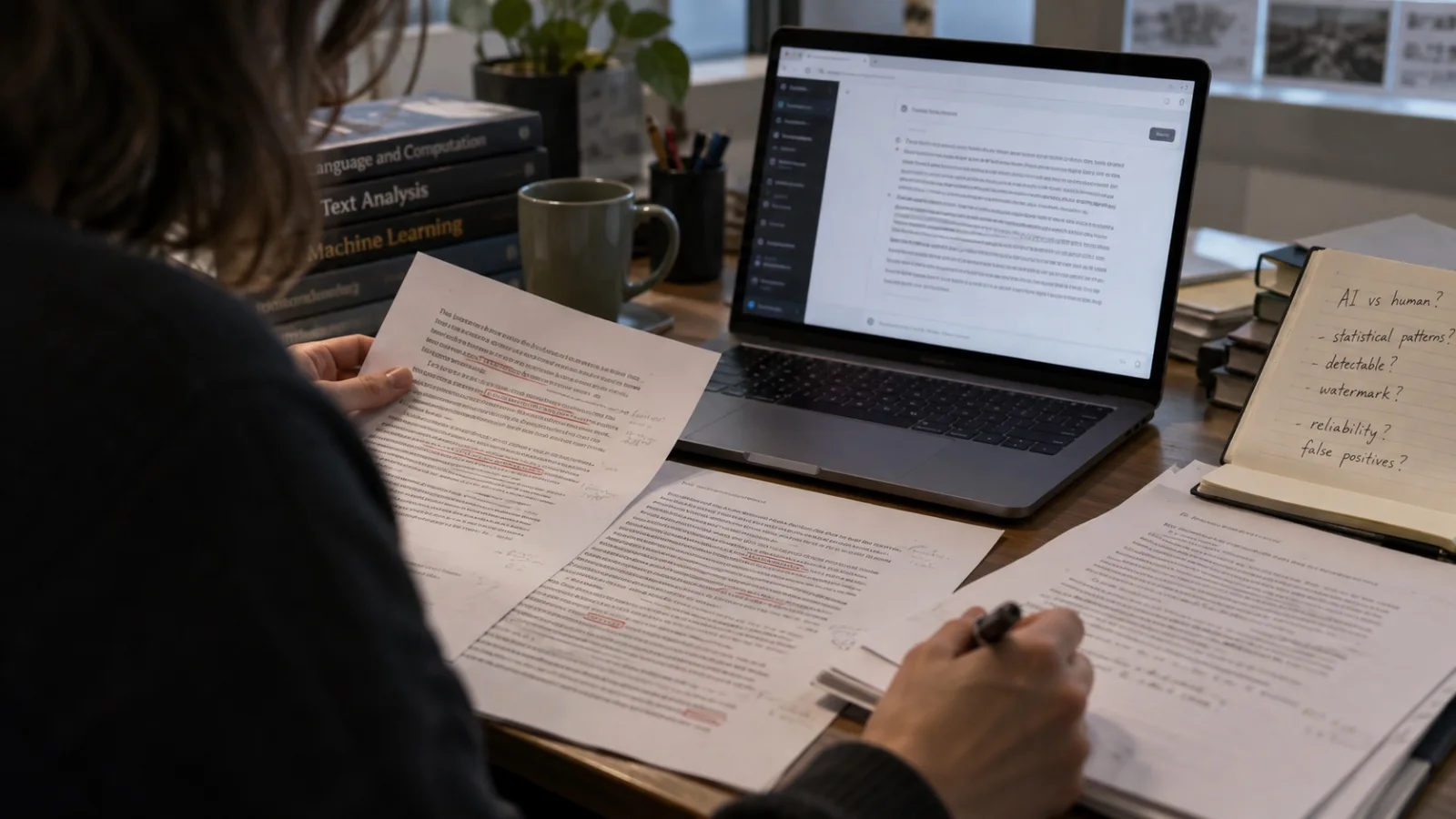
OpenAI has started placing an invisible watermark in text written by AI. With Claude already in the field, ChatGPT's arrival marks a more serious push to verify where AI text comes from.
1. How do you leave an invisible mark in writing?
The watermark does not rely on special characters or hidden spaces between letters.
When an AI writes a sentence, it calculates the probability of each possible next word. After "Today's lunch is," for example, the options might include kimchi stew, pasta or salad.
OpenAI's tool, called textGrain, nudges those probabilities slightly according to a secret rule. Over several hundred words, the nudges build a statistical pattern that sets the text apart from ordinary writing.
AI generates sentence → word choices adjusted → pattern detected
The method does not force specific words into the text. It checks for a statistical signal that accumulates across many word choices.
A reader would struggle to see any difference, but a detector holding the same secret rule can test for the pattern. If the text is copied and pasted unchanged, the trace may well survive.
2. Change a few words and detection drops sharply
An experiment released by OpenAI shows both the promise and the limits of the technology.
Watermark detection rate for 400-token English text
| Condition | Detection rate |
|---|---|
| Unedited | 92% |
| 10% of words edited | 66% |
| 25% of words edited | 17% |
Source: OpenAI experiment on ELI5 data. Words were replaced with synonyms. Target false-positive rate was 1%. The figures do not describe accuracy across everyday use.
Swapping 10% of words for synonyms cut detection by 26 percentage points. Swapping 25% cut it by 75 points.
Length matters too. On psychology-related text, detection reached about 80% at 200 tokens and about 95% at 400 tokens. Fields with little room for varied phrasing, such as math, were harder to detect.
One number needs to be read carefully. A 1% false-positive rate does not mean the tool finds AI-written text with 99% accuracy. It is a condition set for the experiment: the chance of wrongly flagging text written by a person.
3. Why isn't the detector public?
OpenAI's text watermark detector is currently open only to approved research institutions and professional organizations that apply for access. It is not a public checker that ordinary users, schools or contest organizers can use.
A public detector could speed the development of tools that get around it. It could also lead people to use results without context and cast unfair suspicion on others.
The two risks point in different directions but show the same limit. A watermark is meant to give an additional signal about where text came from. It is not meant to deliver a final verdict.
Article 50 of the EU AI Act also requires machine-readable marking of generated content. It does not treat all AI-assisted writing as cheating, though. For AI-generated text published to inform the public, exceptions exist where a human has reviewed and taken editorial responsibility.
4. The real question: Did AI write it, or who took responsibility?
The same watermark can sit on texts made in very different ways.
| Case | What a watermark can't tell you |
|---|---|
| AI draft submitted as is | Who actually bore responsibility for the writing process |
| AI research, human writing | The human's independent contribution |
| Human draft proofread by AI | How much the AI changed |
| AI text heavily edited | AI use that goes undetected |
Finding a watermark does not mean every idea in the text came from AI. Finding none is not evidence that a person wrote it.
For schools and contest organizers, then, clear standards may matter more than a single detection score. Those could cover writing history, drafts, cited sources and the permitted scope of AI use.
Insight Times Editorial Desk