China's Memory Challenge: Are Samsung, SK hynix and Micron Really at Risk?
CXMT's new DRAM design rattled memory stocks on Oct. 12. So far the numbers show an announcement, not a production threat. The risk will be settled in volume and pricing.
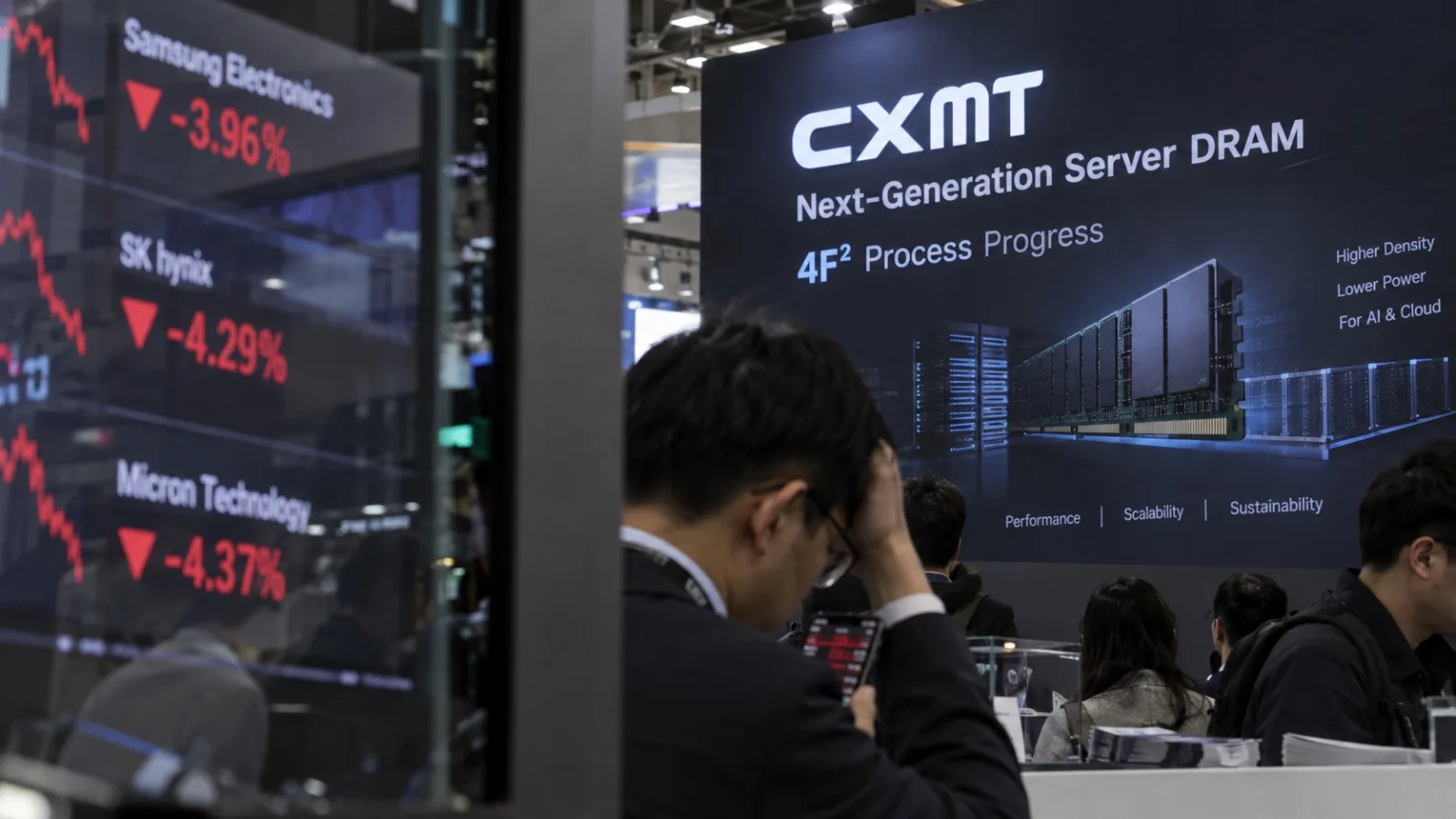
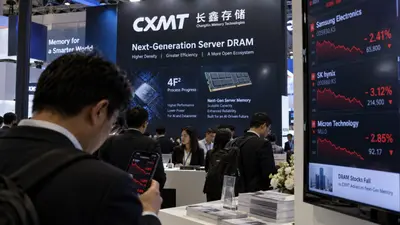
On Oct. 12, Samsung Electronics fell 4.39% and SK hynix fell 4.52%. Micron also dropped about 4% the same day.
1. One Chinese announcement shook memory stocks
The news came from China's ChangXin Memory Technologies (CXMT).
At a semiconductor conference on Oct. 10, CXMT announced a key advance in a new DRAM design called 4F². It said it plans to launch server DDR5 memory using the technology by the end of this year.
The memory market has been a three-player field: Samsung, SK hynix and Micron. Now a Chinese company says it is building smaller, more efficient next-generation memory.
Investors' worry is simple. If China starts mass-producing chips cheaply, could the current memory boom end sooner than expected?
It is a fair question. But CXMT alone does not explain the day's selloff.
Korea's KOSPI index fell 3.65% the same day, and foreign investors sold about 2.02 trillion won of Korean shares on a net basis. Higher oil prices from the Middle East and inflation worries also weighed on markets. News of Chinese competition landed on top of a broad risk-off mood.
2. How big a deal is 4F²?
No chip expertise is needed to follow the idea. It is like redesigning a parking lot so more cars fit in the same space.
Mainstream DRAM uses an area of 6F² per memory cell. The 4F² design CXMT is developing would, in theory, cut that area by a third.
To get there, CXMT is developing VSG technology, which places transistors vertically. Rather than simply making chips bigger, it uses space more efficiently.
If commercialized successfully, it could yield more memory from the same wafer and lower the cost per bit.
Samsung and SK hynix are also researching similar technology. It matters that a Chinese company has declared it will ship a commercial product before the established leaders.
There is a critical difference, though. Announcing a technology is not the same as making money from it.
Server memory has to run 24 hours a day. Manufacturing defects must stay low, and the chips must work reliably on Intel and AMD server platforms.
CXMT's year-end target is notable. It is not yet evidence that the company has secured high yields or large-scale production capacity.
3. China's share is already 9.5%
There are also reasons not to dismiss China's challenge.
According to market researcher TrendForce, global DRAM revenue share in the second quarter of 2026 was 39.4% for Samsung, 24.9% for SK hynix, 23.3% for Micron and 9.5% for CXMT. CXMT's share rose from 7.6% in the prior quarter.
That is not yet a level that threatens the big three, but growth is fast. China also has a huge domestic market for smartphones, servers and cloud services.
That means CXMT does not have to sell to US big tech to grow.
On the other hand, high reliability standards in the global server market and US export limits on advanced chip equipment are problems China still has to solve.
What matters now is neither underestimating nor overestimating China's technology. It is judging how quickly technical progress turns into actual output and customer orders.
Global DRAM revenue share, Q2 2026 (TrendForce)
- Samsung Electronics: 39.4%
- SK hynix: 24.9%
- Micron: 23.3%
- CXMT: 9.5%
4. The more interesting fact: China's growth is tied to the AI boom
AI is deeply involved in the current memory shortage.
HBM, the high-bandwidth memory that goes into Nvidia's AI accelerators, consumes more production resources than standard DRAM. Samsung, SK hynix and Micron are prioritizing capacity for HBM and server memory, which command higher prices.
That leaves a supply gap in the less profitable general-purpose memory market. CXMT is targeting exactly that gap.
Here is the paradox. The AI memory boom is creating room for CXMT to grow. But because AI demand is so strong, Chinese supply growth may not immediately collapse global memory prices.
The shortage will not last forever. If CXMT's new fab expansion and capacity growth at the big three overlap and AI demand slows, the picture could change.
TrendForce said DRAM industry revenue in the second quarter of 2026 rose 59.5% from the prior quarter. It also forecast that the rise in general DRAM contract prices will slow to 13% to 18% in the third quarter. The boom may continue, but the pace of price gains could change.
How the AI boom opens a door for Chinese memory
- AI server investment expands
- The big three concentrate production on HBM and high-end server DRAM
- Capacity for general DRAM shrinks
- CXMT gets an opening to expand
5. Samsung, SK hynix, Micron: who is most exposed?
Treating the three as the same kind of memory company makes investment decisions harder.
Samsung's strengths are a broad DRAM lineup, HBM and a large production base. Investors need to confirm stronger HBM competitiveness and profitability in general DRAM.
SK hynix's strengths are a high HBM share of its business and an AI customer base. HBM pricing, its technology lead and customer concentration are the key issues.
Micron's strengths are HBM, server DRAM and a US production base. The share of high-end products and the return on new fab investment are worth watching.
For now, HBM competitiveness can act as an important buffer. But a high HBM share does not by itself make a stock safe. A stock with a lot of expectations priced in can pull back even when earnings are good.
China's catch-up is likely to hit general-purpose DRAM pricing and the Chinese domestic customer market first. Whether full-scale competition spreads to high-performance server memory and HBM is a later-stage question.
Four numbers to watch
- Actual shipments of CXMT's server DDR5: whether there is commercial mass production, not just a launch announcement.
- General DRAM contract prices: whether the slowing quarterly increases turn into declines.
- HBM pricing and major customer orders: whether the big three keep their ability to defend profits.
- 2027-2028 capacity and operating margins: whether rising memory supply leads to lower margins.
China's memory catch-up is hardly minor news. But the speed at which stocks react in a day differs from the speed at which a chip fab actually adds capacity.
If CXMT has opened a new chapter in the technology race, the next scene for investors to check is not a product announcement but mass production and price competition.
Until then, the scale of AI-driven memory demand deserves as much attention as China's growth.
Insight Times Editorial Desk