SpaceX Jumps 7.35%: Investors Are Pricing Three Cash Engines, Not Rockets
SpaceX shares rose 7.35% to $158.96 on Oct. 2 after three launches in 13 hours. The bigger driver is Falcon, Starlink and AI compute growing inside one company.
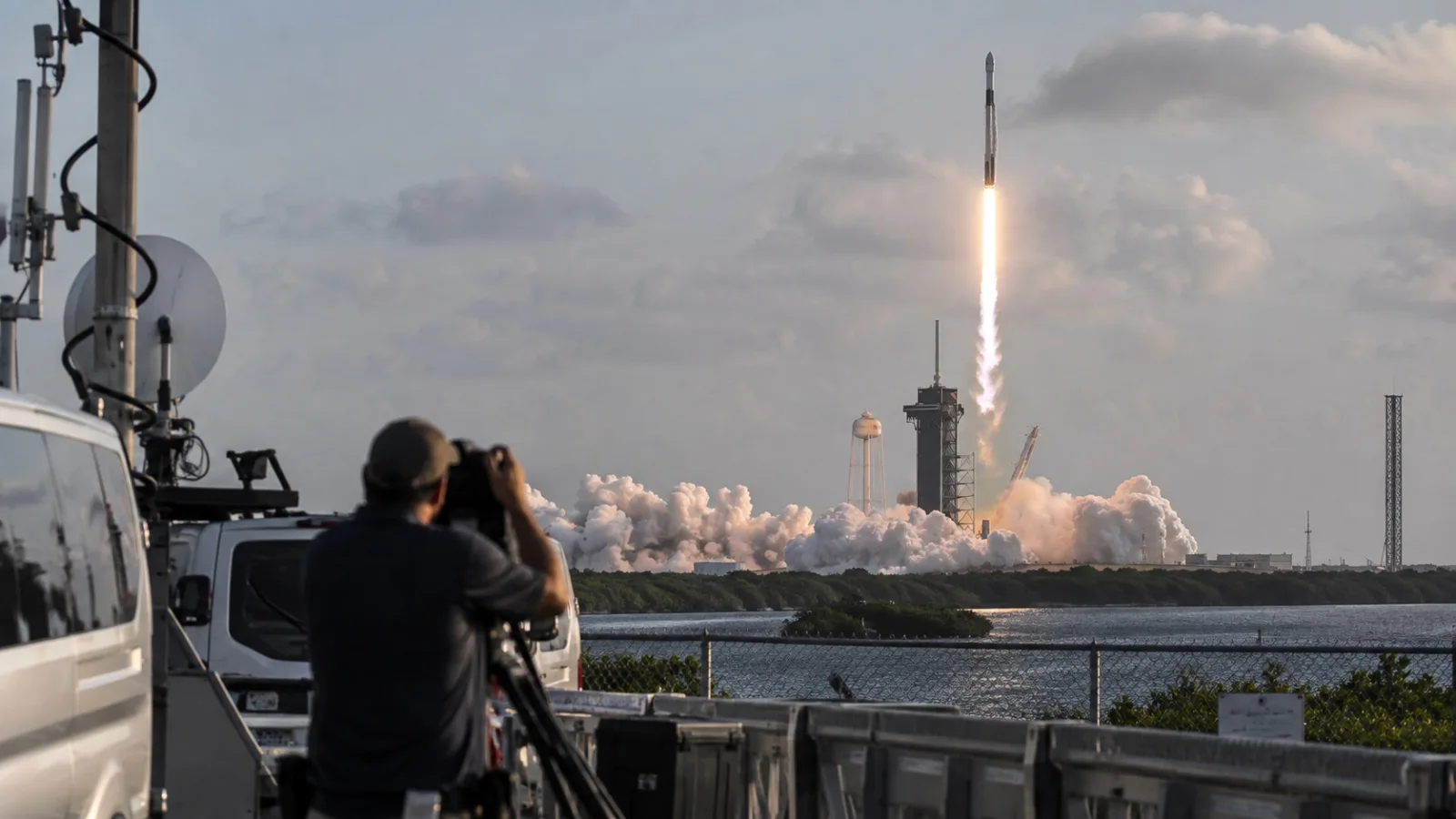
SpaceX shares jumped 7.35% to $158.96 on Oct. 2. On the surface, the cause was three successful launches in 13 hours. What the market appears to have reread is something else: Falcon's operating system, Starlink's cash generation and AI compute revenue are all growing inside one company at once.
Bottom line: With SpaceX, it is better to ask first whether Starlink and AI actually leave money behind, rather than whether rockets succeed.
The trigger was the combination, not the three wins
From Oct. 1 to Oct. 2, SpaceX completed three launches in about 13 hours.
- Crew-13 sent four astronauts to the International Space Station and docked in about eight hours.
- Transporter-18 lifted 130 payloads, including Google's Project Suncatcher TPU experiment satellite.
- NROL-97 was the first National Reconnaissance Office mission flown by Falcon Heavy.
The point is the breadth of customers. NASA crew transport, commercial rideshare and U.S. national security missions were handled almost at once. For enterprise value, what matters more than any single success is whether SpaceX has turned launch into a repeatable industrial operation.
Starship moves from test rocket toward revenue infrastructure
On Flight 14 on Sept. 28, Starship reached Earth orbit for the first time and deployed 26 Starlink V3 satellites. The engines had problems in flight, but the core mission was completed. Full reuse and high-frequency flights are not yet proven. Still, the flight comes close to a first commercial turning point, showing Starship can be used to add real Starlink capacity.
In earlier disclosures, SpaceX said each V3 satellite is designed for about 1 Tbps of downlink capacity. It also said that deploying up to 60 on a single Starship could raise the Starlink capacity delivered per launch by as much as 20 times versus Falcon 9. If that assumption holds, Starship's economics would likely show up first in Starlink's network cost and capacity, before launch revenue.
Starlink, already profitable, supports the valuation
- Starlink subscribers: 12 million at the end of the second quarter of 2026, double the 6 million a year earlier.
- 2025 Connectivity revenue: $11.39 billion, up 49.8% from the prior year.
- 2025 adjusted EBITDA: $7.17 billion, about 63% of revenue. This is a non-GAAP measure presented by the company.
Starlink is no longer just a future option. Second-quarter 2026 Connectivity revenue was $4.291 billion and operating income was $1.656 billion. But international expansion and lower-priced plans pushed subscriber ARPU down to $66 from $85 a year earlier. If revenue per subscriber keeps falling while subscribers grow, the quality of that growth can change.
AI is the new growth axis, and the most expensive one
SpaceX now runs AI as a separate unit after acquiring xAI. Its contract with Google provides access to about 110,000 NVIDIA GPUs, at $920 million a month from October 2026 through June 2029. With Anthropic, it signed a contract worth $1.25 billion a month for compute capacity including about 325,000 GPUs. Added together, the two come to $2.17 billion a month, or about $26 billion annualized. The contracts include termination clauses and capacity-delivery conditions, so this cannot be treated as locked-in revenue.
The numbers on the other side are also large. Second-quarter 2026 AI revenue was $2.561 billion, with an operating loss of $1.257 billion. AI capex that quarter was $15.828 billion, and $23.551 billion for the first half. AI lifts SpaceX's growth rate and is also the business that consumes the most capital.
Four links investors should watch
| Axis | Strength | Risk | What to judge by |
|---|---|---|---|
| Falcon | High-frequency launch and reuse, diverse customers | Cost and operating complexity during the shift to Starship | Customer launch revenue and cost per launch, more than annual launch count |
| Starlink | 12 million subscribers, strong cash generation | Falling ARPU, satellite replacement and ground network spending | Subscriber growth, ARPU, Connectivity operating margin |
| Starship | Mass V3 deployment, potential to cut launch costs | Full reuse, recovery and regular service not yet achieved | Actual reuse count, V3 deployment volume, launch cadence |
| AI | Large Google and Anthropic contracts | Huge GPU and data center capex | Contract revenue realization, AI operating income, cash return on capex |
Insight Times Editorial Desk