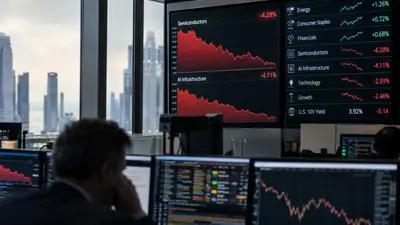
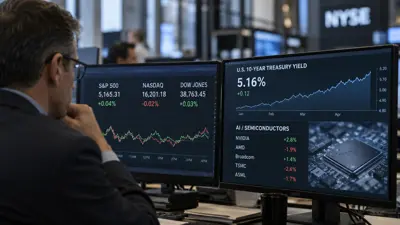
Nasdaq Falls 2.14%, SOXX Drops 4.14% as CoreWeave Debt Fears Spread Across the AI Supply Chain
The Friday selloff did not start with a collapse in AI chip demand. It started in the bond market, with doubts over whether AI data-center builders can pay for their buildout.
U.S. stocks fell sharply again on Friday, Oct. 16, but this decline looked different. It was not because demand for AI chips vanished. Doubts about whether the companies building AI data centers can carry the enormous cost of that investment began in the bond market and spread to equities.
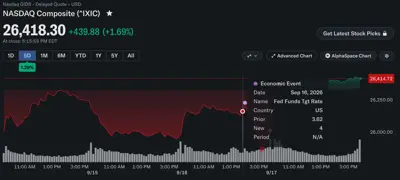
The Nasdaq fell 2.14% and the semiconductor ETF SOXX dropped 4.14%. The S&P 500 slid 1.09%, while the Dow lost only 0.34%. Even within U.S. stocks, the market is applying different standards to risk.
Why the indexes moved so differently
| Major index | Close | Change |
|---|---|---|
| S&P 500 | 7,659.44 | -1.09% |
| Nasdaq | 26,140.03 | -2.14% |
| Dow | 52,002.41 | -0.34% |
| Russell 2000 | 2,721.37 | -1.66% |
| SOXX (semiconductor ETF) | $493.39 | -4.14% |
Regular session, Oct. 16. Index changes may differ by 0.01 percentage point depending on a data provider's rounding.
The Nasdaq fell 1.80 percentage points more than the Dow, a sign that selling concentrated in technology. But the Russell 2000, which is weighted toward small caps, also fell 1.66%, and that matters.
Financials and energy held up the market early. As the session went on, selling widened and software turned weak too. This looks less like a rotation out of chips into other growth stocks and more like a trade to cut risk exposure across the whole equity market.
CoreWeave exposes the weak link in AI spending
The most important number of the day was not the Nasdaq's decline. It was the yield on CoreWeave's corporate bonds.
CoreWeave is a "neocloud" company that rents GPU-based AI computing capacity. Its model is to borrow heavily up front to secure GPUs and data centers, then recoup the investment through long-term rental payments from customers.
The problem is that the cost of borrowing is rising fast. According to Reuters, a bond issued in June at a yield of about 9.675% traded at a yield of about 15%. Some other bonds reportedly rose to around 16%. A higher bond yield means a lower bond price and a greater demand for compensation for credit risk.
How the worry could spread through AI infrastructure
- Neocloud borrowing costs rise. Bond prices fall and required yields climb.
- Data-center returns come under pressure. Interest expense rises and payback periods look heavier.
- Expansion and GPU purchase schedules may be revisited. Doubts grow about customers' capacity to invest.
- Chip and AI infrastructure stocks are repriced. Future revenue growth gets a discount for uncertainty.
This is a scenario for how credit risk could travel, not a chart of confirmed order cancellations.
Credit stress does not automatically mean AI demand has collapsed. Contracted computing demand and supply capacity still exist. Nvidia's backing and long-term contracts also work in CoreWeave's favor.
Even so, having enough demand is different from being able to repay debt on time. The growth potential of the AI market and the financial survival of individual companies have to be judged separately. That is a key message of this pullback.
Brent near $110, and unease spreads beyond growth stocks
Brent crude rose to around $110 a barrel. Concerns about Middle East supply disruptions pushed energy prices up and raised wariness about inflation.
Higher oil prices threaten growth stocks by raising the risk that high discount rates persist for a long time. For consumer and transport companies, they raise the risk of higher costs and weaker spending.
The 10-year Treasury yield, however, was around 5.10%, little changed from the prior day. So a rise in Treasury yields alone does not explain the Nasdaq's drop. It is more reasonable to see high oil prices as an added burden on a reassessment of AI companies' credit risk that was already under way.
Expectations that the Fed will hold rates at its October meeting also rose. Markets put the odds of a hold at roughly 83% to 85%. But even if the policy rate stays put, borrowing costs for higher-risk companies do not fall automatically.
Nvidia, Tesla and Palantir fell for different reasons
| Stock | Close | Change |
|---|---|---|
| Nvidia (NVDA) | $214.12 | -1.43% |
| Tesla (TSLA) | $354.91 | -2.08% |
| Palantir (PLTR) | $186.03 | -7.22% |
| Salesforce (CRM) | $240.70 | -2.45% |
| CoreWeave (CRWV) | $61.40 | about -11.9% |
Nvidia held up better than the semiconductor sector. Its position at the center of the GPU supply chain may have offered some relative protection. But if customers' funding problems drag on, Nvidia could also feel the effect on the pace of new GPU orders.
Tesla fell 2.08% despite the buzz around the Roadster unveiling. The mood may have shifted toward checking near-term cash flow and capital spending rather than technological promise. In the coming earnings report, what matters is not only auto margins but also the cash-generating power to fund autonomy and robotics investment.
Palantir plunged 7.22%, showing selling pressure on richly valued AI software. The premium attached to growth expectations has shrunk in software as well as in chips.
The takeaway
The point of this Friday is not how far prices fell. It is that even investors who believe in the AI revolution now have to price the cost of the debt that supports it.
The evidence the market demands is changing. Investors may need to adjust their own yardsticks to match.
This article is for information and market interpretation, not investment advice.
Insight Times Editorial Desk