Fed Hiked Rates. So Why Did the Nasdaq Jump 1.69%?
Oil and the 10-year yield fell together, and chips pulled the market back up. The rally says more about real discount rates and energy prices than about anyone ignoring the Fed.
The day after a rate hike, stocks rallied harder
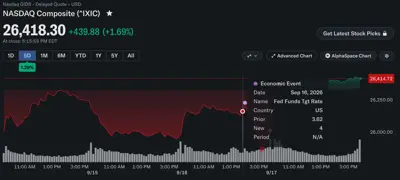
On September 17, US stocks reversed much of the previous day's hawkish FOMC shock in a single session. The Dow rose 0.62% to 51,779.85, the S&P 500 gained 1.14% to 7,637.74, and the Nasdaq jumped 1.69% to 26,418.30. On the surface, that looks backwards. The Fed had just raised its benchmark rate 25 basis points to 3.75%-4.00% and left the door open to further hikes later this year. That is normally bad news for growth stocks. Yet the day after the hike, the rate-sensitive Nasdaq and semiconductor names led the market higher.
The reason is that markets do not price off a single policy number. Long-term Treasury yields, which feed more directly into the actual discount rate applied to stocks, fell. So did energy prices, which weigh on corporate costs. Both moved down at once.
The market was watching the 10-year near 5% and oil near $105, not just the Fed
The 10-year Treasury yield had topped 5% the day before and eased back to about 4.95%. Brent crude fell 0.95% to $104.82 a barrel, and WTI settled at $101.91. That combination matters most for growth stocks. When long-term yields fall, the discount rate used to translate distant future earnings into present value falls with them. At the same time, cheaper oil eases pressure on inflation and slightly lowers the odds the Fed needs to tighten even more aggressively down the road.
So calling this rally "the market ignoring the Fed" misses the mechanism. A more accurate read: the Fed's clear signal on fighting inflation calmed some of the bond market's anxiety, long-term yields came down as a result, and that eased conditions worked in tech's favor.
Chips up more than 3%, and this time the rally had breadth
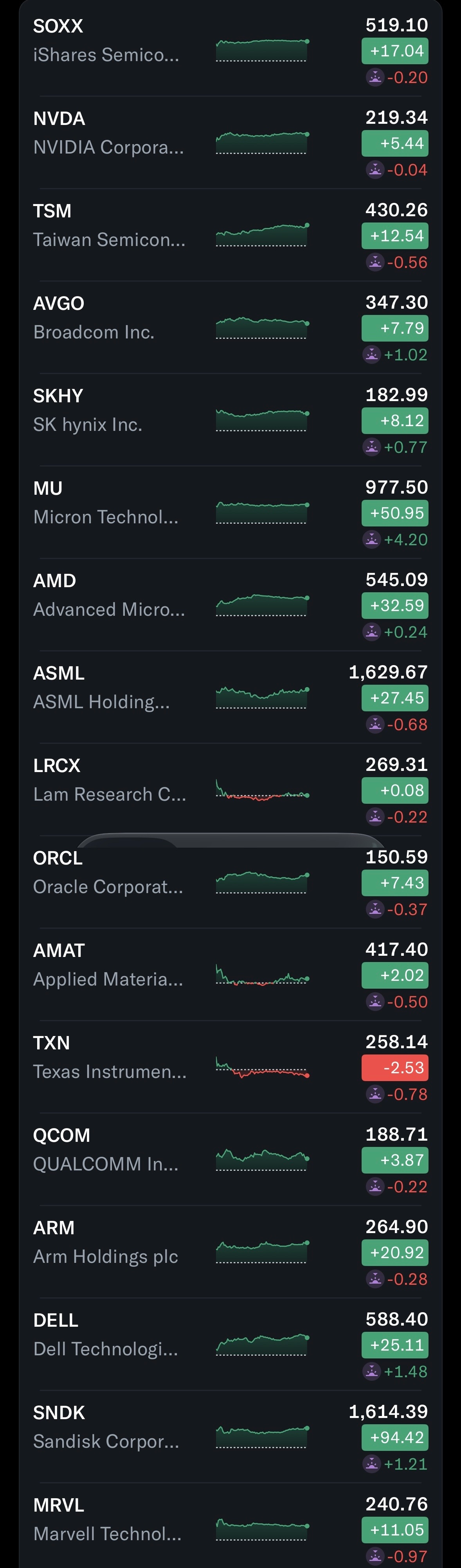
Semiconductors were again at the center of the move. The Philadelphia Semiconductor Index rose more than 3%, outpacing the Nasdaq. It was bargain-hunting and short-covering hitting the same group that had sold off sharply days earlier on worries about a slowdown in AI development spending combined with the 10-year's break above 5%.
The size of the move was not the only notable thing. On the NYSE, advancing stocks outnumbered decliners by 2.38 to 1; on the Nasdaq, the ratio was 2.21 to 1. Total US exchange volume came in at 17.57 billion shares, above the 20-day average of 15.37 billion. In other words, this was not an index move driven by a handful of mega-caps like Nvidia. Participation was broad, which is a reason to rate the quality of this bounce a bit higher. Still, one day of broad market breadth is not enough on its own to confirm a new uptrend.

Good news for AI chips, but not a green light for multiples to expand across the board
For AI-chip names like Nvidia, AMD, Broadcom and Micron, a drop in long-term yields is an immediate valuation relief valve. That is especially true after a sharp selloff had already compressed some of the valuation premium; falling yields give any technical bounce more room to run.
But over the medium term, share prices come back to earnings. What matters more than the rate backdrop is whether data-center capex, GPU and ASIC demand, HBM shipment volumes, network investment, and companies' actual returns on AI spending hold up, even with rates elevated.
Tesla can benefit from the same mechanism, since both auto financing costs and the discount rate applied to a long-duration growth stock are rate-sensitive. But Tesla carries its own company-specific variables separate from rates, including Cybercab certification, vehicle sales, margins, and robotaxi execution. A drop in market rates alone does not make company-specific risk disappear.
Insight Times Editorial Desk