Will the Bull Market Last Into 2027? Earnings Now Matter More Than AI
The S&P 500 has topped 7,800 even with the 10-year Treasury yield at 5.24%. Corporate profits are carrying the market, but the test is likely to shift from AI spending to AI returns.

The S&P 500 has moved above 7,800, and the 10-year Treasury yield has climbed to 5.24%. That is a hostile rate backdrop for stocks, yet the bull market continues.
The reason is corporate profit. Rising AI investment is lifting US company earnings, and that is helping stocks absorb the burden of higher rates.
In 2027, though, the market's yardstick may change. Until now, what mattered was how much companies invested in AI. Next, what matters is how much profit and cash that investment generates.
1. How much upside is left this year?
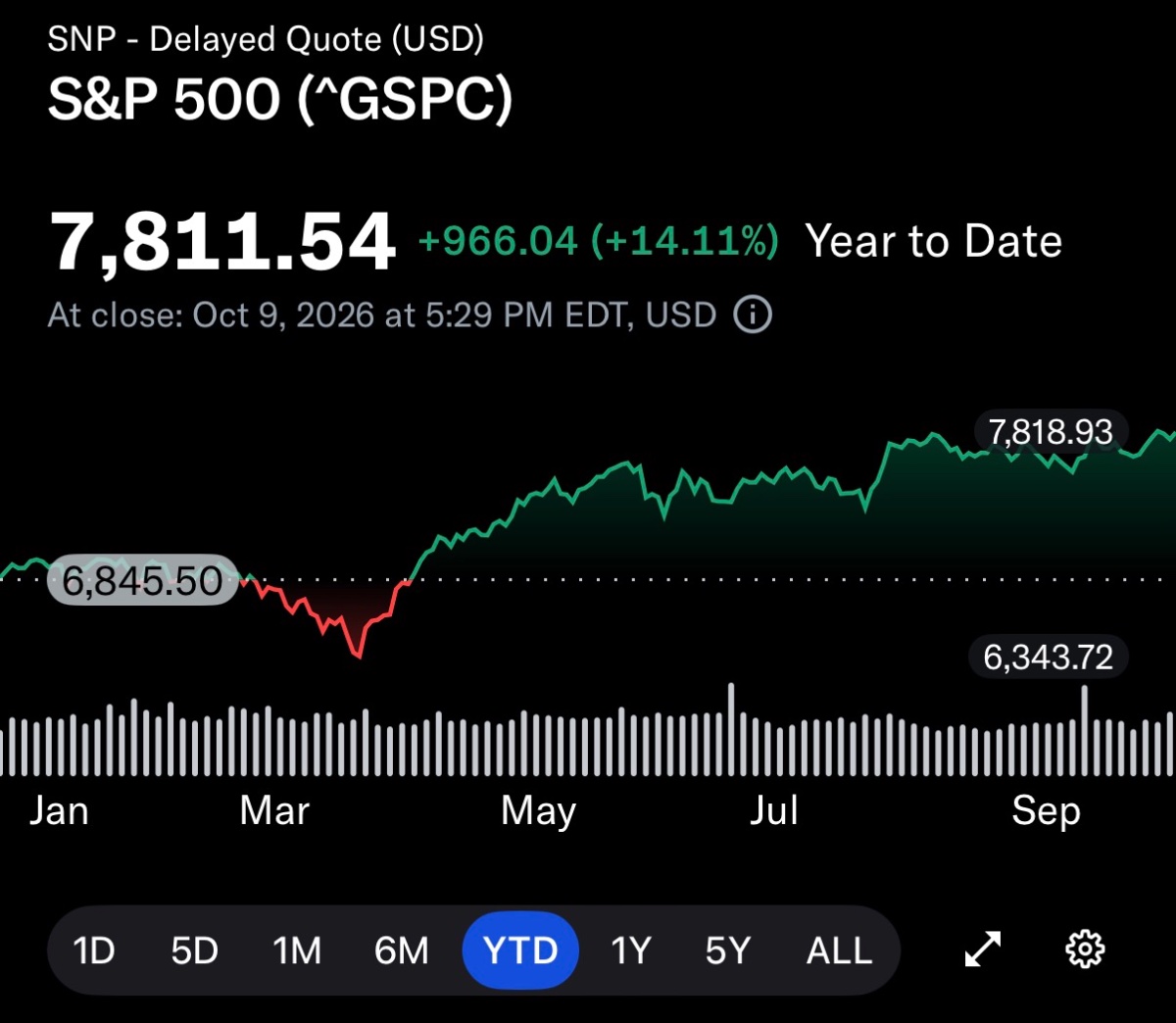
The S&P 500 closed at 7,811.54 on Oct. 9. Major brokerages including Goldman Sachs and Citigroup forecast 8,000 or higher by year-end. Not every institution expects the same level.
| Measure | Value | Note |
|---|---|---|
| Oct. 9 close | 7,811.54 | Actual close |
| Year-end 8,000 | +2.4% | If the target is reached |
| UBS, June 2027 | +7.5% | If 8,400 is reached |
Price change only, excluding dividends. Institutional forecasts do not guarantee realized returns.
Stocks could still rise through year-end. But from an already high price, further gains likely require earnings that beat expectations.
FactSet's expected third-quarter earnings growth is 29.6%. One analysis suggests that if companies keep their historical pattern of topping estimates, the final growth rate could rise above 35%.
The high growth rate itself is not the key point. What matters is how far results exceed the expectations already priced into stocks.
2. In 2027, AI has to prove it can make money
UBS forecasts global AI-related capital spending will rise from about $900 billion in 2026 to $1.2 trillion in 2027, an increase of about 33%.
AI's growth potential remains large. But the more that is invested, the more profitability is demanded in return.
| Sector | Focus so far | Focus ahead |
|---|---|---|
| Nvidia and other chipmakers | GPU orders, supply volume | Revenue durability, margins |
| Microsoft, Google, Amazon | Data center buildout | AI revenue, return on investment |
| AI software | User and usage growth | Paid conversion, operating profit |
| Power and infrastructure | Orders, capacity additions | Utilization, cash flow |
Wider use of AI technology does not mean every related stock will rise. Success for a technology and success for a stock are different things.
3. The warning in a 5.24% yield
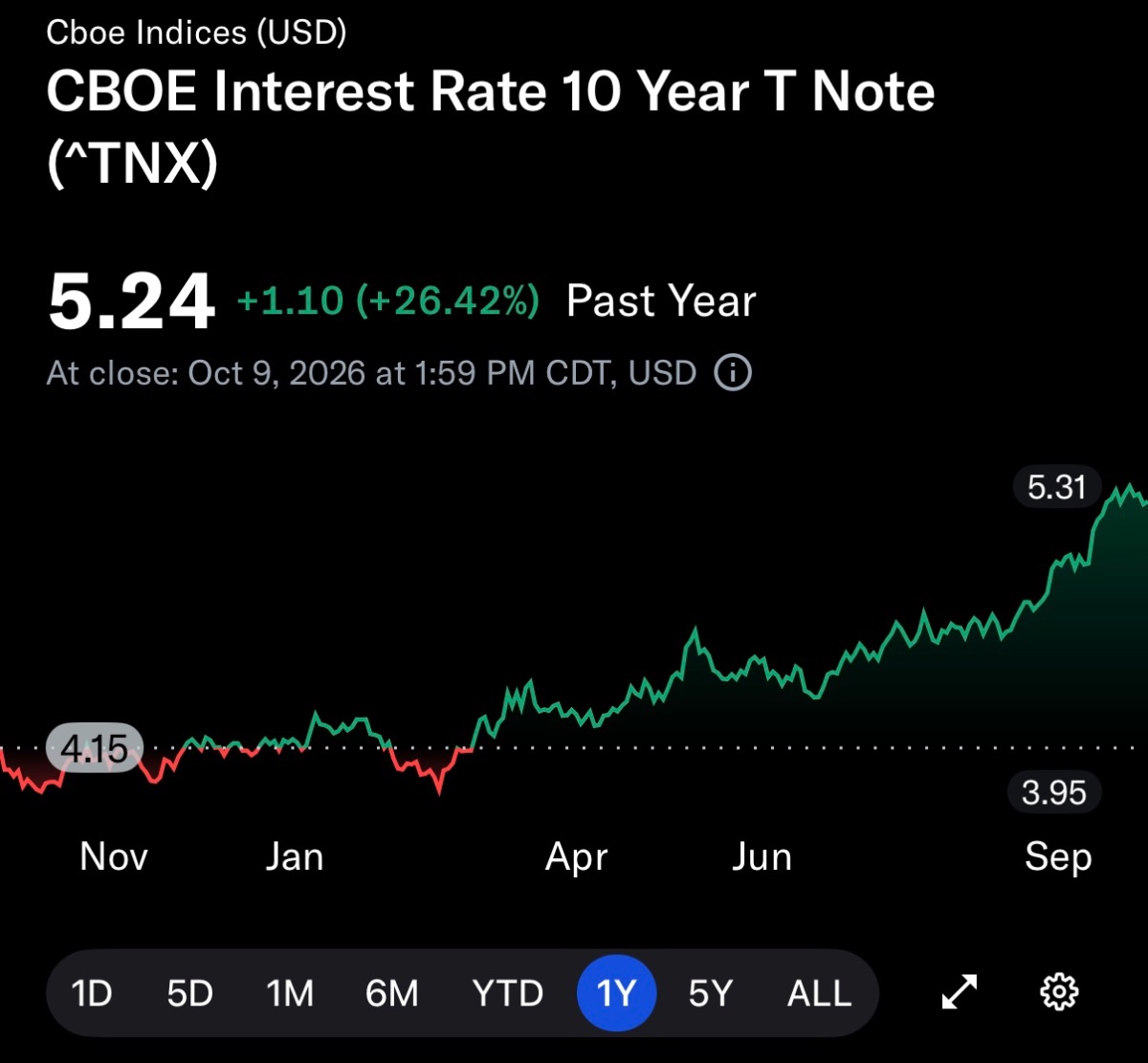
The 10-year Treasury yield was about 5.24% on Oct. 9. Long-term yields are hovering near their highest level in 24 years.
When yields rise, the discount rate applied to future earnings rises with them. Even if profits grow, a lower price-to-earnings multiple can cap the gain in the stock.
A simple example shows how:
| Assumption | Result |
|---|---|
| Today: EPS of 5 × 20x P/E | Price 100 |
| Earnings +15%, P/E falls to 17x | Price 97.75 (-2.25%) |
A hypothetical case to illustrate how valuation works, not a market forecast.
The most dangerous combination for a bull market is rising yields together with falling earnings forecasts. If yields stabilize and earnings estimates keep rising, the case for higher prices can hold.
4. A longer bull market needs broader leadership
The top 10 companies in the S&P 500 now account for about 40% of its market value, up sharply from about 28% in October 2022.
Having a few companies produce high earnings growth is a strength. It also concentrates the whole market in a single AI investment cycle.
In 2027, the question is whether earnings growth spreads beyond AI chips and Big Tech to industrials, financials and consumer discretionary.
If improvement shows up not only at companies investing in AI but also at those adopting it to cut costs and raise productivity, the base of the bull market could widen.
The bottom line is earnings. AI investment can keep growing in 2027. But the companies the market is likely to reward are not those spending the most. They are the ones that turn that spending into profit and cash most efficiently.
Insight Times Editorial Desk