2027 Isn't the End: Citi's Case for a Memory Supercycle Running to 2031
Citi says the memory shortage timeline is stretching again. If AI shifts from "train once" models to continual learning, HBM, server DRAM and enterprise SSDs could all fall short at the same time.
AI MEMORY
The memory supercycle timeline just stretched from 2028 to 2031
Until now, the bullish case in the memory industry ran roughly like this: 2027 is the tightest year, and starting in 2028 new supply gradually catches up. Citi's global semiconductor report, released September 14, pushes that timeline out further.
Citi argues that as AI moves beyond simple training and inference into continual learning, the global memory shortage could persist through 2031. The report goes further, suggesting that 2028 supply-demand conditions may actually get worse rather than better.
If that view holds, the nature of memory demand changes. It's no longer just about needing a large batch of HBM to train a model once. Server DRAM and SSDs would need to keep growing continuously as long as the service is running.
Citi's numbers are aggressive
- -8.7%: Citi's projected 2027 DRAM supply-demand gap
- -9.7%: Projected 2028 DRAM supply-demand gap, a wider shortfall than 2027
- +62%: Projected 2027 HBM bit demand growth
- +69%: Projected 2028 HBM bit demand growth
Citi expects global DRAM bit demand to rise about 30.2% year over year in 2027, while supply grows only 18.8%. In 2028, it sees demand up roughly 35% against supply growth of about 22%. The gap between demand and supply doesn't close. It widens.
Server DRAM is the key driver. Citi estimates server DRAM demand, measured on a 1Gb-equivalent basis, will rise from 226.3 billion units in 2026 to 341.7 billion units in 2027, an increase of about 51%. By that math, servers would account for roughly 67% of total DRAM demand.
The price outlook is equally aggressive. Citi estimates blended DRAM ASP will rise 242.4% year over year in 2026, with another 23.1% increase in 2027. That 242.4% figure is Citi's own blended ASP estimate, not a claim that every DRAM product's spot price triples uniformly. It shouldn't be read that way.
Why continual learning consumes so much more memory
Most generative AI today works by pretraining a large model, then answering user requests through inference. Models get updated periodically, but they aren't constantly folding new knowledge into their parameters in real time.
Continual learning goes a step further. AI would need to keep absorbing new tasks and new information, updating its performance without losing what it already learned.
That creates demand for memory on three fronts at once:
- HBM - ultra-fast data supply for new training, retraining and large-scale inference
- Server DDR5 - holding model state, data preprocessing and agent task state around CPUs and accelerators
- Enterprise SSDs - storing and retrieving past knowledge, vector data, KV cache and state for large numbers of individual users
Put simply, if today's AI resembles a student who has finished studying for an exam, continual learning AI looks more like an employee who reads new material every day on the job, remembers past notes, and pulls them back up for the next task. It's not just the compute load that grows. The sheer volume of memory needed grows too.
Trimming HBM doesn't make memory demand disappear
One of the more interesting parts of Citi's report is how it reads the recent debate over HBM "de-spec." Some AI accelerator designs are lowering HBM capacity or offloading part of the KV cache to external storage, which some have read as a sign of cooling memory demand.
Citi's read runs the other way. Because HBM is scarce and expensive, system designers are shifting some data to server DRAM or high-capacity enterprise SSDs. That doesn't shrink memory demand. It spreads it across other layers.
If KV cache offloading expands further, high-capacity QLC-based enterprise SSDs stand to benefit. On the NAND side, Citi projects 2027 demand growth of 29% against supply growth of 21%, and 2028 demand growth of 33% against supply growth of 25%. That implies a supply shortfall of roughly 6.1% in 2027 and 5.5% in 2028.
This matters. It's getting harder to define AI memory investment as just an HBM story. When system design changes, demand doesn't vanish, it can migrate from HBM to DDR5 and enterprise SSDs.
Why supply is moving so slowly
If demand is growing 30% to 60% a year, it might seem like memory makers just need to build more fabs. But supply is responding unusually slowly this cycle.
First, HBM eats into general-purpose DRAM capacity. HBM consumes more wafers and requires heavier back-end processing than standard DDR. The more HBM output rises, the less capacity remains for commodity DRAM.
Second, bit growth from process-node shrinks alone is harder to come by than in past cycles. Citi expects the DRAM industry's average wafer capacity to grow only about 8% in 2027.
Third, new fabs take years between announcement and production. Site selection, construction, equipment installation, yield ramp and customer qualification can take several years. A surge in capex doesn't turn into next-quarter supply.
The upshot: memory makers have to reallocate capacity while demand is surging, and that reallocation itself cuts into supply of other memory types.
Personal AI and Physical AI are the wildcards after 2028
Citi's 2031 outlook is aggressive in part because it assumes entirely new sources of demand emerge after 2028.
If Personal AI ends up remembering an individual's emails, documents, calendar, and years of past conversations and preferences, the storage and active memory needed per user grows well beyond today's levels.
If Physical AI spreads into robots, self-driving vehicles and industrial automation, AI systems would need to keep storing and processing sensor data not just in the cloud but in vehicles, factories and robots as well.
Citi's long-run scenario rests on the assumption that these two demand sources combine with continual learning. If that plays out, new fabs coming online in 2028 could see their added supply absorbed almost immediately by new demand.
The three memory makers now need a different lens
| Company | Strength | What to watch this cycle |
|---|---|---|
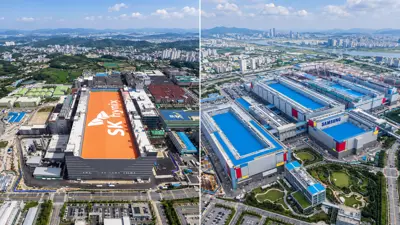
| SK Hynix | HBM leadership and leverage with AI customers | HBM4/HBM4E yields, customer concentration, next-gen packaging capacity |
| Samsung Electronics | Large DRAM base plus combined HBM, foundry and packaging capacity | HBM4 customer qualification, yields, improving AI DRAM mix |
| Micron | Exposure to the US AI supply chain across HBM, server DRAM and enterprise SSDs | Long-term contracts, HBM4E transition, new fab capex and free cash flow |
Beyond Samsung, SK Hynix and Micron, Citi also named SanDisk and Kioxia among its top memory picks. On the equipment and materials side, it flagged names including Applied Materials and Lam Research. Being named a "top pick" reflects Citi's own investment view. It is not a guarantee that any of these companies' valuations will actually rise.
Three scenarios make the picture clearer
Bull case: Continual learning, agentic AI, Personal AI and Physical AI spread quickly, and HBM, DDR5 and enterprise SSDs all fall short at once. New 2028 supply gets absorbed by demand as fast as it arrives.
Base case: 2027 is the tightest year, and supply growth eases somewhat starting in 2028-2029. High-value AI memory still holds stronger pricing power than commodity products.
Bear case: A slowdown in AI capex, delays in commercializing continual learning, and faster-than-expected ramp-ups at new fabs combine to normalize the supply shortage sooner than expected after 2028.
Insight Times Editorial Desk