China's AI Labs Went Open Source Because They Had to, Not Because They Wanted To
A GPU shortfall pushed Chinese AI labs toward efficiency and open weights, and that constraint is now reshaping the global competition over who controls AI's basic infrastructure.
A GPU shortage rewired the strategy
Reuters' reporting on China's AI industry points to a simple origin story: open source was not a policy slogan handed down from above. US export controls limited access to cutting-edge Nvidia GPUs, and Chinese AI startups had less capital and compute to work with than American frontier labs. Huawei itself admitted in September 2026 that its AI computing hardware supply could not keep up with domestic demand.
When compute is scarce, research habits change. Labs cannot afford to throw hundreds of ideas at the wall and let money absorb the failures. Experiments have to be more selective, more training has to be squeezed out of the same GPUs, and reusing already-proven research becomes far more valuable.
DeepSeek's history illustrates the pattern. DeepSeek-V2 cut training costs by 42.5% compared with its predecessor, according to the company, and V3 and R1 released their model weights and technical papers publicly. V4 shipped as an open-weight model in 2026 as well. The point is not simply "free models." When one organization's optimizations become public, other research teams can build on top of them, startups can build applications, and the whole ecosystem learns faster.
The US and China are selling different products
Best Intelligence as a Service. Offer the strongest general-purpose model through APIs and cloud services, and capture high prices and margin directly at the model layer.
Good Enough Intelligence as Infrastructure. Distribute sufficiently capable model weights widely, allow local deployment and customization, and move toward becoming the ecosystem standard.
The line is not absolute. The US has open models too, notably Meta's, and China has closed services as well. But the underlying economics diverge clearly. American frontier labs are trying to convert massive compute spending into model performance and API revenue. China's open-weight labs have shown a strength in stretching fewer resources into faster distribution and broader developer adoption.
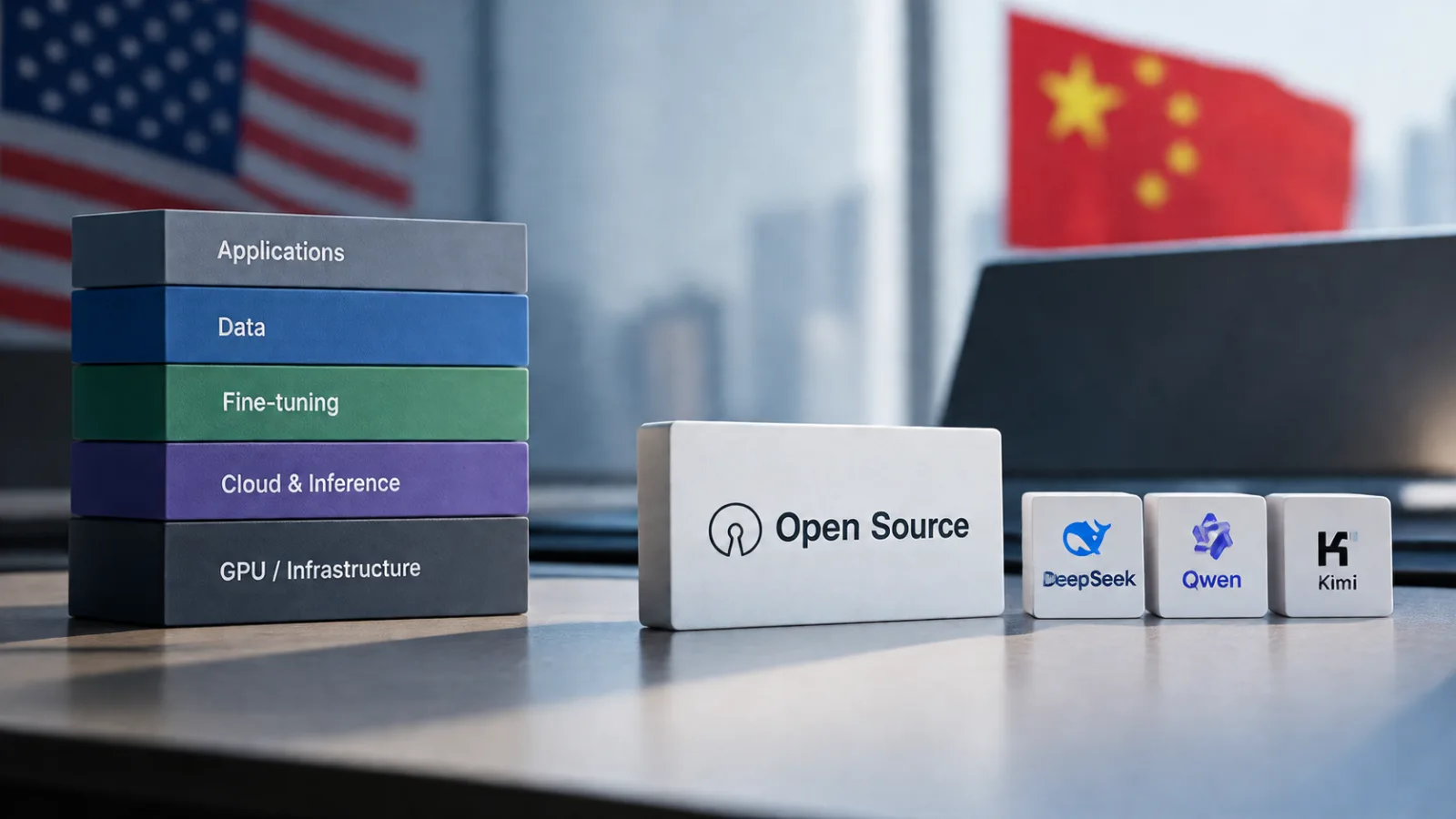
The difference matters for AI diplomacy too. Closed models from OpenAI or Anthropic are accessed mainly through external API and service contracts. Open-weight models like Qwen, DeepSeek and Kimi let users download the weights and run them on domestic data centers or private cloud. That can be an attractive option for countries and companies that prioritize data sovereignty and cost control.
Usage and revenue are not the same thing
This is also where China's strategy shows its biggest weakness. The more a model spreads, the more influence it carries, but distributing weights externally does not guarantee that inference revenue flows back to the original developer. Reuters Breakingviews has noted that Chinese AI companies are under revenue and margin pressure from heavy R&D spending combined with aggressive price competition.
Alibaba's push in August 2026 to require revenue sharing from large commercial users of its next-generation Qwen model reflects exactly this tension. It is an attempt to keep the reach of open weights while clawing back some economic value from the biggest commercial deployments.
| AI value chain | What changes as open weights spread | What investors should watch |
|---|---|---|
| Model APIs | Rising price pressure | Whether frontier performance still commands a premium |
| Cloud and inference | Potential direct beneficiary of rising usage | GPU utilization, inference cost per query, customer lock-in |
| Applications and agents | Lower switching costs between models | Proprietary workflow data, integration, customer switching costs |
| Data and post-training | Differentiation shifts outside the model itself | Proprietary data and verifiable task performance |
| Semiconductors and infrastructure | Overall AI usage can expand | Inference volume, memory, networking, power demand |
Because of this, the threat from China's open AI push does not have to show up as users abandoning ChatGPT directly. The more consequential scenario is open models seeping into the lower layers of corporate AI stacks as the default foundation. Thomson Reuters built its own specialized model in 2026 starting from a strong open model, spending a total of $40 million to post-train it on its own data and domain expertise. Rather than calling a general-purpose frontier model every time, the trend is toward owning intelligence tailored to a specific task.</markdown> <parameter name="tags">["AI infrastructure", "DeepSeek", "Alibaba", "open-source AI", "China tech", "semiconductors"]
Insight Times Editorial Desk