AI's Second Act Is Being Fought Outside the Model
China's Broadcom probe, cheaper Claude Opus 5.5 tokens, and unbroken US-China capital flows look like separate stories. Together they show the AI contest widening from "smartest model" to a full system of networks, cost, and capital.
Why three stories are actually one
The first AI race was about models. Who built the biggest one, who topped the benchmarks, that was the story. But as AI has moved out of the lab and into real corporate workflows and massive data centers, the question has changed.
Building a good model is no longer enough to dominate the industry. You need to link hundreds of thousands of accelerators, get the same job done more cheaply, and keep raising the capital to fund hundreds of billions of dollars in equipment and R&D.
<div class="flow"> <div><b>Compute</b><br>GPUs and AI accelerators</div> <div><b>Memory</b><br>HBM and high-bandwidth memory</div> <div><b>Network</b><br>Switches, interconnects, optics</div> <div><b>Intelligence</b><br>AI cost per task</div> <div><b>Capital</b><br>CapEx, IPOs, VC funding</div> </div>
This week's three stories touch three of those five layers at once: network, the price of intelligence, and capital. Read together, they say more about where the AI industry actually stands than any one of them alone.
1. China's next problem is an AI factory without Nvidia
Reuters, citing the Financial Times, reported that SASAC, the Chinese agency that oversees state-owned enterprises, recently surveyed how much Broadcom switching gear is used in state-run data centers. The FT's preliminary findings put the figure as high as 90%. Reuters said it could not independently verify that number.
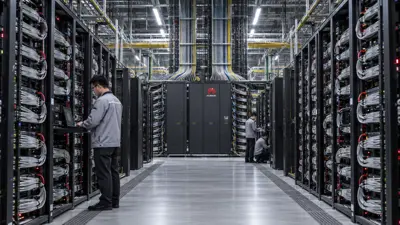
What matters more than the 90% figure is what's being surveyed: not GPUs, but the network. Tens or hundreds of thousands of AI accelerators need to constantly exchange data. When bandwidth runs short or latency stretches out, expensive GPUs sit idle waiting for data instead of computing.
Having already restricted Nvidia, if China moves to cut Broadcom too, the scope of its self-sufficiency push expands from "domestic GPUs" to "domestic AI data centers." That means tying together compute, memory, packaging, networking and software all at once. If a single chip underperforms, more chips can be lashed together to compensate, but that strategy makes the network even more critical, not less.
There's a read-through for US investors too. The value in AI infrastructure isn't concentrated in GPUs alone, it can spread out to adjacent bottlenecks like Broadcom, Arista, optical networking and advanced packaging. At the same time, suppliers exposed to China revenue now carry fresh risk from Beijing's localization push.
2. The new unit of model competition is the price of one successful task
Anthropic priced Claude Opus 5.5 at $4 per million input tokens and $20 per million output tokens, a 20% cut in token pricing from Opus 5. The bigger claim is that overall operating cost for typical workloads is down roughly 40%. Anthropic also says output speed is up more than 30%.
What investors should watch here isn't who tops the benchmark leaderboard. As agents do more real work, cost per successful task matters more than cost per token. The real economics only show up once you add in how many tool calls a task needs, how often failures trigger retries, and how much human intervention is still required.
<div class="grid"> <div class="card"><div class="label">TOKEN PRICE</div><div class="big">$4 / $20</div><p>Price per million input/output tokens, 20% below the prior Opus 5.</p></div> <div class="card"><div class="label">TYPICAL WORKLOAD</div><div class="big">-40%</div><p>Anthropic's claimed drop in operating cost for typical tasks.</p></div> <div class="card"><div class="label">OUTPUT SPEED</div><div class="big">+30%+</div><p>Improvement in output speed versus the prior model, per Anthropic.</p></div> </div>
This trend squeezes model makers on price but lowers costs for AI applications built on top. And as the price of intelligence falls, usage can rise even faster. A company running an AI agent 10 times a day doesn't cut usage in half just because cost falls by half. It often finds reasons to run it 100 times instead.
So reading falling model prices as automatically bad news for Nvidia or the cloud providers is too simple. What investors need to track is not the drop in unit price, but how much faster total inference volume grows in response.
3. Technology is splitting, but money still crosses the border
According to LSEG data cited by Reuters, US banks acted as bookrunners on 19 capital markets deals for Chinese tech companies in 2026 worth a combined $17.2 billion, about 30% of total issuance. In the other direction, S&P Global Market Intelligence data show that funding rounds for US AI companies involving Chinese or Hong Kong investors grew from roughly $436 million in 2023 to about $8.9 billion through mid-September 2026.
This doesn't mean US-China tech tension has eased. It more likely means tech decoupling and financial coupling are moving at different speeds. Governments prioritize national security, technological sovereignty and supply-chain resilience. Private capital looks at growth rates, returns, valuations and liquidity.
That leaves the AI industry pulled by two opposing forces at once, for now. Supply chains are being duplicated around US and Chinese hubs, while capital keeps chasing returns across both ecosystems. If a full separation ever does materialize, that lingering financial link could end up amplifying market volatility rather than cushioning it.
What matters isn't "AI companies," it's the economics of the AI system
<div class="table-wrap"> <table> <thead><tr><th>Shift</th><th>Where the upside may land</th><th>Risk that comes with it</th></tr></thead> <tbody> <tr><td>AI clusters getting bigger</td><td>Networking, optics, HBM, packaging</td><td>Localization policy, customer concentration</td></tr> <tr><td>Falling cost per AI task</td><td>AI applications, cloud usage, inference infrastructure</td><td>Price competition and margin pressure on model makers</td></tr> <tr><td>US-China stack separation</td><td>Regional supply chains and alternative suppliers</td><td>Duplicated CapEx, regulation, market access limits</td></tr> <tr><td>Financial ties holding</td><td>Capital access and global investment opportunity</td><td>Risk of sudden capital flight if policy shifts</td></tr> </tbody> </table> </div> </markdown>
Insight Times Editorial Desk