Burry's AI Bubble Warning Moves From Prices to the Balance Sheet
Michael Burry's case has shifted from expensive stocks to debt, long-term commitments and private credit. New BIS data supports part of it. Microsoft's results complicate the rest.
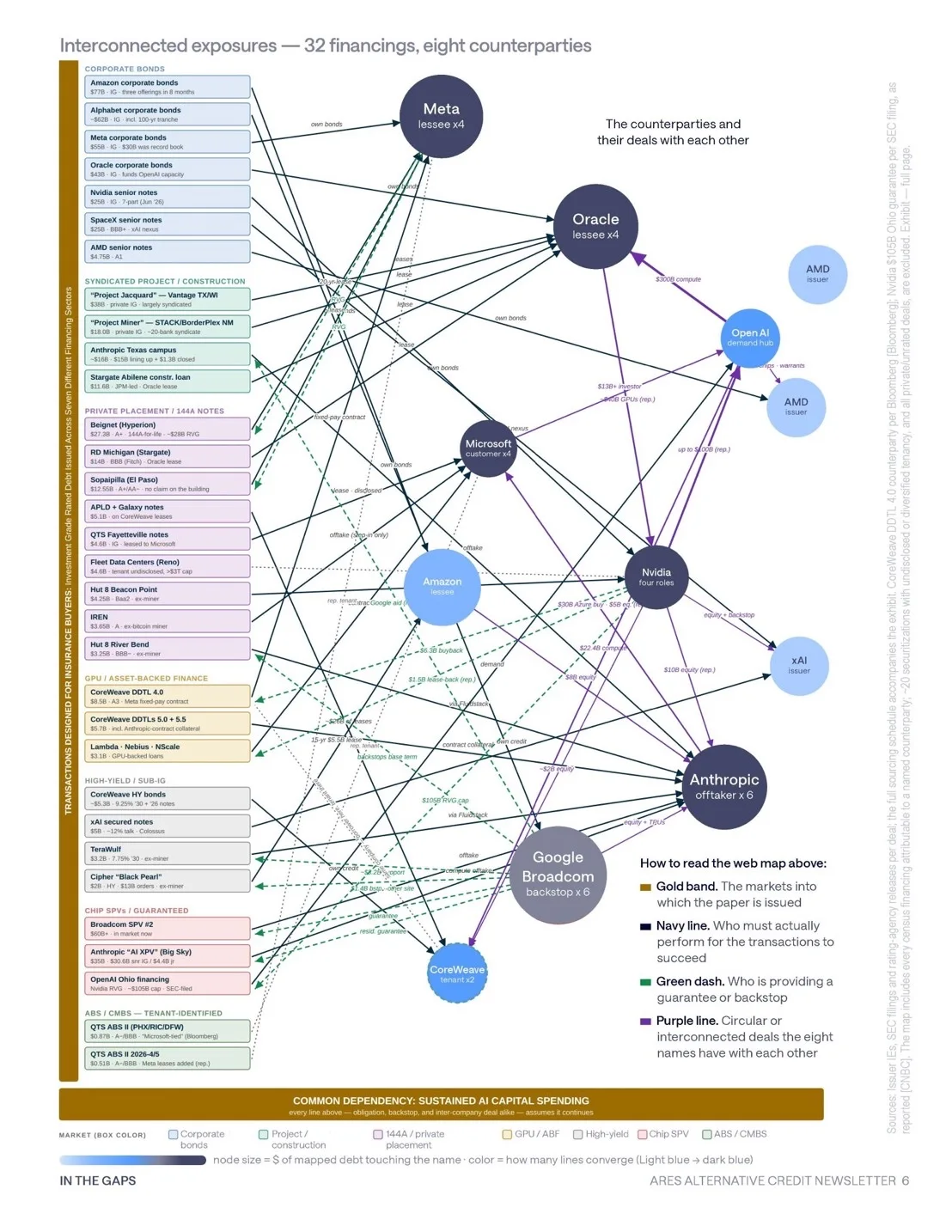
Michael Burry has warned about an AI bubble many times, so it is easy to shrug and say, here he goes again. His October 2026 warning is different. The bigger issue is no longer expensive stocks. It is AI spending moving beyond cash flow into debt, long-term commitments and private credit, and that shift is starting to show up in real data.
Burry has always been bearish. Look only at what is new
Burry's market warnings are not rare. In May he wrote that he is treated like the "boy who cried wolf." His name alone gives this warning no special weight.
What matters is how his argument has changed.
| Date | Theme | Argument |
|---|---|---|
| Nov. 2025 | Depreciation | If the economic life of GPUs and servers is shorter than their accounting life, big tech earnings may be overstated. |
| Feb. 2026 | Construction in progress | Data centers and equipment are not depreciated until they go into service, which can push cost recognition later. |
| May 2026 | Customer concentration | Nvidia's revenue is tied too closely to the spending decisions of a handful of hyperscalers. |
| Aug. 2026 | Circular financing and debt | AI companies invest in each other and buy each other's products. As debt grows, the bubble has a "clock." His base case is 2028. |
| Sept.-Oct. 2026 | Capital cycle | He tracks roughly $3 trillion in potential commitments across the five big hyperscalers, including purchase obligations, future leases, third-party debt guarantees and SPVs. In October he brought the GPU useful-life debate back to center stage. |
The key point: Burry's thesis has moved from a valuation argument ("stocks are expensive") to a capital-structure argument: who is financing whose investment, and when do those costs hit the income statement and cash flow?
Why October 2026 is different, part one: circular financing is no longer only Burry's claim
On Oct. 1, the Bank for International Settlements (BIS) published some notable numbers.
- 55.2%: share of money flowing into AI companies in 2021-2025 that came from other AI companies.
- 46.4%: share of AI-to-AI investment, by value, where an investment relationship and a commercial transaction existed together.
- +50%: the BIS model's conservative estimate of AI overinvestment relative to the socially efficient level.
These figures do not mean "fake revenue." Securing supply through strategic investment is normal in chips and cloud.
The problem is that price discovery gets blurred. Say Nvidia invests in an AI cloud provider. That provider uses the money and outside borrowing to buy Nvidia GPUs, then signs long-term cloud contracts. Every transaction is real. But it is risky to read money paid by end customers and money recycled inside the ecosystem as the same growth rate.
The "closed loop" Burry has described for months is now visible in BIS's large-scale transaction data. That is the newest part of this warning.
Part two: risk is moving from equity to credit
The early AI boom was largely paid for by big tech's enormous cash flow. Investment is now growing faster than that cash flow.
In a September speech, the BIS said publicly that capital spending at large AI companies is outrunning cash flow, raising reliance on debt and private credit. Recent analysis of the bond market also suggests that financing by hyperscalers and data center operators is changing the structure of the global corporate bond market.
This matters. Money raised through equity has no maturity date if the stock falls. Debt is different. It carries interest costs, must be refinanced, and comes with collateral values and covenants.
Burry's 2028 base case, set in August, fits the same logic. It is less a short-term prediction of an imminent crash than an argument that the long-term contracts and debt being signed now will face a real profitability test a few years out.
The numbers that are awkward for Burry
For the bubble case to hold, end demand eventually has to fall short of expectations. That has not been confirmed.
Microsoft's Azure revenue rose 43% year over year in the fourth quarter of fiscal 2026. Annual Microsoft Cloud revenue reached $214.4 billion, and commercial remaining performance obligations stood at $678 billion. The company said the backlog grew 25% excluding OpenAI. It also said roughly 90% of total cloud revenue comes from outside frontier-model companies.
In the same quarter, Microsoft spent $41 billion on capex but produced $55.4 billion in operating cash flow and $19.6 billion in free cash flow. AI spending is squeezing margins, but that is a long way from "there is no end demand."
The company also expects supply constraints to last through 2026. Others argue that older GPUs are still being used in the actual rental market. Burry's point about fast economic depreciation and the fact that GPUs keep earning money for several more years can both be true at once.
That is why laying today's AI market directly over the 2000 dot-com bubble makes for crude analysis. Back then the weak link was telecom companies that did not make money. Today the spending is centered on the companies that generate the most cash in the world.
How to read the October 2026 AI bubble debate
First, do not ask "bubble or not." A technological revolution and an asset bubble can exist together. Railroads and the internet both did.
Second, watch customers' cash flow more than Nvidia's revenue. If GPU sales keep rising but customers do not earn enough on that investment, the next order cycle becomes the problem.
Third, watch commitments more than capex. Purchase contracts, leases, guarantees and project financing that must be paid in the future are becoming more important than money already spent.
Fourth, watch the quality of AI revenue. Separate demand from companies inside the ecosystem from demand actually paid by outside businesses and consumers.
Fifth, do not try to call the top. The market was near record highs in early October, and Nvidia has held a high share price, contrary to Burry's warning. The hypothesis that a bubble exists is a very different thing from a prediction that prices fall tomorrow.
Insight Times Editorial Desk