Tesla's FSD Clears Eight European Countries. The Number That Matters Now Is Paid Conversion
European regulatory barriers for FSD Supervised are falling. But investors who lump supervised software revenue together with the value of driverless robotaxis risk pricing the same news twice.
Eight countries is clear progress, but it is not all of Europe
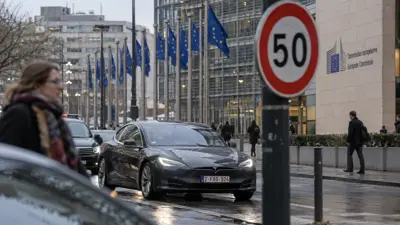
The Netherlands' vehicle authority, RDW, granted FSD Supervised a provisional type approval on April 10. Lithuania, Estonia, Denmark, Belgium, Slovenia, the Czech Republic and Croatia then recognized the Dutch approval at home. Tesla also lists these eight countries as its official European launch markets.
Despite the name, the system is not fully autonomous. It is an SAE Level 2 driver-assistance system. The driver must keep watching the surroundings and be ready to intervene at once. RDW stated that the European software and features are not identical to the US version.
- 8 countries: EU member states that currently recognize FSD Supervised
- About 12.6%: rough share of the EU population living in the eight approving countries
- 15 countries + 65%: the core threshold for a qualified majority needed for EU-wide approval
The easiest mistake is to count national recognitions as yes votes in an EU ballot. They are separate processes. Legal use in eight countries means the commercial reach is wider. It does not guarantee EU-wide approval.
Germany has moved, but "imminent" is a stretch
On October 6, Germany's transport ministry publicly backed swift EU approval of FSD Supervised. It said it supports keeping responsibility with the driver and limiting the allowed overshoot of speed limits to roughly 10%. It also said it had suggested that Tesla rename the system "Tesla Assisted Driving."
Germany's support carries political weight. It is the EU's most populous country and its largest car market. But political backing, technical review, national recognition and EU-wide approval are different stages. The TCMV, the EU committee that votes on such approvals, held no vote in October, and an EU-level decision slipped to December at the earliest.
A more accurate description than "approval is imminent" is that the political and regulatory conditions that raise the odds of approval are improving.
Two businesses investors should separate
| Business | What the current news supports | Additional evidence needed |
|---|---|---|
| FSD Supervised | Wider market access for paid driver-assistance software that can be sold to existing cars | Number of eligible vehicles, paid conversion, retention, realized price, localization cost |
| Driverless robotaxi | Indirect progress in technology and brand awareness | Permits for driverless operation, driverless safety record, fleet utilization, insurance and maintenance costs, per-unit profitability |
The two share a software stack, but the business models differ. The customer value of supervised FSD is not removing the driver. It is reducing the burden of driving. Robotaxi value comes from removing the driver entirely and earning transport-service revenue.
Converting a European FSD Supervised approval straight into robotaxi approval pulls forward future value that has not been proven. That distinction matters more for a company like Tesla, where expectations for autonomy are a major pillar of the valuation.
How many people pay matters more than approval
Regulatory news opens the door. Revenue only arrives when customers walk through it and pay. So estimates of European FSD earnings should not simply multiply EU population or Tesla's total fleet.
As an illustration, if 100,000 new paying users spend 100 euros a month for an average of six months, revenue is 60 million euros. This is only a way to understand the structure. Actual prices, free trials, discounts, one-time purchases and cancellation rates could all differ.
The existing installed base matters more. Even if new-car sales stall, software revenue can grow if many existing vehicles meet the regulatory and hardware requirements. The reverse also holds. If approvals spread but few cars are eligible, or payment does not follow the free trial, the earnings effect is limited.
The safety debate has not gone away. It has moved to the next stage.
RDW said it approved the system after more than 3,000 hours of its own testing, over 1,000 test runs and 1.8 million km of data accumulated in Europe. That is not the same as a regulator accepting Tesla's data as given.
At the same time, traffic-safety researchers contacted by Reuters raised concerns about the comparison groups, the use of proxy measures in place of crashes, and whether data from professional test drivers generalizes. A manufacturer's safety claim should be kept apart from a safety conclusion established independently.
Safety data from a supervised system also does not directly prove the safety of an unsupervised one. In a Level 2 system a driver can step in. In a driverless robotaxi, the liability structure and the required level of safety are different when something fails.
Insight Times Editorial Desk