Tesla Isn't Selling Cars: Three Proofs Its "Operating System for Abundance" Needs
Master Plan Part IV bets that energy, mobility and labor costs can fall together inside one vertically integrated system. Investors should watch how far each cost is actually falling, not how big the story is.
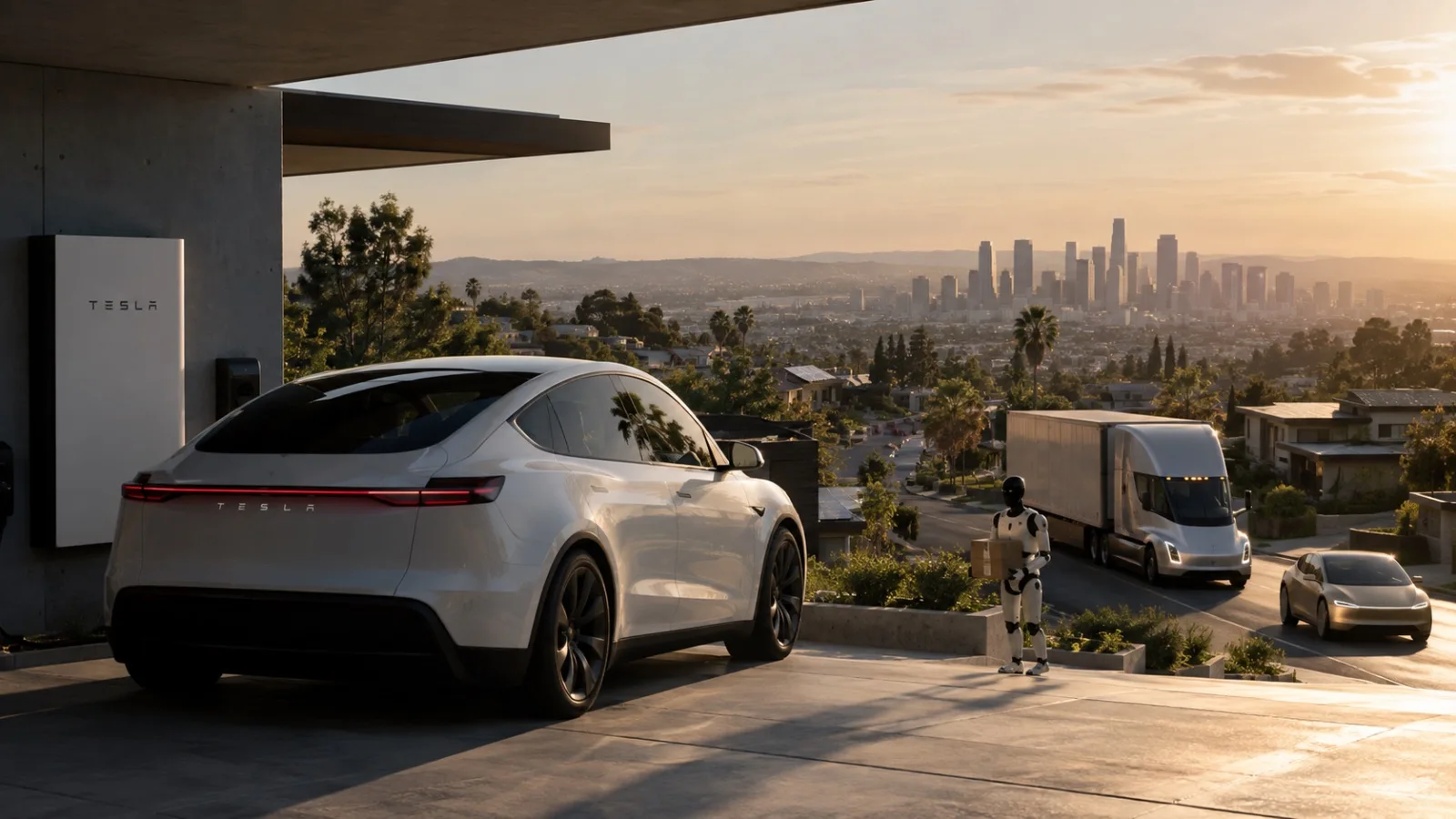
The core of Master Plan Part IV is not a plan to grow cars, batteries and robots separately. It is a plan to cut three costs at once, energy, mobility and labor, inside one vertically integrated system. What investors should watch is not the size of the narrative but how far those three costs are actually falling.
Master Plan 4 changes the question: from "how many do we sell" to "how much cost do we remove"
In Master Plan Part 3 in 2023, Tesla worked out an engineering path to fully electrify the world's energy system. The model called for about 240 TWh of battery storage and about $10 trillion in manufacturing investment. Master Plan Part IV, published in 2025, extends that logic. The company's official phrase is "Sustainable Abundance."
The key change is how the business is defined. Part 3 calculated the physical quantities of the energy transition. Part 4 ties vehicles, energy storage, autonomous driving and humanoid robots into one system. What Tesla wants to lower is not a single product price but the unit cost of energy, of mobility and of physical labor.
Seen this way, Tesla's vertical integration is more than bringing parts in-house. Batteries and grid storage, vehicle manufacturing, AI training, inference hardware, autonomy services and robot production are linked inside one company, so that a cost decline at each stage passes through as lower input cost at the next. If the chain connects as planned, a cost cut in one business can lift the competitiveness of another, forming a powerful industrial flywheel.
First proof: not a company that makes electricity cheap, but one that trades the "time" of electricity
Viewing solar and batteries as mere generation and storage equipment captures only half of what Tesla Energy means. A battery's economic value does not end with storing power. It lies in moving power from cheap hours to expensive hours and absorbing sudden swings in grid supply and demand.
- Lathrop: 40 GWh. Tesla's official nominal annual capacity, based on 10,000 Megapacks.
- Shanghai: 20 GWh. Installed capacity as of the company's second-quarter 2026 disclosure, the current installed capacity that can be confirmed from Tesla's official filings.
- Q3 2026 deployments: 13.7 GWh. Actual deployments in one quarter. Nominal capacity and actual shipments need to be kept apart.
Tesla's new Megafactory in Brookshire, Texas, also began Megapack 3 production in the second half of 2026. Its design capacity is reported at 50 GWh a year. Simply adding up California's 40 GWh, Shanghai's 20 GWh and Texas's 50 GWh gives a nominal 110 GWh. But a new plant's design capacity is not the same number as its actual annualized output.
Profitability should not be read as a straight line either. Tesla's energy storage gross margin was 39.5% in the first quarter of 2026 and fell to 20.4% in the second. That means it can swing widely with product mix, average selling price and warranty costs. The claim that "energy always earns a higher margin than cars" is still premature.
The structural strength is clearer. Instead of treating Powerwalls as hundreds of thousands or millions of separate batteries, software can tie them into one virtual power plant. Tesla said its California VPP supplied more than 535 MW in July 2025, with Powerwall homes providing about 500 MW of that. The point is that after the hardware sale, participation in power markets and software control can add another revenue layer.
Second proof: FSD is decided not by "how well it drives" but by "what a mile costs"
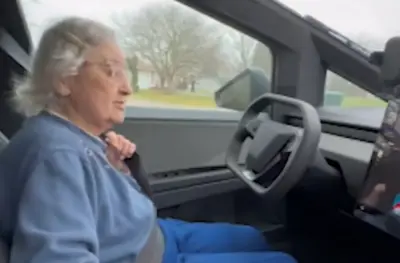
The biggest asset in Tesla's autonomy effort is fleet scale. Tesla's FSD Evidence Dashboard shows cumulative FSD Supervised miles of more than 6.5 billion. That reflects a structural strength: Tesla can accumulate large volumes of real-road data quickly. FSD Supervised today is an SAE Level 2 system that requires continuous driver supervision.
Even so, the data matters industrially because it connects to the cost structure. Tesla's goal is to mass-produce vehicles that minimize expensive sensor packages, high-definition maps and driver labor, and to replicate the same software stack across millions of cars.
| Item | Confirmed today | Economics Tesla is aiming for | What to check next |
|---|---|---|---|
| FSD Supervised | 6.5 billion+ cumulative miles, driver supervision required | Software improvement from large fleet data | Same safety level without supervision |
| Robotaxi | Service operating in several US cities | No driver cost, high vehicle utilization | City-level regulation, insurance, remote-support costs |
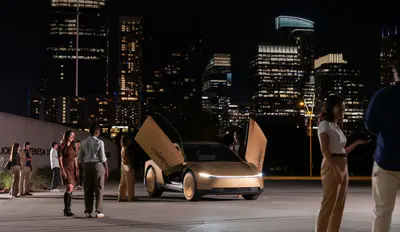
| Cybercab | Production began in 2026, limited operation in Austin | Lower cost from a dedicated two-seat design and driverless operation | Mass-production yield and actual total cost per mile |
The target of about $0.20 per mile is the key number for understanding Cybercab economics. It is closer to a long-term goal than to an actual average operating cost confirmed in a large commercial network. As real network costs, including insurance, cleaning, tires, charging, accident handling, remote support and vehicle idle time, become public, the competitiveness of Tesla's designed cost structure can be assessed more concretely.
Cybercab's value should be viewed the same way. What matters is less that the car drives itself than whether it can run more hours at a significantly lower total cost than human-driven ride-hailing. The winner in autonomy is likely to be not the company with the best demo video but the one that cuts cost per mile the furthest while holding safety and utilization.
Third proof: Optimus targets the labor cost curve, not a single robot
Optimus is cited as the largest option in Tesla's valuation because of market size. Cars cut travel time, but humanoids could target nearly every physical task in which humans spend time: manufacturing, logistics, services and care.
At this stage, though, the gap between vision and commercialization is wide. In its second-quarter 2026 materials, Tesla said it was building Optimus production facilities in Fremont and Texas. Production has since started, but by recent reports it has not yet generated revenue from outside customers.
The price of $20,000 to $30,000 per unit that Elon Musk has mentioned is a target range premised on long-term mass production. If it becomes real, humanoid economics could move to a different dimension from existing industrial automation. Actual cost will be set jointly by volume, actuator yield, hand durability, AI chip cost, battery life and the maintenance system.
The calculation investors should make is therefore simple. It is not robot price divided by annual effective working hours. It is the cost per effective working hour, including depreciation, maintenance, failure rate, charging time, remote supervision and task success rate. The moment that number falls meaningfully below human labor cost, Optimus's economic value could rise sharply.
The real moat of vertical integration: does one business's cost decline lower another's cost?
Tesla's long-term logic runs as follows. Large-scale storage reduces power price volatility. Cheaper power lowers the cost of AI training and vehicle charging. Cheaper AI and charging lower the cost per mile of the autonomy network. Robots in turn cut labor costs in factories and logistics, reducing the manufacturing cost of vehicles, batteries and the robots themselves.
This is the strongest version of what Tesla means by abundance. What matters is not that "each business exists." It is whether cost savings in each business actually transfer into the economics of the next.
Tesla's recent $30 billion new credit facility and its guidance of more than $20 billion in capital spending in 2026 should be read in this light. The company is putting capital into Cybercab, Optimus, Semi, AI compute, solar and semiconductor manufacturing at once. That looks less like growing each business independently and more like a capital allocation strategy to bind them into one integrated production system. The key from here is how quickly these investments convert into productivity gains and better unit economics.
"Universal High Income" is still a productivity hypothesis, not economic policy
Musk has repeatedly said that if AI and robots advance enough, something beyond universal basic income, Universal High Income, becomes possible. But this should not be read as an official Tesla business plan or an already designed government policy. For now it is closer to a future hypothesis that technology will sharply lower the cost of goods and services.
The more accurate economic description is not "everyone is paid a lot of money." It is a rise in real purchasing power, where the same income buys far more goods and services. If the costs of energy, mobility, manufacturing and some services fall together, living standards can rise even if nominal income does not grow much.
For UHI to translate into broad real purchasing power, several conditions are needed. Lower production costs have to become lower consumer prices. The gains from automated productivity have to spread through society in various forms. And bottlenecks in areas where technology alone cannot quickly expand supply, such as housing, land and health care regulation, need to ease as well.
The core of UHI is therefore not that money disappears, but how much of the productivity gain from AI and robots converts into real consumption capacity for society as a whole. Technology may be a necessary condition, but it is not a sufficient one.
Technology maturity at a glance
| Axis | Current stage | Strongest evidence | Key items to verify |
|---|---|---|---|
| Energy | Commercialization and global expansion | 13.7 GWh deployed in Q3, multiple Megafactories | Margin swings, grid interconnection, battery supply chain |
| FSD / Robotaxi | Large-scale supervised driving plus limited driverless service | 6.5 billion+ FSD Supervised miles, Robotaxi in several US cities | Unsupervised safety, regulation, insurance, unit economics |
| Cybercab | Early production and limited deployment | Production started, real operation in Austin | Mass production, FMVSS, network costs |
| Optimus | Facility build-out and early production | Factory construction and production start | Hand and actuator durability, task generalization, cost |
Insight Times Editorial Desk