Tesla's FSD Approval in Europe May Slip to December Over a '50%' Problem
The EU-wide vote on Tesla's Full Self-Driving software has slipped from October to at least December, and the sticking point is a feature that lets cars drive up to 50% faster than the posted limit.
Why '50%' became the sticking point
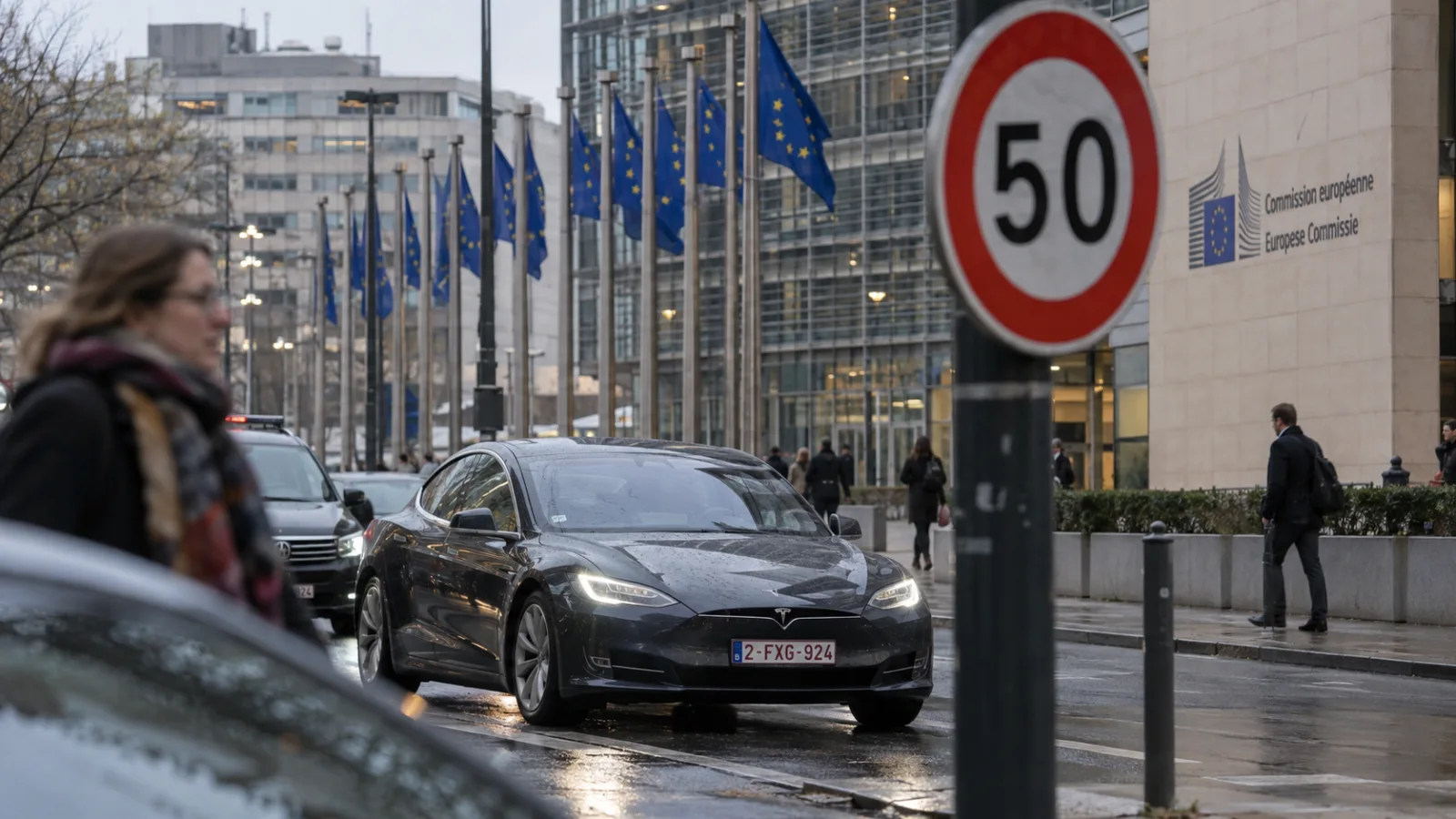
According to Reuters, the European Transport Safety Council (ETSC) has raised objections to Tesla's Speed Offset feature in FSD Supervised, which lets the car drive up to 50% faster than the speed limit it detects. ETSC says Tesla never filed the separate exemption required under UNECE regulations for this feature. Tesla did not immediately respond to Reuters' request for comment.
Here is the detail that matters: the Netherlands' existing approval was never a blanket sign-off that covered this disputed feature. Reuters reports that the Dutch approval did not include the Speed Offset function now under scrutiny. In other words, regulators are not evaluating FSD as one giant AI product. They are breaking it into pieces, speed settings, lane changes, steering, driver monitoring, and judging each against existing rules.
Europe has already started approving FSD, but "EU-wide" is a different bar
The Netherlands' RDW granted type approval to FSD Supervised in April. That approval currently only applies within the Netherlands. To be usable across the EU, RDW needs to file for an extension with the European Commission, and member states then vote, requiring majority support in the relevant committee.
RDW says it did not take this decision lightly. According to its own materials, it ran more than 3,000 hours of testing and over 1,000 individual tests, and reviewed data from 1.8 million kilometers driven by FSD Supervised in Europe. Even so, the European approval process is not finished. Reuters reports the EU-wide vote, originally expected in October, has now slipped to at least December.
At the same time, Europe is not moving in one direction only. Following the Netherlands and Belgium, Croatia approved deployment of FSD Supervised on September 29. Sweden, France and the Czech Republic, by contrast, have raised concerns. The European market looks less like a simple approve-or-reject split and more like a transition period where each country sets its own scope and conditions.
FSD's bottleneck is shifting from technology risk to regulatory risk
Tesla investors have long focused on the technical maturity of FSD: intervention frequency, miles driven, the end-to-end neural network, training compute. But once a product clears a certain performance bar, the next constraint becomes permission to operate, the legal right to actually use it on public roads.
It is similar to a new drug. Strong clinical data does not guarantee large-scale sales before regulators sign off. Self-driving software faces a similar separate gate between technology and commercialization. Nor is this a case of shipping software that works well in the US straight to European vehicles. RDW explicitly states that software versions and features in European and American vehicles cannot be compared one to one.
Investors should watch three curves at once
Compressing FSD's valuation into a single question, how good is the AI, risks missing what matters now. Going forward, it is more useful to track three curves moving at different speeds: technology, regulation and monetization.
- Capability Curve: How quickly does FSD improve its safety and consistency on actual roads.
- Regulatory Curve: How many countries allow it, under what conditions, and how fast EU-wide mutual recognition opens up.
- Monetization Curve: In approved markets, how much do paid adoption rates, pricing and software revenue per vehicle actually rise.
When all three curves move in the same direction, FSD's economic value shows up more clearly on the income statement. If technology improves but approval is slow, potential value builds up while revenue conversion lags. And even where approval comes through, monetization stays limited if consumers do not pay.
Insight Times Editorial Desk