Year Five of the Bull Market: Why U.S. Stocks Aren't Expensive Yet, and What AI Chips and Power Must Deliver
U.S. stocks have gained about 117% since the October 2022 low. What happens next depends less on the bull market's age than on whether expected earnings, which lean heavily on AI semiconductors, turn into reality.
U.S. stocks have risen about 117% since the October 2022 low. The bull market is entering its fifth year, but what decides the market's future is less the rally's age than the earnings companies actually produce.
1. Year five: the paradox of an expensive-looking market
The bull market that began on Oct. 12, 2022, is approaching its fourth birthday. In historical cases analyzed by Keith Lerner of Truist, most bull markets that survived four years or more rose again the following year.
The more important signal, though, is valuation.
| Measure | Level |
|---|---|
| S&P 500 forward P/E, about a year ago | 23x |
| S&P 500 forward P/E, recently | 19x |
The multiple fell because expected earnings rose.
The P/E ratio is price divided by earnings per share. Even when prices rise, the P/E falls if earnings forecasts grow faster.
That is a positive change. But a lower P/E alone does not make stocks cheap. If the future earnings estimates in the denominator are too optimistic, valuations look lower than they really are.
The key question for U.S. stocks now is not how far prices have risen, but whether the earnings currently expected can actually be realized.
2. Earnings are surging, but the engine of growth is narrowing
According to FactSet, third-quarter 2026 earnings growth for S&P 500 companies is estimated at 29.6% from a year earlier. If the usual pattern of companies beating estimates repeats, FactSet says the final figure could top 35%. These are not confirmed results.
The makeup of the forecasts is more interesting.
Share of year-to-date upward revisions to S&P 500 EPS estimates coming from semiconductors and hardware
- 2026 full-year EPS: 40%
- 2027 full-year EPS: 75%
Analysis by Barclays strategist Venu Krishna. This is the contribution to upward revisions in estimates, not the share of total corporate earnings.
In other words, semiconductors and hardware play a very large role in the rise in 2027 earnings expectations.
That is positive evidence that booms at Nvidia, Broadcom, TSMC and the memory makers can lift earnings expectations for the whole market.
The reverse also holds. If Big Tech cuts AI spending, or chip prices fall faster than expected, a slowdown in one sector could turn into a downgrade of earnings forecasts for the entire S&P 500.
That does not mean most U.S. companies are failing to grow. Earnings are also expected to rise in energy, financials and other sectors. The issue is less a lack of growth than where the force that keeps lifting market expectations is concentrated.
3. AI chip profits pass through four bottlenecks
Building AI infrastructure is not finished by ordering lots of GPUs. Securing usable computing capacity requires several supply chains to move at once.
- Advanced logic chips. TSMC, ASML: manufacturing the compute chips.
- HBM and advanced packaging. SK hynix, Micron, Samsung Electronics, TSMC: joining memory to compute chips.
- High-speed networking and optical communications. Nvidia, Broadcom, optical component makers: linking huge numbers of GPUs.
- Power grid and cooling infrastructure. Utilities, power equipment makers: actually running the data centers.
This is a simplified map of typical supply constraints in AI computing infrastructure. Real manufacturing is not a single sequential chain but several stages connected in parallel.
TSMC's CoWoS is an advanced packaging technology that connects compute chips and HBM at high density. That is why packaging capacity matters in GPU production, not just output of the chips themselves.
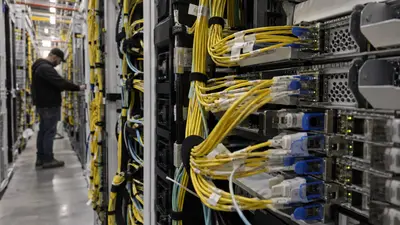
Networking works the same way. Even with enough GPUs, a large AI cluster loses efficiency if data cannot be exchanged quickly.
Still, a bottleneck does not give every related company the same pricing power. Benefits differ with long-term supply contracts, competitors' expansions, customers' adoption of their own chips and technology shifts.
In particular, when supply capacity expands, industries that were bottlenecks can face new price competition.
4. After GPUs, power. After power, return on investment
Big Tech's huge AI spending becomes chip companies' revenue, which in turn creates demand for data centers and power infrastructure.
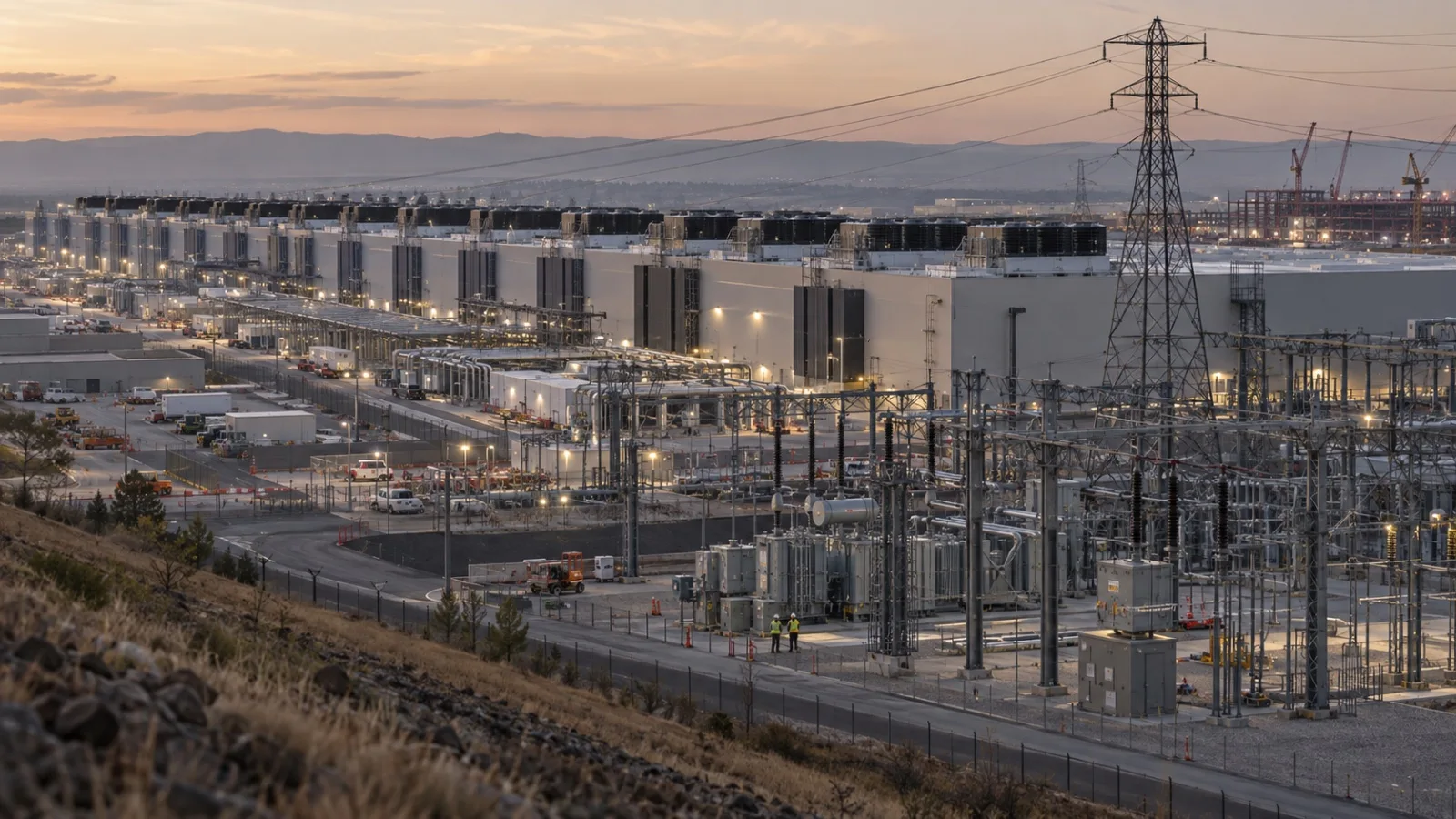
In this structure, what matters is not only how much power is produced but when it can be delivered where it is needed.
On Oct. 5, the U.S. Department of Energy announced a conditional loan commitment of up to $4.2 billion to support upgrades at Vistra's nuclear facilities in Pennsylvania and Ohio. The case shows nuclear plants and existing power assets becoming an important supply base for the AI industry. A loan commitment, however, does not mean confirmed revenue or profit.
The bigger problem is recovering the investment.
A Reuters analysis of LSEG estimates found that combined 2027 capital spending at five companies, Microsoft, Alphabet, Amazon, Meta and Oracle, is expected to exceed their free cash flow. That does not mean the investment has failed. It means investors need to verify whether cash generation can keep pace with the speed of the spending.
AI infrastructure lifts chip companies' revenue during the build-out, but for Big Tech buyers it creates depreciation costs and cash outflows.
In the end, several years from now, what will decide corporate value is not how many GPUs a company bought but how much profit it earned from them.
5. Who benefits, and who is squeezed
| Industry and companies | Growth opportunity | Risks to check |
|---|---|---|
| Nvidia, Broadcom | Expansion of AI accelerators and networking | Rival in-house AI chips, customer spending adjustments |
| TSMC, ASML | Demand for leading-edge processes and packaging | Cost of large capacity additions, geopolitical risk |
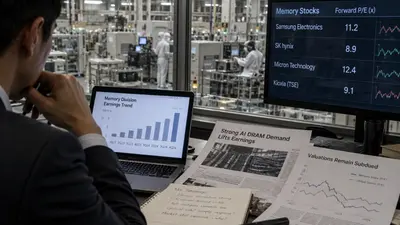
| SK hynix, Micron, Samsung Electronics | HBM demand and product upgrades | Capacity additions, yields, memory price cycle |
| Vistra, Constellation | Long-term power purchase agreements and power demand | Regulation, generation costs, valuation |
| Amazon, Alphabet, Microsoft, Meta | Growth in cloud and AI service revenue | Capital spending, depreciation, lower free cash flow |
What matters is not only an industry's growth but who captures how much of the economic profit that growth generates.
For example, when memory prices rise, that can help HBM makers' earnings but raises costs for the AI server companies that buy the chips. Conversely, a utility with long-term contracts gains demand visibility, but an investor who buys at a high share price may earn a low return.
The winners of an industry and the winners among its stocks are not always the same.
Five numbers to watch
- S&P 500 EPS estimates: whether 2027 earnings forecasts keep rising after earnings season progresses.
- Hyperscaler capex and free cash flow: whether bigger capital spending translates into better operating cash flow.
- HBM prices and packaging utilization: whether supply shortages persist, or added supply starts to pressure prices.
- Data center power hookups and utilization: whether the data centers built generate actual service revenue.
- The 10-year Treasury yield: whether it adds a funding burden to an increasingly capital-intensive AI investment industry.
Insight Times Editorial Desk