S&P 500 Rebounds, but Chip Stocks Stall: Valuation, Not Demand, Likely the Culprit
US stocks bounced on Oct. 9, yet AI hardware lagged. With the 10-year yield near 5.24% and Brent above $100, the question is whether earnings can hold and whether semiconductors rejoin the rally.
| Index | Close | Change |
|---|---|---|
| Dow Jones | 51,654.95 | +0.83% |
| S&P 500 | 7,811.51 | +0.59% |
| Nasdaq Composite | 27,366.17 | +0.64% |
| Russell 2000 | 2,806.98 | +0.46% |
| Philadelphia Semiconductor (SOX) | 12,572.42 | -0.41% |
The rebound was about earnings expectations, not a return of risk appetite
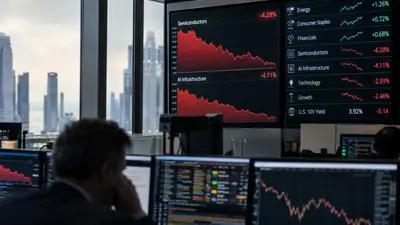
Stocks recovered part of the prior day's sharp drop, but this was not a broad growth rally. REITs, health care and financials outperformed tech. Software and cloud names bounced. Semiconductors did not follow.
According to Reuters, the Dow rose 0.83%, the S&P 500 gained 0.59% and the Nasdaq added 0.64% on Oct. 9. Communication services was the only one of the S&P 500's 11 sectors to fall. Ahead of big-bank earnings and CPI next week, the market shifted its focus from geopolitical headlines back to corporate profits.
Pressure in the background remains. The 10-year Treasury yield was about 5.24%, down from a 24-year high but still elevated. Brent crude gave back its intraday decline and closed up 0.4% at $104.72. WTI also rose 0.4%, to $91.85. So the day is hard to describe as a market that rose because rates and oil fell. It looks more like a session in which fears of further deterioration eased and earnings expectations took over.
The real question behind the $50 billion OpenAI debate
The OpenAI revenue controversy that rattled AI stocks the day before is not really a story of $20 billion in revenue vanishing. The gap between an annualized run rate of about $50 billion at the end of September and the $68 billion to $70 billion figure reported earlier was attributed in large part to whether cloud-partner sales are counted gross or net.
Still, the market reacted sharply less because of the number itself than because of doubts about how long AI spending takes to pay back. AI infrastructure will keep needing huge amounts of outside capital. Reuters, citing Morgan Stanley estimates, said external financing needs for AI infrastructure could reach $1.5 trillion through 2028.
With rates above 5%, the issue shifts from how much is being invested to how fast it turns into revenue and cash flow. On Oct. 9, Microsoft rose 2.38%, Amazon 3.29% and Palantir 5.17%. Nvidia fell 0.52% and AMD 2.03%. One day of trading is not enough to say money has structurally rotated from hardware to software. But the signal is clear that the market's question has moved from the volume of GPU demand to return on investment and cash flow.
Chip weakness is not the same as an AI demand collapse
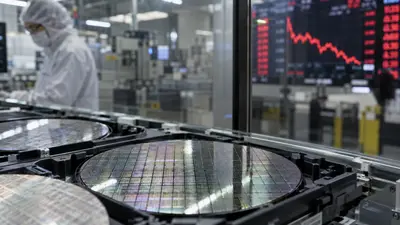
The SOX fell 3.39% on Oct. 8 and slid another 0.41% on the 9th. Nvidia, AMD and TSMC stayed weak, while Broadcom rose 0.39% and ASML gained 0.60%.
That split matters. There is no evidence yet that memory and AI server demand have turned down. The more plausible reading for now is that valuation pressure hit richly priced GPU names and some AI hardware harder. Samsung Electronics has guided to record third-quarter operating profit on AI memory demand, and the industry sees the memory shortage possibly lasting through 2028.
It is premature to read the chip pullback as the end of the AI investment cycle. It is equally premature to call the correction over after one day's bounce. The next checkpoints are orders and guidance from ASML and TSMC, and customer capex.
SpaceX's spectrum deal shakes up wireless competition
SpaceX agreed to buy low-band 800 MHz spectrum in the US for about $8 billion, producing sharply divergent moves among telecom stocks. T-Mobile fell 13.27%, AT&T 10.82% and Verizon 8.75%. Tower REIT Crown Castle jumped 15.60%.
Low-band spectrum carries signals over wide areas and into buildings. If SpaceX builds a hybrid mobile network that combines satellites with ground base stations, it could pressure incumbents' pricing power and subscriber retention. At the same time, demand for ground antennas and towers could rise.
FCC approval and actual network construction still lie ahead. Prices now reflect the possibility first. How much of the carriers' losses and the tower company's gains turns into reported earnings is a separate matter.
Tesla and Apple: two faces of the same AI cycle
Tesla's September wholesale sales of China-made vehicles were 95,366, up 5% from a year earlier. The mix is what counts. Exports rose 58% to 30,529, while domestic China sales fell 9% to 64,837. The gain is better read as exports offsetting weaker domestic demand than as a recovery in Chinese consumption. Tesla shares rose 2.05% to $382.70.
Apple faced pressure from the other direction. Nikkei Asia reported that Apple cut its October component orders for the iPhone 18 Pro and Pro Max by at least 15% from its original plan. Higher component costs for phones and PCs, as AI data centers lift memory demand, are another burden. Apple fell 1.11%.
Taken together, the two show how the AI boom spreads. On one side it raises expectations for autonomous driving and software value. On the other, it pushes up memory and power costs, squeezing the cost and pricing of consumer devices.
Insight Times Editorial Desk