Nvidia Put $2 Billion Into Lumentum. Optics May Be the Next Bottleneck, but the Stock Has Already Run
Optical networking is emerging as the next constraint on AI data centers. Investors need to separate the industry's growth potential from the price they are already paying for it.
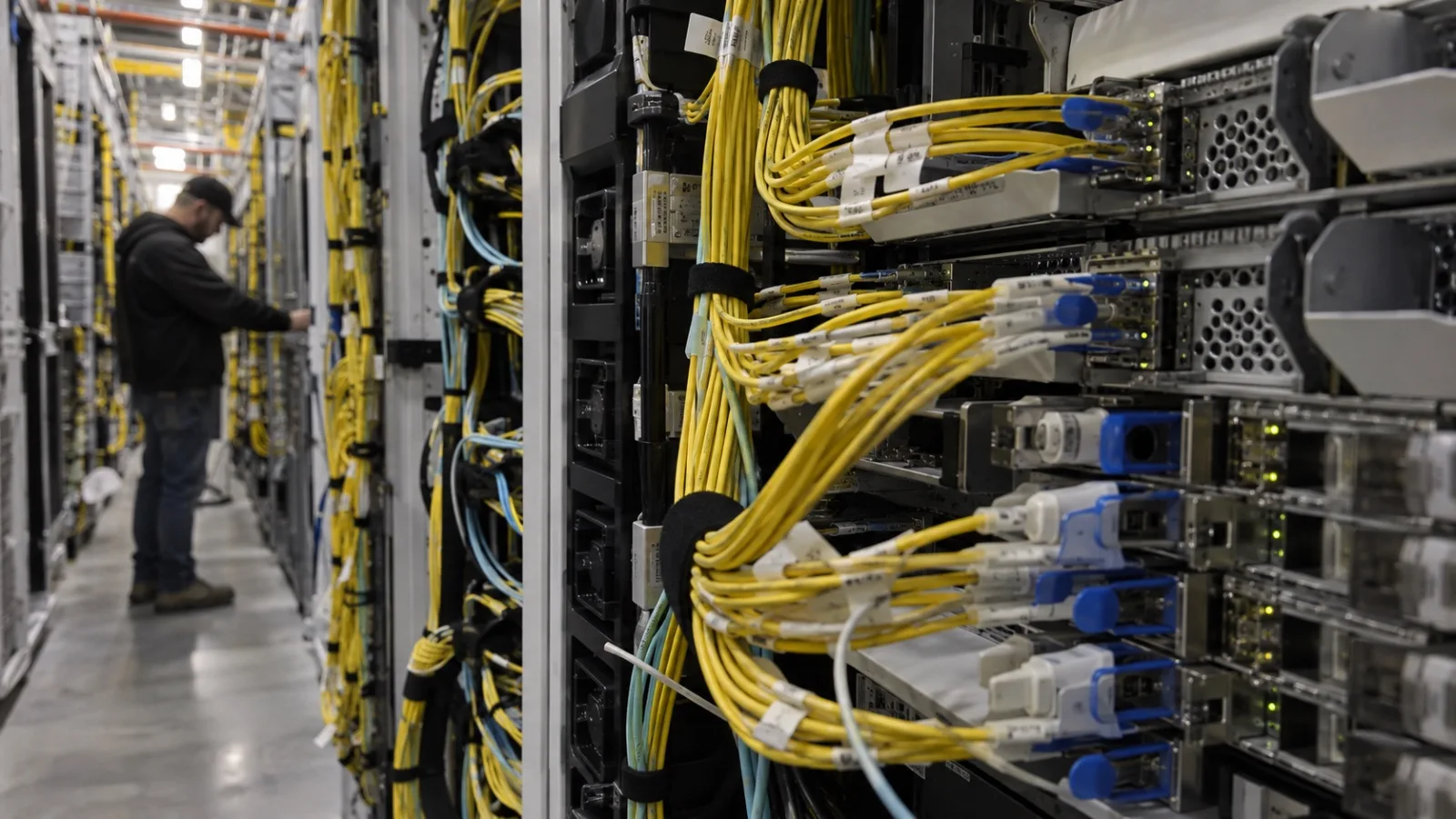
1. Why light may be the next AI data center bottleneck
On Oct. 9, 2026, Lumentum CEO Michael Hurlston said in a Bloomberg interview in Tokyo that production capacity for some optical components is fully booked through early 2029.
He also said some products are expected to fall short of demand by about 70% through 2027, and others by about 30% through 2028. These describe different product lines. They are not a shortage rate for the optical industry as a whole.
In an AI data center, GPUs do the computing. The network moves the data those GPUs need. Training a large AI model requires many GPUs to exchange results continuously.
If the network slows, expensive GPUs spend more time waiting for data. That is why adding GPUs does not raise total system performance in proportion.
GPU -> Network -> GPU: a delay in high-speed data exchange lowers overall computing efficiency.
Optical networking converts electrical signals into light to move large volumes of data quickly. It is central to high-speed links between servers and to scaling data centers. Not every connection will turn optical, though. Copper and optical links will coexist, depending on distance, power efficiency and cost.
2. Why Nvidia put $4 billion into optical companies
On March 2, 2026, Nvidia announced strategic agreements to invest $2 billion in Lumentum and $2 billion in Coherent.
The agreements include multiyear purchase commitments, access to future production capacity, and expanded research and development and U.S. manufacturing. Both deals are non-exclusive.
Nvidia is not seeking investment returns alone. It also wants to reduce the risk that a shortage of optical parts delays customers' AI system builds.
That suggests a GPU supplier now has to manage the supply chain for networking, connectivity and the whole system, not just chips.
Nvidia's interests differ from those of ordinary shareholders, however. Nvidia can gain strategically from a secure supply of parts. Shareholders have to weigh today's share price against future cash flow.
3. The industry looks promising, but the stock has already climbed
Rising demand for optical networking is not new. About six months earlier, Lumentum had said its capacity would be booked through 2028.
What changed in the latest news is that the shortage could last longer than expected.
The share price already reflects much of that growth expectation.
- Lumentum close, Oct. 9, 2026: $1,103.36 (+5.22% on the day)
- Coherent close, Oct. 9, 2026: $312.62 (+3.40% on the day)
Lumentum rose about 184%, from $368.59 at the end of 2025 to $1,048.60 on Oct. 8, the day before the shortage reports. It is also up about 50% from $700.91 on Feb. 27, just before Nvidia's investment announcement.
Valuation is hard to ignore. Applying the provided fiscal 2027 normalized EPS estimate of $21.78, the Oct. 9 close implies a forward P/E of about 50.7. Normalized EPS differs from GAAP earnings, and the multiple can vary with how estimates are compiled.
Coherent has also been re-rated sharply. Neither company is easy to present as an AI beneficiary the market has yet to discover.
4. Earnings can grow 30% and the stock can still fall
In growth investing, the rate of earnings growth is not the only thing that matters. So does any change in the multiple investors apply to those earnings, the P/E.
| EPS change | P/E change | Theoretical price change |
|---|---|---|
| +30% | 50x to 50x | +30% |
| +30% | 50x to 40x | +4% |
| +30% | 50x to 35x | -9% |
| +50% | 50x to 35x | +5% |
Simple arithmetic assuming a starting P/E of 50x. Not a price target or return forecast.
A company can grow as expected and still see its P/E shrink if the market judges that growth as less durable. If results keep beating expectations, a high multiple could hold or even expand.
So the central question for Lumentum is not whether optical demand will grow.
It is how far actual EPS can exceed current market estimates, and how long that growth can last.
5. "Sold out through 2029" is not guaranteed profit
Booked capacity improves visibility into demand. It does not mean all revenue and profit for that period are locked in.
A shortage signals strong demand. It also means the volume that can be shipped is limited. Unmet demand is not yet revenue.
Expanding production takes time and money. Delays in adding capacity limit how fast sales convert. If demand or technology shifts by the time new plants are finished, the burden of recovering the investment grows.
That is why laser and optical component yields, average selling prices, gross margins and free cash flow all need checking.
6. Which companies could benefit
| Company | Role in the industry | Key investment question |
|---|---|---|
| Lumentum (LITE) | Lasers and optical components for high-speed optical networking | How fast added supply turns into EPS and cash flow |
| Coherent (COHR) | Optical materials, lasers and optical networking components | Profitability by business, expansion efficiency, how much growth is priced in |
| Broadcom (AVGO) | AI network switches and custom chips | Networking revenue and contribution to overall AI results |
| Marvell (MRVL) | Data center connectivity chips and optical-related technology | Customer adoption and gross margin by product |
All four are tied to the optical ecosystem, but their business models differ. A shortage in one Lumentum product should not be translated directly into Broadcom's or Marvell's overall growth rates.
Insight Times Editorial Desk