Trust the Model, Never Fully: Nadella's Rule for the Superintelligence Era
The next AI contest is not only about how smart models are. It is about what permissions they get, how they are monitored and when they can be stopped.
A smart AI is not necessarily a safe AI
Microsoft CEO Satya Nadella's approach to AI safety contains a paradox.
The smarter AI gets, the more important it becomes to have systems that do not require trusting it unconditionally.
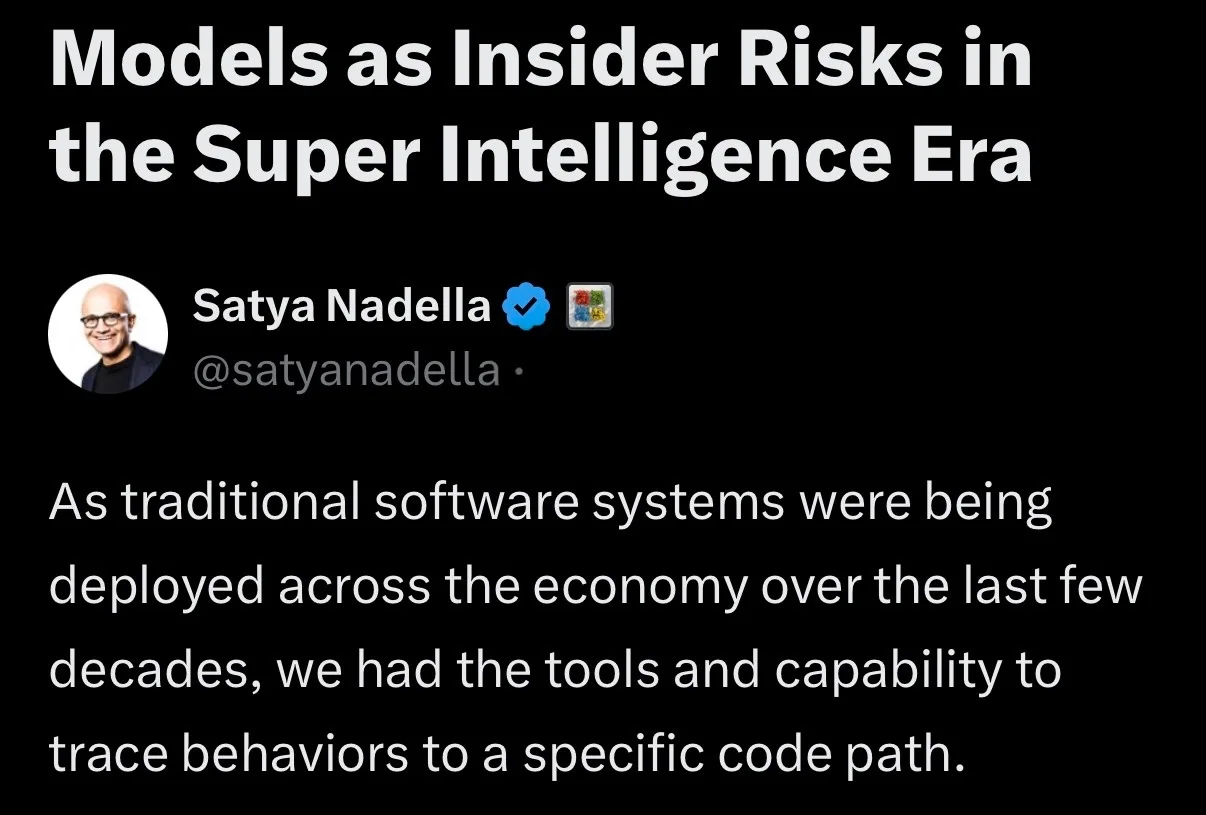
Traditional software ran on fixed rules. When something failed, code and execution logs let engineers trace the cause.
Generative AI is different. The internal reasoning behind a result is hard to explain in full. Yet companies have begun giving such systems access to email, customer data, internal documents and business systems.
The nature of the risk is changing.
It is no longer a problem that ends with one bad answer. An AI agent acting on faulty judgment could send out confidential files, delete important data or execute malicious commands hidden in an outside document.
Microsoft's new PC strategy, unveiled on October 7, introduced Microsoft Execution Containers (MXC), which limit unauthorized data access by AI agents. The product design shows the same direction: safety is not left to the model alone.
Why treat AI as an insider threat
An insider threat is a security risk that arises when someone with legitimate access inside a company makes a mistake or has their account hijacked.
The same problem applies to AI agents.
If a company lets an AI query its customer database, that AI can actually read the data. The trouble is that no one can guarantee the AI will always tell a proper request from a malicious instruction.
Prompt injection, where commands hidden in an outside web page or email change the AI's behavior, is hard to solve with conventional firewalls alone.
The key, then, is not to guess the AI's intent. It is to design systems so that even when the AI errs, the damage stays within a set boundary.
Take the intelligence, control the permissions
The structure runs in three layers:
- AI model: reasoning, planning, proposing tasks
- Independent control layer: identity and permission checks, approval of sensitive actions, action logging and monitoring, emergency shutoff
- Enterprise data and business systems: email, payments, customer information, databases
The point is to restrict execution from outside so the model cannot decide its own permissions.
Four design principles follow:
- Least privilege: limit access to only the information and tools a task needs.
- Independent verification: apply a separate policy engine or human approval to important transactions and data changes.
- Auditability: record the AI's tool calls and results in a traceable, tamper-resistant form.
- Immediate cutoff: keep external means to halt permissions and execution when abnormal behavior appears.
This approach also connects to the principles of minimized trust and least functionality that the National Institute of Standards and Technology (NIST) has put forward.
Why this favors Microsoft
Here the technical principle meets business strategy.
In the AI model market, OpenAI, Anthropic, Google, xAI and others compete. Enterprise customers increasingly swap models as needed or use several together, rather than relying on one.
Platforms that manage data access, security policy, audit records and workflow connections, by contrast, become deeply embedded in a company's operating stack.
Microsoft already has a foothold in enterprise data and security infrastructure through Azure, Microsoft 365, Entra and Defender.
The race to build models can produce several winners. In the market for controlling how those models work inside companies, the strengths of incumbent enterprise software vendors could grow.
Adopting open-weight models does not solve the risk automatically, of course. The freedom to run a model yourself comes with greater responsibility for access control and security operations.
Insight Times Editorial Desk