The robot race is not about walking. It is about putting 10,000 of them on a floor
Humanoid demo reels are already impressive. Industry asks a different question: how often does the fleet stop, who fixes it, and is it cheaper than a person after maintenance?
When AI leaves the screen, the nature of the problem changes
If generative AI gives you a wrong answer, you ask again or edit it.
Physical AI does not work that way.
A car that misjudges can crash.
A robot arm that misplaces itself can injure someone.
A logistics robot that stops blocks the flow of a warehouse.
Industrial equipment that malfunctions can halt an entire production line.
So physical AI is not simply a matter of putting an LLM inside a robot.
The real world has friction.
Sensors drift.
The light changes.
The floor gets wet.
A person appears without warning.
Parts wear down.
Batteries run out.
The network drops.
Through all of that, the machine has to act correctly, over and over.
If accuracy is the central problem in digital AI, then in physical AI reliability, safety, maintainability and recoverability all become part of the product as well.
Physical AI is much wider than humanoids
Say the words physical AI and most people picture a humanoid.
The category is far broader.
Self-driving cars.
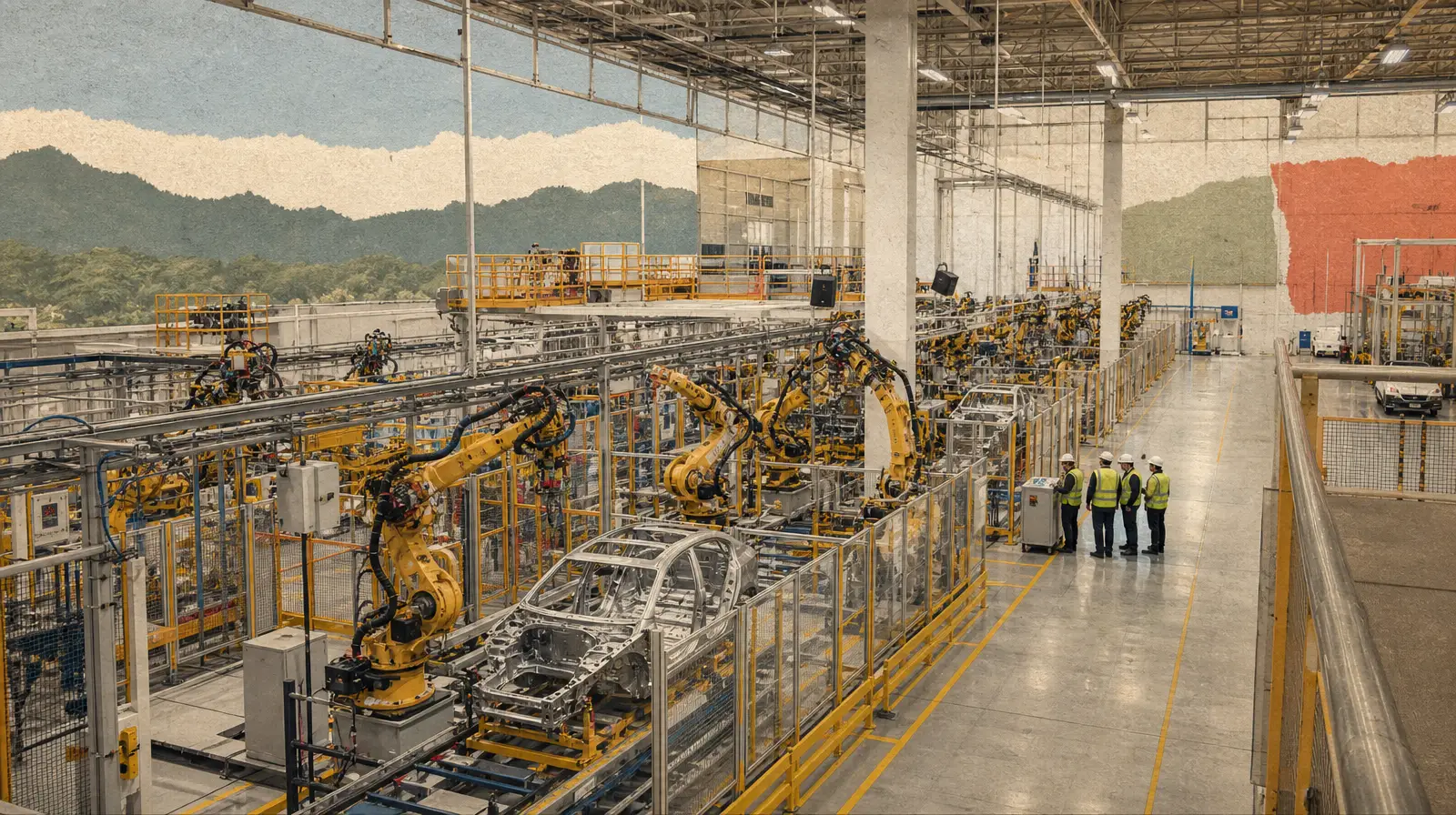
Factory robots.
Warehouse AMRs.
Drones.
Farm machinery.
Construction equipment.
Surgical robots.
Security cameras.
Smart factories.
All of these systems sense the physical world, judge with AI, and produce a result through actual motion.
NVIDIA defines physical AI as systems that perceive, reason about and act in the real world, and it bundles its development tools into a single workflow that runs from simulation and synthetic data through model training to edge deployment.
What matters is that the wider the category, the more the order of commercialisation changes.
The final world-changing form may well be a humanoid.
But the form that makes money first does not have to be the most human one.
The first robot to earn its keep may not be the most impressive one
Industry looks at ROI before it looks at a tech demo.
The questions a factory CEO asks are simple.
How many hours a day does this robot work?
When it breaks, how many minutes until it runs again?
Can it hold the night shift without people?
Does it replace one worker, or does it require an extra supervisor?
How many battery swaps?
After parts and servicing, does it pay back inside three years?
Robots will spread first where those questions are easy to answer.
Factories.
Warehouses.
Ports.
Mines.
Distribution centres.
Repetitive work.
Structured space.
Places with acute labour shortages.
Dangerous work.
Night work.
In these settings the range of tasks is limited, routes and rules can be controlled, and the economic value a robot creates is easy to calculate.
So the early contest in physical AI is likely to be less about human-like generality and more about the ability to earn money very reliably in one specific environment.
The distance between a demo and a deployment
There is one thing robot videos make it easy to get wrong.
Treating a single successful action as the same thing as an industrially repeatable one.
Say a robot lifts a box once.
That is not what a plant needs.
It needs to lift 1,000 times a day.
Every day.
With boxes of different sizes.
With the floor slightly different from yesterday.
With dust on the sensors.
Safely, while a person walks past.
At the same performance a month later.
And when it does break, a technician on site has to be able to fix it quickly.
A demo proves technical possibility.
A deployment proves economics.
They are entirely different stages.
Which is why one of the most important words in evaluating physical AI is deployability.
How do you measure deployability
As the robot industry grows, a new set of KPIs starts to matter.
Uptime.
The share of the 24 hour day the machine can actually work.
MTBF.
Mean time between failures.
MTTR.
Mean time to repair, from breakdown to running again.
Task success rate.
What percentage of assigned tasks finish correctly.
Intervention rate.
How often a human has to step in.
Safety incident rate.
How often the system creates a situation dangerous to people or facilities.
Cost per task.
The true cost of one job including electricity, depreciation, maintenance and supervisory labour.
None of these numbers show up well in a YouTube clip.
At the commercialisation stage they can matter far more than any benchmark.
Why Hyundai's Atlas strategy is interesting
Hyundai Motor Group sits in an unusual position in physical AI.
It owns Boston Dynamics.
It has car plants.
It has a parts supply chain.
It has a logistics network.
It has global production facilities.
It holds manufacturing data at scale.
In other words, it can be a company that builds robots and the first large customer for those robots at the same time.
At CES 2026, Hyundai said it would introduce Atlas into manufacturing sites including HMGMA in phases.
In 2028 it starts with processes where safety and quality effects are easy to verify, such as parts sequencing.
In 2030 it expands to component assembly.
After that the plan widens to repetitive motion, heavy loads and more complex tasks.
The order matters.
It does not drop in an Atlas that does everything a human does from day one.
It validates process by process.
It confirms the safety and quality effect.
Then it widens the scope.
That is how industrial deployment actually works.
A sentence that matters more than 30,000 units a year
Hyundai has set a target of building capacity to produce 30,000 robots a year by 2028.
On the number alone that is very aggressive.
The more important passage is elsewhere.
Hyundai says that after deployment it will provide OTA software updates, hardware maintenance, repair, MRO, and remote monitoring and control.
That is much closer to the essence of the physical AI business.
A robot is not a product you sell once, like a phone.
It breaks.
Parts wear.
The work environment changes.
Software needs updating.
Safety rules change.
New tasks have to be learned.
So a physical AI company is a manufacturer and a software company and a service company, and over time it starts to look like a fleet operator.
The physical AI data flywheel is not the digital one
Digital AI could draw on the vast body of text and images already sitting on the internet.
Physical AI has a much harder time getting data.
Data of a robot picking an object in a real factory.
Data of moving safely beside a person.
Data of failing and dropping the object.
Data of losing balance and recovering.
Data of working in a tight space.
None of this exists on the internet at scale.
It has to be produced.
Which makes the shop floor itself a core competitive asset.
When Hyundai uses its own plants as a testbed, Atlas performs real work.
Failure data accumulates.
The model is retrained.
It is validated in simulation.
It goes back onto the floor.
More data accumulates.
That is the physical AI data flywheel.
Seen this way, a company with many manufacturing plants is not merely a customer. It is a data production platform.
What the Google DeepMind and Boston Dynamics tie-up means
Boston Dynamics has long been strongest at the body of the robot.
Balance.
Motion control.
Locomotion.
Whole-body movement.
Hardware design.
In the current phase of competition, general-purpose intelligence is what is becoming decisive.
Understanding an environment.
Interpreting instructions in language.
Handling objects it has never seen.
Adapting to new tasks.
Boston Dynamics and Google DeepMind began joint research in 2026 combining Gemini Robotics family models with Atlas.
DeepMind is emphasising more complex robot behaviour in Gemini Robotics 2, including whole-body control, fine dexterity and teamwork.
The meaning of the combination is clear.
Good robot hardware alone is not enough.
A good multimodal model alone is not enough.
In physical AI the body, the sensors, the model, the control stack, the data and the simulation have to move as one system.
The cloud is not going away
As physical AI grows, you hear the line that AI is moving from the cloud to the edge.
That is half right.
A car cannot wait for a datacentre response before it brakes.
A robot arm cannot query the cloud in the instant before it hits a person.
Millisecond real-time judgment and safety control have to run locally.
That does not mean the cloud becomes unnecessary.
Large-scale model training happens in the cloud.
Data from thousands of robots is pooled there.
Digital twins run there.
New policies are simulated there.
Software is distributed from there.
Anomalies across the whole fleet are analysed there.
So the future of physical AI is not a choice between cloud AI and edge AI.
It is cloud AI plus edge AI plus on-device AI, with the roles divided.
Why simulation becomes core infrastructure
Training robots in the real world carries cost and risk.
You can topple the robot.
You can wreck the equipment.
You can collide with a person.
And it is hard to reproduce every rare situation repeatedly in reality.
Which is what makes simulation important.
NVIDIA bundles physical AI development into one workflow spanning data collection, digital twin, synthetic data, model training, policy evaluation and edge deployment.
Large industrial robot makers worldwide are moving the same way, using digital twins and virtual commissioning to validate robots and production lines before they go into a real plant.
In physical AI, simulation is not a development convenience.
It is safety infrastructure that lets you fail a million times without causing a single accident.
That is why synthetic data and digital twins matter so much in a field starved of data.
Humanoids can still win in the end
None of this means the long-run case for humanoids is weak.
The world was built around the human body.
The height of a door handle.
Stairs.
Cars.
Tools.
Shelves.
Workbenches.
Factories.
Warehouses.
All of it designed on the assumption of human height, arms and hands.
So if you want to drop a machine into existing facilities without redesigning the environment around it, the human form has an advantage.
If hand generality and bipedal mobility get good enough, one robot platform can cover many tasks.
But that advantage does not guarantee commercial viability.
Humanoids are complex.
Many joints.
Hard balance control.
High power draw.
Hands are especially hard.
Many parts that can fail.
So the robot with the largest eventual TAM and the robot that first generates high ROIC may not be the same robot.
The most dangerous illusion in physical AI investing
The most dangerous illusion is treating technical possibility and economic deployment as the same thing.
The robot walks.
Next it walks all day in a factory.
Next 1,000 of them work at once.
Next the incident rate is low enough.
Next the maintenance bill is bearable.
Next the cost per task is below a human's.
Next the customer places another order.
Only at that point is it a business.
So the strongest signal in a physical AI company is not the demo reel.
It is the reorder.
Does the pilot customer buy a second and a third robot?
Does it spread from one validated plant to another?
Does the scope widen from the first task to other tasks?
Is the maintenance cost falling?
Is the human intervention rate falling?
Those numbers have to stack up before physical AI crosses from a technology theme into an industry.
The real winner may not be the company selling robots
Over the long run the business model here can grow well beyond hardware sales.
Sell the robot.
Charge a software subscription.
Sell task-specific AI models.
Provide remote monitoring.
Provide MRO.
Analyse fleet data.
Attach insurance and financing.
Charge a monthly fee as robot-as-a-service.
In the end the customer is more likely to be buying an outcome than a machine.
A plant does not exist to own one Atlas.
It exists to get the night-shift parts run done more cheaply and more safely than a person did it.
So physical AI arrives at the same conclusion as digital AI.
The unit that matters is not robots shipped. It is cost to outcome.
How much robot cost replaces one hour of human labour.
When that gap gets wide enough, mass deployment starts.
Sources
- Hyundai Motor Group CES 2026 AI Robotics Strategy
- Hyundai Motor Group Physical AI Vision, 2026
- Boston Dynamics & Google DeepMind AI Partnership
- Google DeepMind Gemini Robotics 2
- NVIDIA Physical AI / Robotics workflow
- NVIDIA, Global Robotics Leaders Take Physical AI to the Real World
Insight Times Editorial Desk