What the Tesla Roadster's Five New Technologies Could Mean for Model 3 and Model Y
Tesla's new Roadster flipped, hung upside down and jumped in a demo. Which of its technologies could realistically reach mainstream Teslas, and which are showpieces?
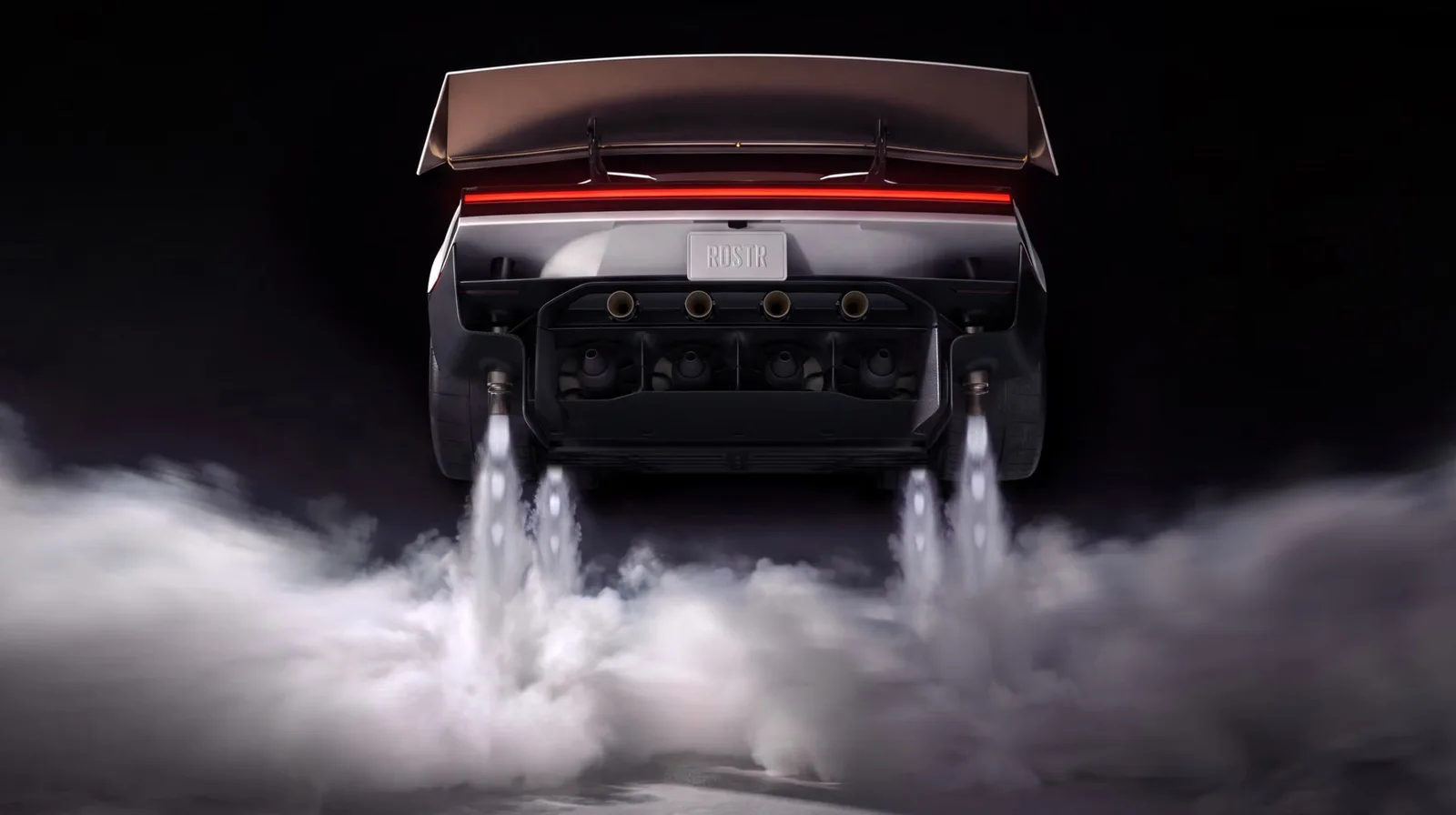
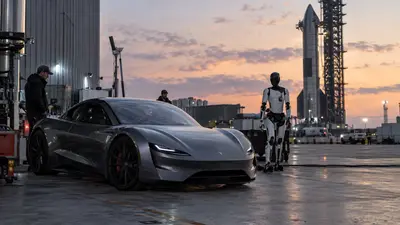
On Oct. 15, 2026, Tesla's new Roadster surprised viewers. The car ran upside down, jumped into the air, changed its attitude and landed. It looked like a movie scene, but it was a demonstration with a real prototype.
Tesla drivers may have had a different thought watching it: "What if even one of those technologies came to my car?"
What if parking took almost no steering, charging got faster, and the car gripped the road harder in a panic stop? Driving could change a lot without the car ever leaving the ground.
In its fourth-quarter 2024 official results materials, Tesla marked several technologies, including the Cybertruck's steer-by-wire, as candidates for future vehicles. But a stated direction for future vehicles is not a promise that a specific technology will arrive in the Model 3 or Model Y at a specific time.
Technology 01: Steer-by-wire
A car that does not make you spin the wheel while parking
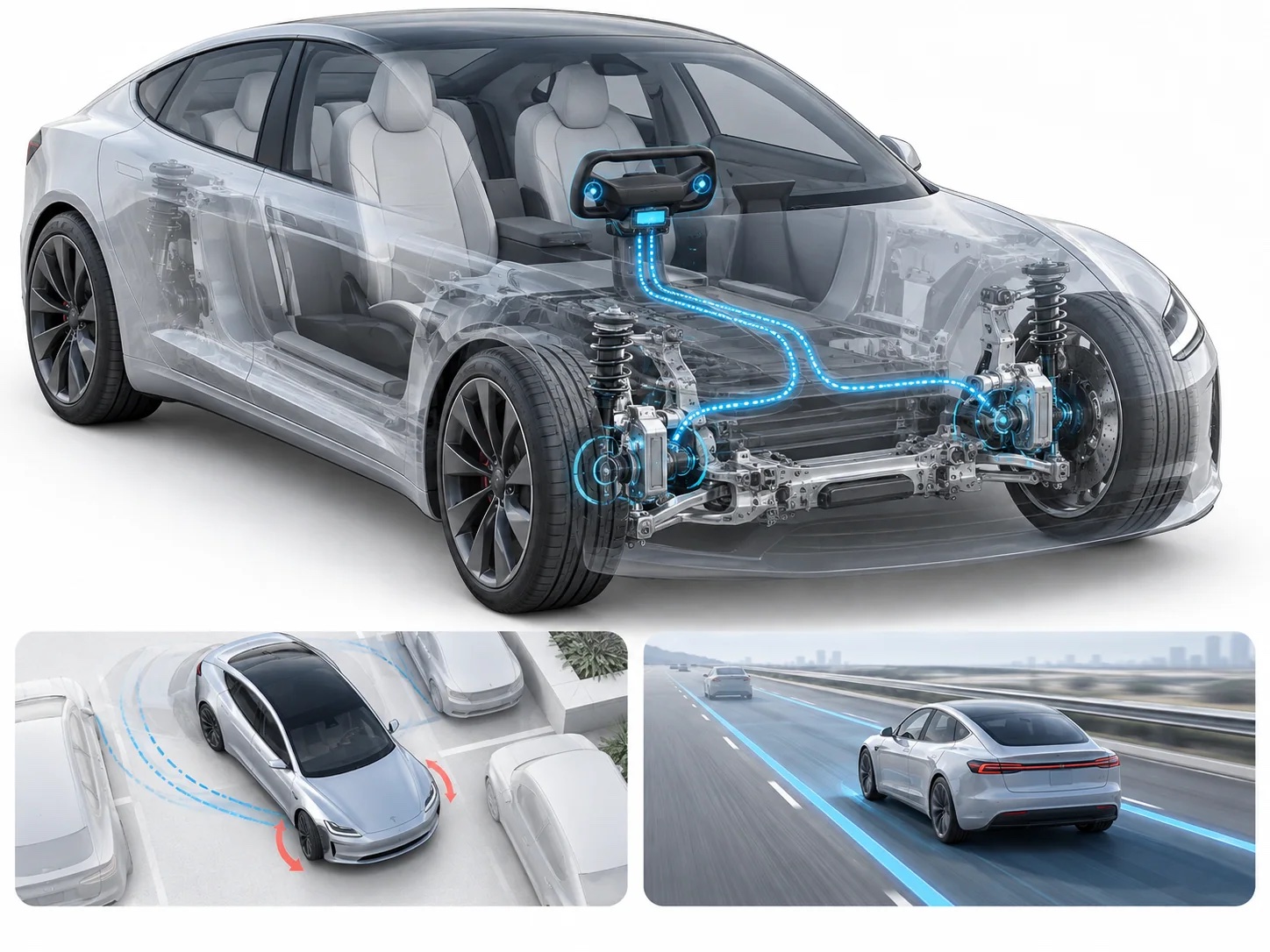
Concept illustration of sensors and drive motors transmitting motion instead of a mechanical link between steering wheel and wheels. An AI-generated concept illustration, not an actual production design or performance-test photo.
Imagine no mechanical shaft between the steering wheel and the front wheels. Sensors read the wheel's movement, and motors turn the tires. This is steer-by-wire. The Cybertruck already uses it.
It helps most in tight parking lots, because a small turn of the wheel can be set to turn the tires a lot. On the highway, the same wheel movement can be made to move the tires less.
The Cybertruck's small turning circle also owes something to rear-wheel steering. Steer-by-wire alone does not make every car pivot in place. And with the mechanical link gone, redundant sensors, redundant power and fail-safe control matter more.
Likelihood of reaching mainstream vehicles: High. The technology has been validated in production, and Tesla has pointed to future vehicles. A Model 3/Y timeline is not confirmed.
Technology 02: 800V high-voltage system
Faster charging, less heat?
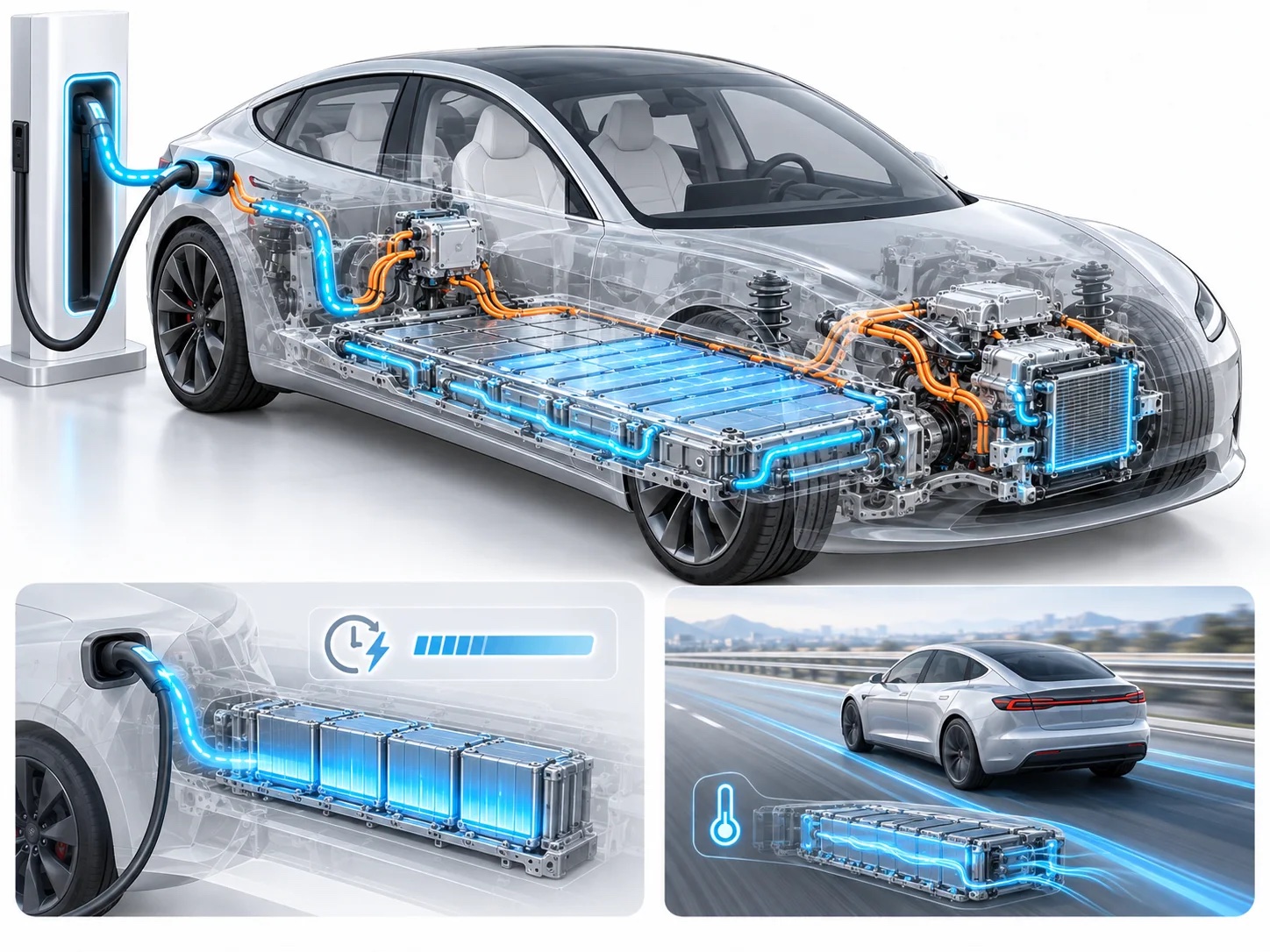
Explanatory illustration of high-voltage wiring, battery cooling and charging paths. An AI-generated concept illustration, not an actual production design or performance-test photo.
Doubling voltage from 400V to 800V can, in theory, halve the current needed to deliver the same power. That offers a chance to cut wiring heat and weight, and it helps with high-power charging.
The Cybertruck already uses a high-voltage architecture. Tesla's manual lists the high-voltage battery's nominal voltage at about 700V. The industry's "800V-class architecture" should not be confused with the actual nominal battery voltage.
Drivers could expect shorter charging waits and more thermal headroom during repeated high-power driving. But double the voltage does not mean half the charging time. Charger output, battery acceptance, temperature and state of charge all have to line up. The Roadster's specific charging-time target also cannot be treated as a confirmed spec for mainstream models.
Likelihood of reaching mainstream vehicles: High to medium. The technology is in production, but when and how far it reaches affordable models depends on cost and product design.
Technology 03: Floor suction fan
What if a car stuck to the road?
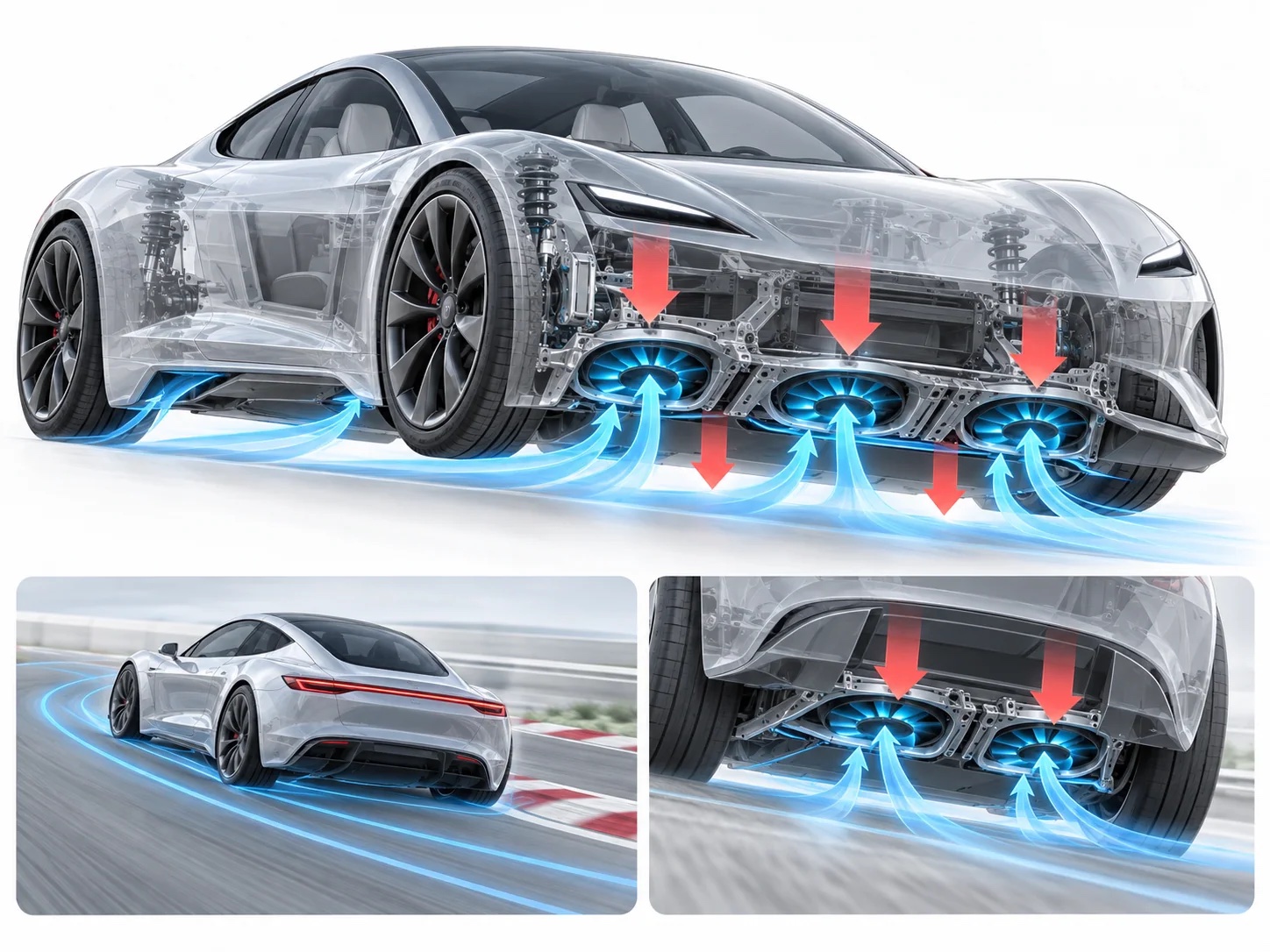
Hypothetical illustration of a floor fan extracting air to create a pressure difference between car and road surface. An AI-generated concept illustration, not an actual production design or performance-test photo.
The most striking moment in the Roadster demo was the car hanging upside down. The principle is like a giant vacuum cleaner. Forcing air out from under the car lowers the pressure there, and the higher outside pressure pushes the car toward the road.
If practical on an ordinary car, it could raise grip in low-speed corners or increase the force tires can pass to the road in an emergency stop. Unlike conventional aero devices, the device itself can create the pressure difference even at low speed.
But real-world effect would vary with tire condition, road surface and how fast the device responds. Fan noise, power use, keeping ground clearance, and dust and debris ingestion remain open issues. The performance of the demo device should not be converted directly into on-road safety performance.
Likelihood of reaching mainstream vehicles: Low. Application to high-performance or special-purpose vehicles first is more convincing than to ordinary passenger cars.
Technology 04: Moving wings
A car that uses air only when it needs to
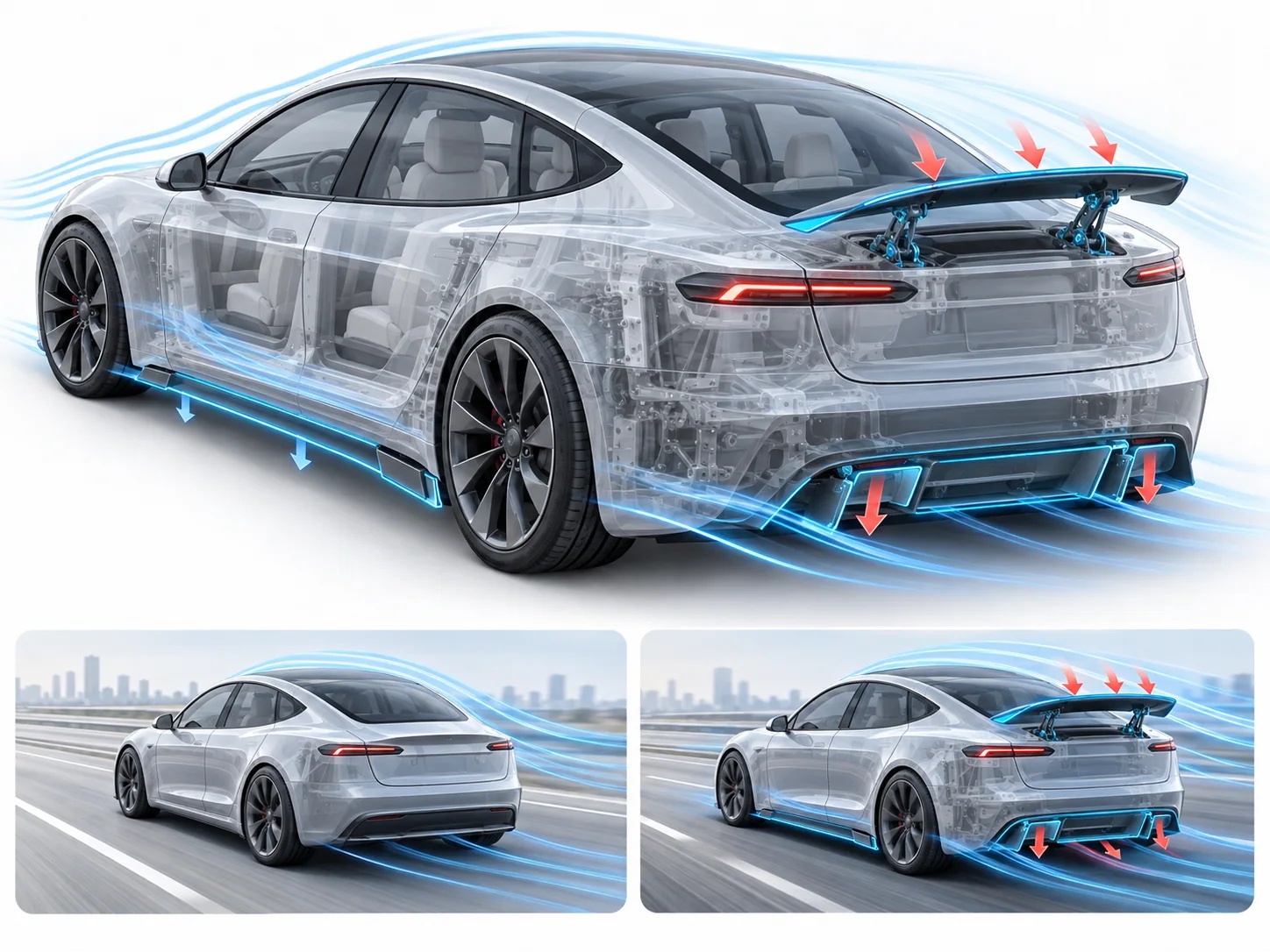
Hypothetical illustration comparing efficient driving with wings folded and high-speed stability with wings deployed. An AI-generated concept illustration, not an actual production design or performance-test photo.
On the highway, less wind resistance is better. But in sharp corners or hard braking, air pressing the car downward helps. The two goals can conflict.
Active aerodynamics moves wings and airflow parts as needed. It lowers drag normally and raises stability in specific situations.
A simplified form is possible on a regular Tesla. But moving parts add weight, cost and potential failures. The claim that a particular Roadster configuration is necessarily cheaper because it shares actuators and parts with Optimus is also not verified production cost data.
Likelihood of reaching mainstream vehicles: Medium. Simple active aero devices are realistic, but there is little basis for putting Roadster-level complexity on a mainstream model.
Technology 05: Cold-gas thrusters
What if a car could jump for a moment?
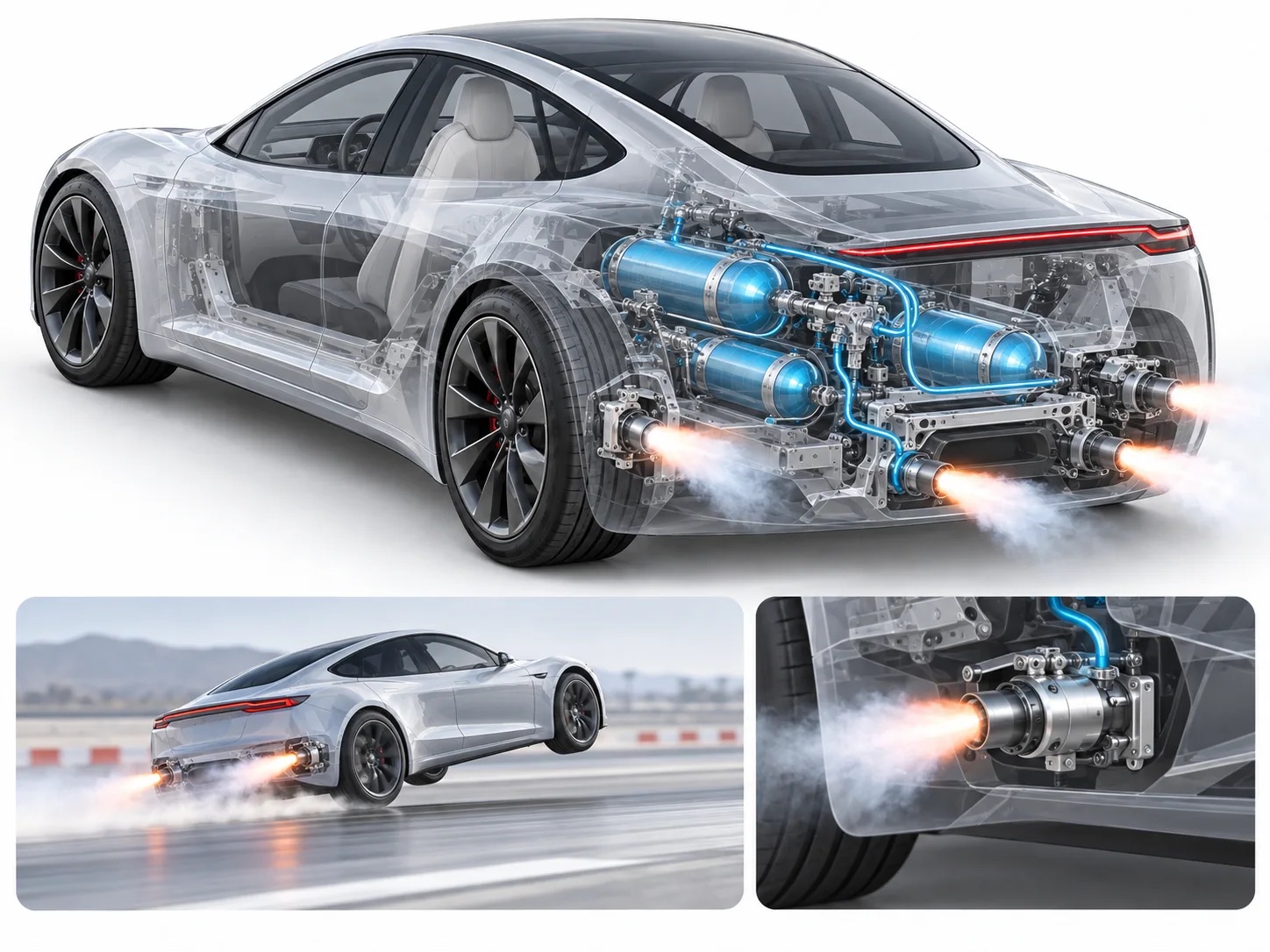
Concept illustration of a high-pressure gas tank and nozzle. Not an actual road-driving scene. An AI-generated concept illustration, not an actual production design or performance-test photo.
Spray high-pressure gas backward and the car is pushed the other way. Spray it down and the car gets an upward force. It is the reaction principle used for spacecraft attitude control.
The Roadster used it to demonstrate dramatic acceleration and mid-air attitude changes. But a brief jump and sustained flight are entirely different engineering problems. The demo was also not a test proving public-road certification or production-car durability.
Counting the space a high-pressure tank takes, refill time, jet noise, safety for nearby pedestrians and certification, the barriers look larger than the benefits for an ordinary passenger car.
Likelihood of reaching mainstream vehicles: Very low. It is more reasonable to see it as something that adds to the Roadster's symbolic technical appeal.
The feasibility ratings are the editors' qualitative judgments based on public information, not Tesla's official launch probabilities. Illustrations are hypothetical depictions to aid understanding.
Insight Times Editorial Desk