Tesla's Future Isn't Cars: Musk's Giant Bet on Robots and Space
From a flying Roadster to Cybercab, Optimus and SpaceX, how far can Tesla's valuation stretch? The size of the vision matters less than the odds it arrives and the price paid today.
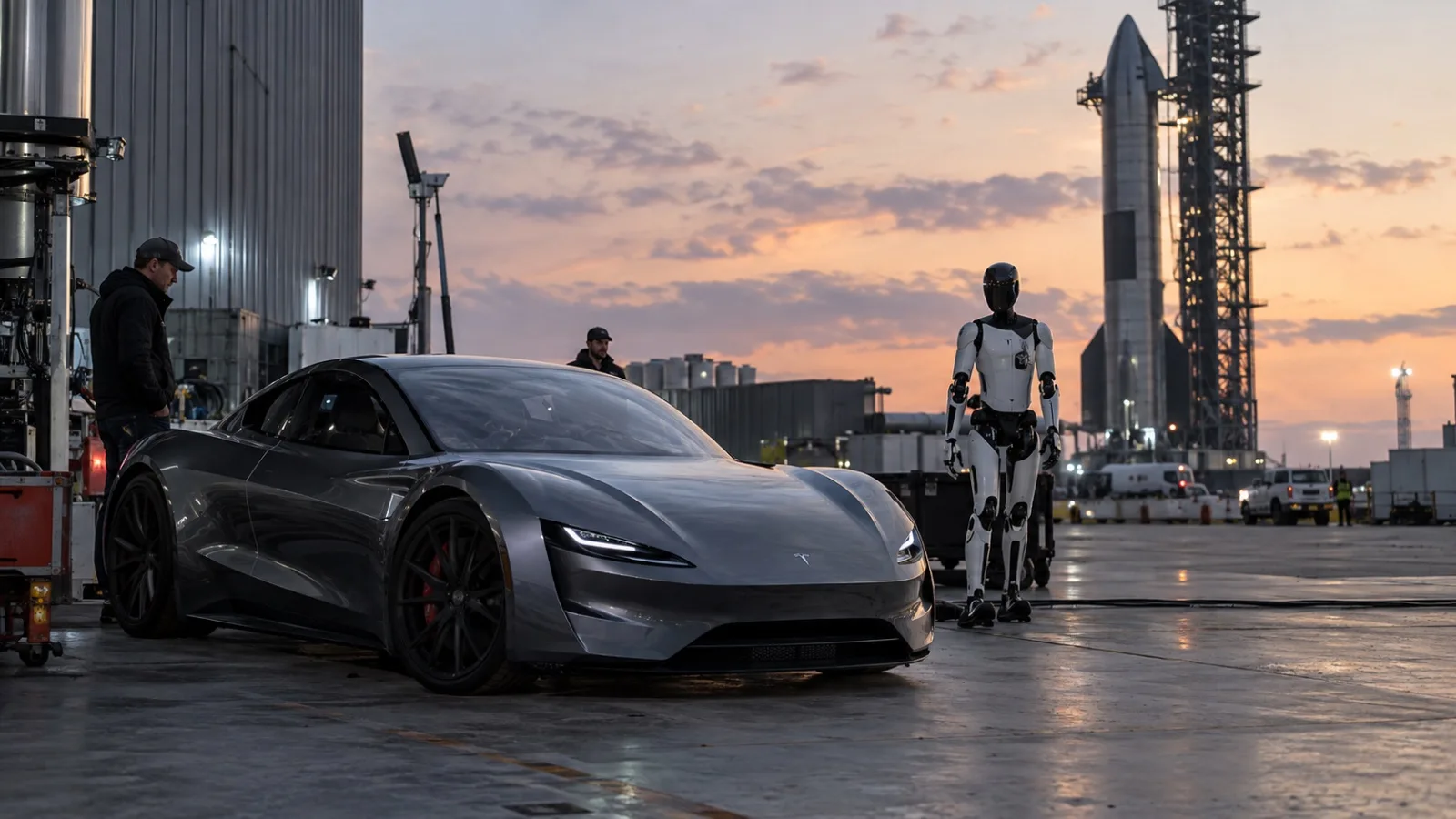
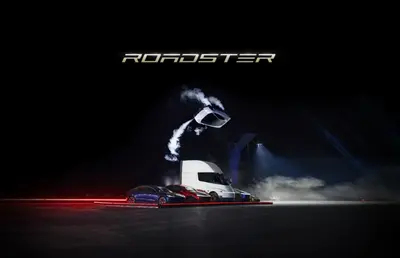
Tesla unveiled a new Roadster after nine years. It spun in midair and cleared five cars in a jump. But the question for investors is not how high the car leapt.
The bigger question is whether Tesla can turn from a carmaker into an industrial platform built on AI and robotics.
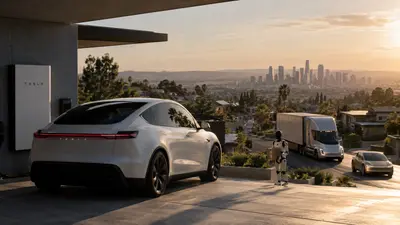
In Elon Musk's picture of the future, self-driving cars move people, humanoid robots do labor, and solar and batteries supply the energy. Connect SpaceX's launch technology, and industrial infrastructure could extend beyond Earth.
It is an interesting future. But business potential and investment returns are separate things. What follows examines how feasible the vision is, and how much of it is already in Tesla's share price.
1. The Roadster shows Tesla's direction, not the future of cars
On Oct. 15, at a SpaceX test facility in Texas, Tesla unveiled the second-generation Roadster. It demonstrated driving upside down and changing attitude in the air, using suction fans under the car and cold-gas thrusters. The demonstration itself is confirmed. Sustained flight capability, and identical performance in a production car, are not.
The Roadster was presented in a base Performance trim, a Thrust trim that uses the thrusters, and a Rocket configuration for invited customers. The most powerful setup may face limits on use on public roads. The production target is 2028.
The message for investors is clear. The Roadster is unlikely to become a mass-market car selling hundreds of thousands a year. It looks more like a technology showpiece, displaying engineering cooperation with SpaceX, high-performance control systems, actuators and new manufacturing methods.
Sharing technology does not mean a merger, though. Two companies co-developing a product is a very different matter from shareholders sharing the economics.
2. What Tesla's 2025 financials say
Tesla's 2025 consolidated revenue was $94.827 billion, down from $97.69 billion in 2024. Automotive and services stalled, while energy storage grew.
- 2025 consolidated revenue: $94.83B, down 2.9% year on year
- Energy revenue: $12.77B, up 26.6%
- Energy gross margin: 29.8%, versus 26.2% a year earlier
- Q2 2026 free cash flow: -$1.09B, with capex of $5.79B
Energy's 29.8% gross margin was well above the 16.2% in automotive and services. But it includes a $1.12 billion US manufacturing tax credit that lowered costs, so profitability risk from policy changes needs to be viewed separately.
Investment pressure grew in 2026. Second-quarter revenue was $28.236 billion, but operating margin was only 1.4%. Capex rose to $5.789 billion and free cash flow turned negative. Cash and short-term investments are still substantial at $43.524 billion.
The conclusion is not that Tesla lacks cash. It is that spending on future businesses is running ahead of their commercialization.
3. Cybercab and Optimus: both AI, but different timelines to profit
Cybercab aims to cut vehicle cost and operating cost and to earn recurring revenue from autonomous ride services. The key shift is from selling a car once to earning each time transport demand arises.
| Role | |
|---|---|
| Cybercab | Mid-term growth engine: ride services and an autonomous network |
| Optimus | Long-term growth engine: automation of physical labor |
In the third quarter of 2026, Tesla delivered 486,532 vehicles and deployed 13.7 GWh of energy storage. Those figures alone cannot show whether the robotaxi business is succeeding. The number of paid vehicles in service, the rate of safety-monitor intervention, and revenue and maintenance cost per vehicle all need separate confirmation.
Regulation is no small hurdle. The National Highway Traffic Safety Administration is reviewing allegations of speeding near schools and whether Cybercab complies with vehicle safety standards. Robotaxi expansion depends on crash response and regulatory trust as much as on manufacturing.
Optimus addresses a wider potential market. Morgan Stanley has projected that the global humanoid market could reach about $5 trillion by 2050, an estimate based on a long-term assumption of about 1 billion units. But that is the potential market for the whole industry, not Tesla's confirmed revenue.
There is a large gap between a robot that can walk or pick up objects and one that works reliably eight hours a day in a factory. Finger actuation, task success rates, repair costs, safety and the actual effect on replacing labor all need verification.
| Investor lens | Cybercab | Optimus |
|---|---|---|
| Core revenue source | Fares, network services | Robot sales, leasing, labor savings |
| Main bottleneck | Unsupervised operation, regulation, operating cost | Production yield, general-purpose capability |
| Value check | Revenue and profit per vehicle | Hourly productivity and payback |
| Time horizon | Medium term | Long to very long term |
4. How big could Tesla's 2030 revenue get?
Combining assumptions by business gives a range of $200 billion to $350 billion in consolidated revenue for 2030. This is not an analyst consensus. It is a scenario in which each business grows as planned.
2030 revenue assumptions by business (scenario estimate ranges, not official guidance)
- Vehicles and FSD: $80B to $120B
- Robotaxi: $40B to $100B
- Energy: $40B to $80B
- Optimus: $10B to $40B
- Services and other: $30B to $50B
Uncertainty around each business is large, and the total may double-count service revenue.
What matters in this model is not adding up big numbers. It is checking whether each business's revenue is truly independent, whether platform income and vehicle sales are counted twice, and how much capex and operating cost the growth requires.
In valuing a company, the cash that ultimately remains for shareholders matters more than what multiple of revenue to pay.
Suppose robotaxis generate $100 billion in annual revenue. If the company owns the fleet itself, it bears depreciation, maintenance, insurance, charging and vehicle replacement. Assuming all platform revenue carries software-like margins is aggressive.
5. A SpaceX merger: attractive technically, but good for shareholders?
After the Roadster reveal, talk of a Tesla-SpaceX merger grew. Wedbush's Dan Ives put the odds of the two combining by 2027 at around 80%. Barclays has also analyzed a possible merger. Neither company has announced a formal merger plan.
The two do share important technology: Tesla's AI, batteries and robotics, and SpaceX's launch, communications network, materials and propulsion.
In a merger, though, the exchange ratio and capital allocation, more than technical synergy, can decide returns for existing shareholders. If SpaceX is valued richly and Tesla issues a large number of shares, existing Tesla holders could be diluted even as the combined business grows.
Specific estimates of SpaceX's cash burn are circulating, but a private company's financials are harder to verify than a public one's. Rather than treating unconfirmed estimates as established losses, it makes more sense to treat them as a reason for financial due diligence.
6. Musk's endpoint is a Kardashev Type II civilization
The Kardashev scale ranks civilizations by the amount of energy they can harness. A Type II civilization uses a star's output, such as the sun's, at large scale.
Translated into industrial structure, Musk's vision looks like this:
- Superintelligence plus general-purpose robots: automation of design, production, assembly and operations labor
- Large-scale energy plus autonomous infrastructure: expansion of solar, batteries, transport and rocket manufacturing
- Orbital computing and a space economy: space data centers, space solar, interplanetary logistics
The logic is understandable. If AI improves design and robots lower manufacturing cost, more solar capacity, rockets and space infrastructure could be built.
But being technically possible does not make something economically advantageous. Space AI data centers face problems beyond launch cost: heat rejection, communication latency, maintenance, space radiation and the cost of replacing failed units. Space being cold does not automatically solve the waste heat of large computing hardware.
A 2039 integrated space-economy scenario is useful for understanding Tesla's strategic imagination. The uncertainty is too great for it to serve as a base case for pricing the stock today.
The bottom line
Judged by the size of its future alone, Tesla is a strikingly attractive company. But investing does not buy the size of the future. It buys the gap between the probability that future arrives and the price paid now.
That is why Tesla's next decade is interesting. For now, the work is imagining how large a market robots and space might create. Next, that imagination has to prove how much of it turns into revenue, operating profit and free cash flow.
Insight Times Editorial Desk