Stocks Rebound, but AI Chips Sit Out as Investors Weigh the Price of Growth
The Dow rose 1.08% and the Nasdaq edged up 0.08% on Oct. 15. Chip stocks fell despite a hot PPI report, falling yields and a 69% jump in TSMC profit.
Stocks rose, but not everything did
U.S. stocks recovered on Oct. 15 from the previous day's sharp drop. The Dow gained about 562 points, and the small-cap Russell 2000 rebounded more than 1%. The tech-heavy Nasdaq barely moved.
| Index / ETF | Close | Change |
|---|---|---|
| Dow | 52,177.69 | +1.08% |
| S&P 500 | 7,744.06 | +0.33% |
| Nasdaq | 26,713.03 | +0.08% |
| Russell 2000 | 2,767.27 | +1.38% |
| QQQ | $728.00 | -0.13% |
| SOXX | $514.71 | -0.91% |
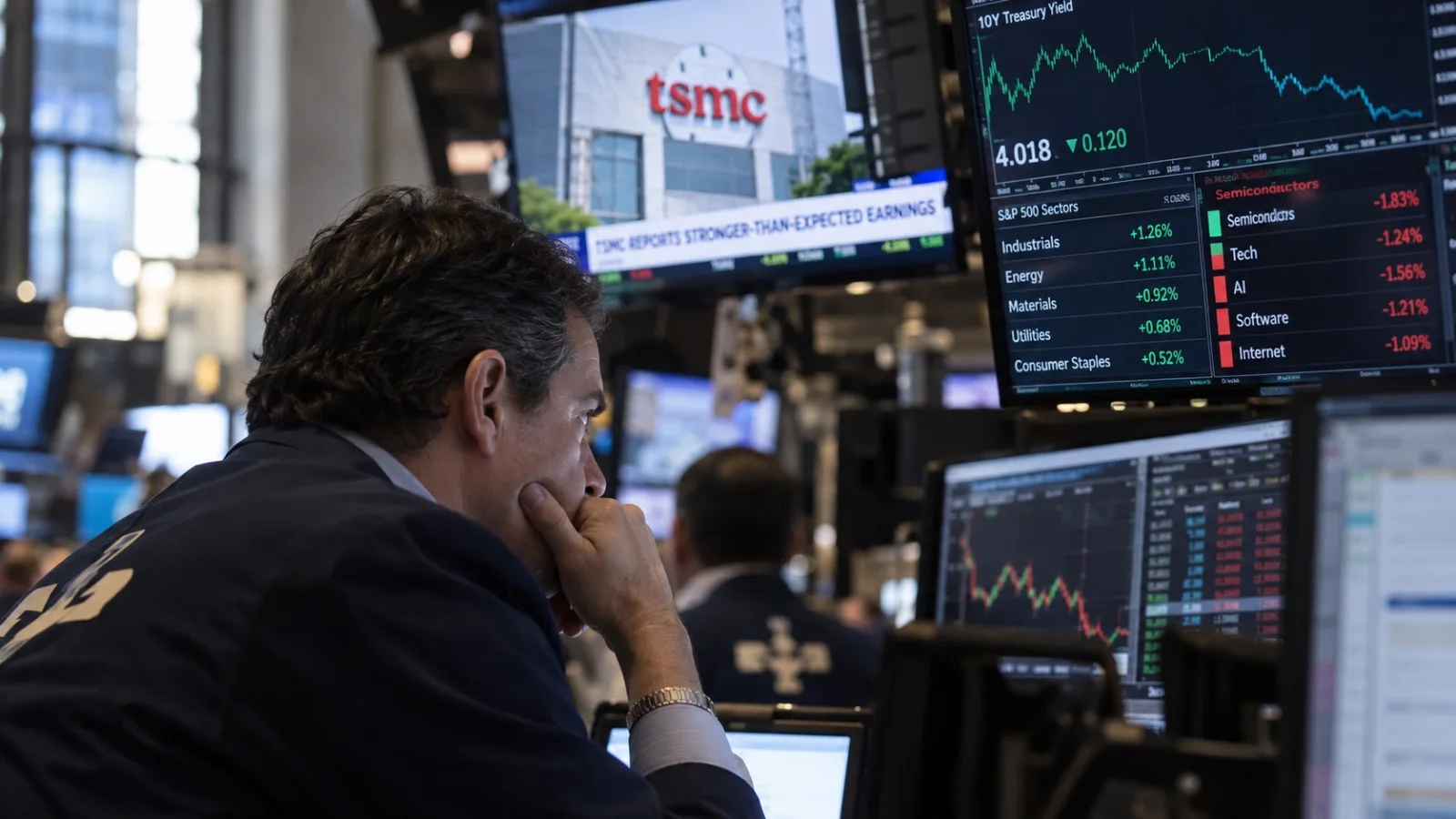
Health care (+1.9%), materials (+1.8%) and financials (+1.4%) led the gains. The technology sector fell about 0.7%.
The split matters. Investors did not abandon stocks as a whole, but they did not aggressively buy back the tech names that have led the market. Defensive and cyclical sectors rose together, which looks less like a simple flight to safety on recession fears and more like a rotation that reduces concentration in tech.
The first paradox: inflation scares, yet Treasury yields fell
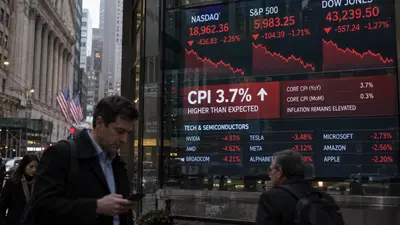
The Bureau of Labor Statistics said the September producer price index rose 1.3% from the previous month. That is the largest monthly gain since March 2022. The annual rate reached 6.3%. Higher energy prices were a big factor, but core prices were also high.
Even so, the 10-year Treasury yield fell about 10 basis points to roughly 5.09%.
Stronger-than-expected inflation usually raises worries about rate hikes and pushes long-term yields up. Not this time.
A mix of slowing-growth concerns, demand for long-dated Treasuries and a reassessment of the rate path may have played a role. Without data on who actually bought bonds, it is hard to pin the decline on a single cause.
The more important fact is that Nvidia and TSMC did not bounce even as yields fell.
If rates were the only weight on tech, a 10 basis point drop in long-term yields would have been a meaningful cushion. But the market was also weighing the return on AI investment and the funding burden on companies.
The second paradox: TSMC set records, and the stock fell
TSMC's third-quarter results were strong.
- Revenue growth, year over year: +50.9% (NT$1.4942 trillion)
- Net income growth, year over year: +68.7% (NT$763.1 billion)
- Gross margin: 66.4%, down 1.3 percentage points from the prior quarter
- U.S. ADR price: $422.25, down about 1.80%
Figures are from TSMC's official consolidated results for the third quarter of 2026. Growth rates are in Taiwan dollars and differ from growth in U.S. dollar revenue.
Results beat expectations. But investors were not satisfied by the fact that AI chip demand is growing.
Questions are growing about whether customers building AI data centers can keep spending heavily, how large financing costs become if that money is borrowed, and when the invested funds turn into actual cash flow.
The spotlight on funding strains at AI infrastructure operators such as Oracle and CoreWeave fits that context. Still, there is not enough evidence to say TSMC's decline came from the credit risk of any one customer.
A good company posting good results does not always produce a good investment return. If high growth expectations are already in the price, strong results need something more to lift expectations further.
Have chips found a bottom?
SOXX fell as low as $495.78 intraday before closing at $514.71, a rebound of about 3.82% from the low. Volume rose about 59% from the previous day.
Dip buying is a positive sign. But the close was still 0.91% below the prior day. A bounce off a low is not the same as the end of a downtrend.
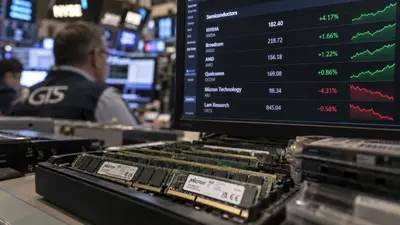
Nvidia also slid to $212.85 before closing at $217.23 (-1.84%). Micron, by contrast, rose about 1.9%.
AI accelerators, foundry and memory did not move in the same direction. That makes it harder to treat semiconductors as a single investment theme.
Levels to watch
| Stock | Close | First support candidate | Recovery confirmation candidate |
|---|---|---|---|
| Nvidia (NVDA) | $217.23 | $212-213 | $224-229 |
| Tesla (TSLA) | $362.44 | $353-355 | $370-375 |
| QQQ | $728.00 | $715-718 | $739-743 |
| SOXX | $514.71 | $495-500 | $517-520 |
Nvidia trades below both its 5-day moving average (about $224.53) and its 20-day (about $228.58). Reclaiming $224-229 is the first hurdle, and holding $233-235 could be evidence of a further improvement in trend.
Tesla fell 1.29% to $362.44. It was weak even as long-term yields eased, but one day's price action is not enough to say new bad news hit electric-vehicle demand or its autonomy business. Anticipation and caution ahead of the Roadster unveiling and next week's earnings are also a factor.
A move back to $739-743 for QQQ and $517-520 for SOXX would be the zone that confirms an early rebound. SOXX's 20-day average, at about $561.96, sits far above the close. Even if a short-term bounce comes, medium-term downward pressure does not vanish at once.
These price ranges are technical observation zones based on daily chart data. They are not trading targets or guaranteed rebound lines.
Takeaway
Stocks rebounded. But the rebound did not come because inflation worries faded, or because doubts about the AI industry were resolved.
The message from Oct. 15 is fairly clear. The potential of AI growth remains large, but what investors will pay for that growth is getting much stricter.
Insight Times Editorial Desk