Micron Falls 3.62%, Nvidia Gains 0.97% as CXMT News Splits Chip Stocks
The S&P 500 barely moved, but memory and AI compute chips went opposite ways after China's CXMT showed progress in DRAM design. Financials also weakened after bank earnings.
1. Index was quiet, the inside was not
| Index | Close | Change |
|---|---|---|
| S&P 500 | 7,805.45 | -0.02% |
| Nasdaq | 27,204.38 | -0.15% |
| Dow | 51,670.10 | -0.35% |
| Russell 2000 | 2,783.37 | -0.40% |
The S&P 500 slipped just 1.79 points. The small-cap Russell 2000 fell 0.40%. Money did not flow evenly across the market. Buying concentrated in a handful of large stocks.
The VIX rose only 0.39% to 15.27. This looks less like broad risk aversion and more like a reassessment of growth expectations and valuations in specific sectors.
2. The CXMT shock: why a technology announcement hit Micron
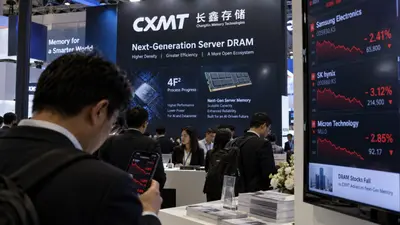
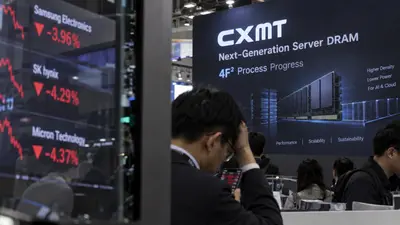
China's CXMT disclosed progress on a next-generation DRAM cell structure known as 4F². Compared with the existing 6F² layout, the design can in theory cut cell area by about 33% at the same feature size.
CXMT said it plans to show server DDR5 RDIMM products using the technology by year-end. A smaller cell means the potential to make more memory from the same wafer. That could affect production cost and supply.
The path runs in three steps: design (technical possibility), mass production (yield and quality), and market (price and share).
The public information is not enough to confirm mass-production yield, volume or product competitiveness.
Micron fell 3.62% to $953.19. That followed a 3.88% drop the day before, a second straight large decline. Investors appear to fear less a near-term drop in memory demand than the chance that expanded Chinese capacity weakens incumbents' pricing power.
Still, the CXMT announcement alone is hard to read as a blow to Micron's HBM competitiveness. Server DDR5 and the HBM used in AI accelerators have different product requirements and supply chains.
3. Why Nvidia and AMD rose
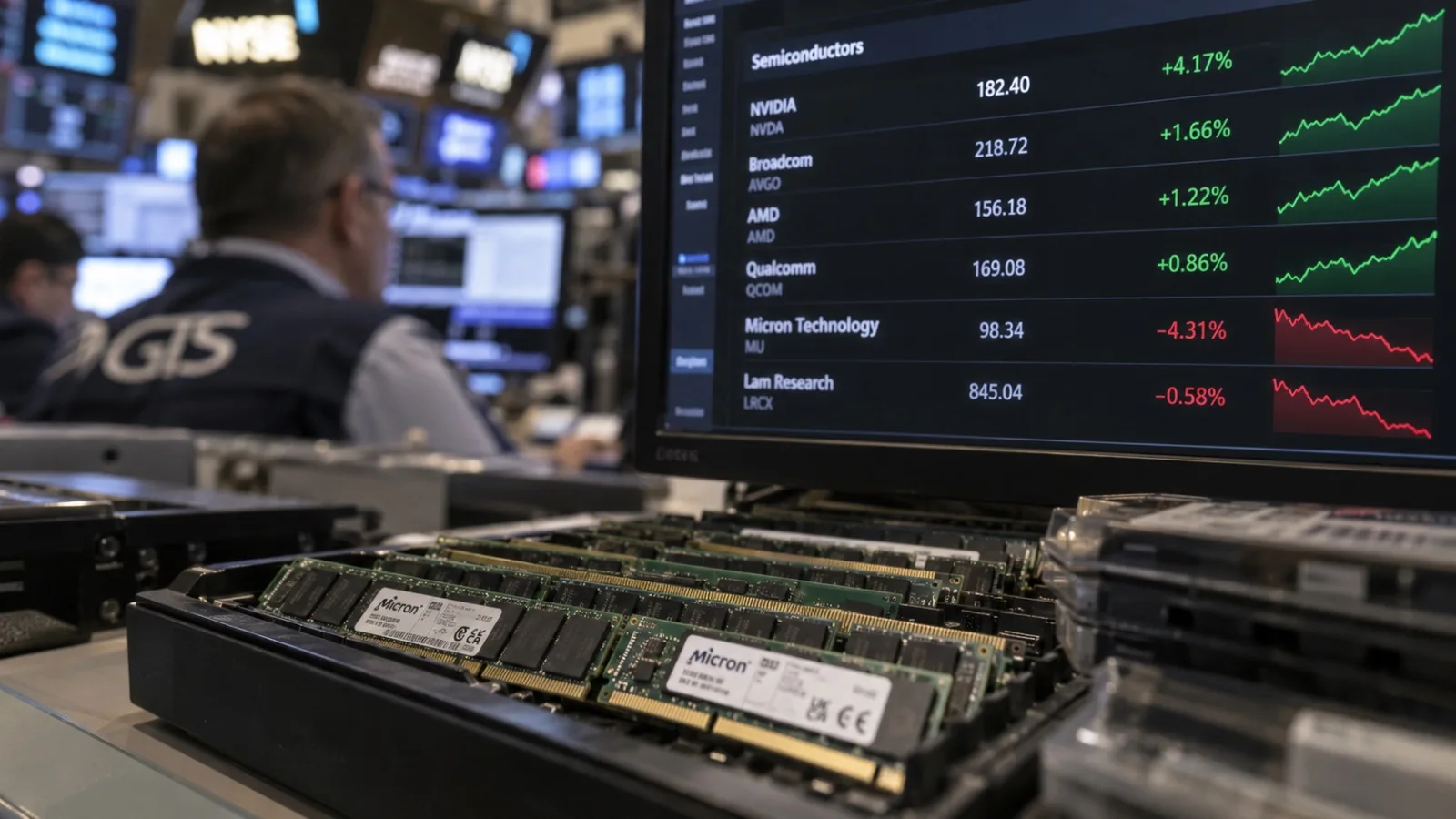
- Micron (MU): -3.62%
- Nvidia (NVDA): +0.97%
- AMD: +1.90%
- Broadcom (AVGO): +0.73%
Supply competition weighs on memory makers, but it is not necessarily bad news for AI compute chipmakers.
Cheaper memory could, over time, lower the cost of building AI servers. That is a scenario that depends on price cuts and supply expansion actually arriving.
The market did not give up on AI spending as a whole. It priced risk differently for different companies within the same AI supply chain.
4. Bank earnings: profits are there, but the market asks about the future
JPMorgan's third-quarter net income rose from a year earlier, but reported EPS of $5.57 missed the consensus of about $5.93. Wells Fargo narrowly beat on EPS but missed on revenue. Goldman Sachs and Citigroup reported relatively solid results.
Even so, financials were weak overall. Investors put more weight on high borrowing costs, refinancing risk and future credit costs than on current strength in consumption and business activity.
The pattern resembles chips. Investors are asking less about current earnings than about whether those earnings can hold next year.
5. Rates and oil: the backdrop weighing on the market
The 10-year Treasury yield fell about 2 basis points to roughly 5.22%. The absence of a further rise cushioned stocks. But a long-term yield above 5% remains a burden on growth-stock valuations and corporate funding.
Brent crude rebounded to $106.26 a barrel at 6:43 p.m. ET, after the regular session closed. Moves in oil after the close should be read separately from regular-session trading.
Rather than blaming the day's weakness on a single jump in yields, it is more fitting to see an environment where already high rates and energy costs have made investors more sensitive to individual negatives.
Insight Times Editorial Desk