Record-High Index, Shaky Chips: A Week to Prove AI Earnings Against 5% Yields
The S&P 500 sits just below a record while semiconductors slide, the 10-year Treasury yield tops 5.2% and oil trades above $100. CPI, ASML and TSMC will test what investors are willing to pay for AI growth.

US stock market weekly outlook | Oct. 12-16
US stocks have reached an odd fork. The S&P 500 is just below its all-time high, but semiconductors, the leaders of the rally, have fallen sharply. The 10-year Treasury yield has topped 5.2%, and oil is trading above $100 a barrel.
Corporate earnings are improving, yet shares are wobbling. Has faith in AI growth vanished? It is too early to say so. What the market is recalculating is less AI's growth potential than how much to pay for that growth.
This week's US consumer price report and earnings from ASML and TSMC are likely to offer important clues.
1. The index is strong, but the market underneath is weak
On Oct. 9, the S&P 500 closed at 7,811.54, just 0.1% short of its record close of 7,818.93. The Nasdaq Composite held at a high level, closing at 27,366.17.
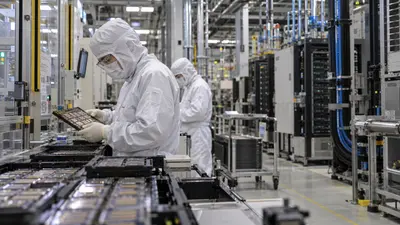
But the Russell 2000 fell 0.9% last week, and chip stocks saw profit-taking. Nvidia, AMD and Micron, names that led this year's AI investment fervor, moved against the index.
| Index | Week ended Oct. 9 |
|---|---|
| S&P 500 | +1.2% |
| Nasdaq | +0.6% |
| Dow | +0.9% |
| Russell 2000 | -0.9% |
The gap matters. If a handful of large caps lift the index while small caps and chips weaken, the rally may be narrowing.
Still, there is not enough evidence to conclude that the AI investment cycle has peaked because chips fell. Real demand and the expectations already priced into shares need to be kept apart.
2. 5% yields and $100 oil: a new test for AI stocks
The 10-year Treasury yield climbed to around 5.24% last week. Brent crude traded near $104 a barrel.
Higher yields lower the present value of future earnings. The burden is heaviest on companies that carry high price-to-earnings multiples on expectations of explosive growth years from now.
Oil is another variable. If high prices persist, transport and production costs rise and household spending power shrinks. That can squeeze corporate profits and make it harder for the Fed to deal with inflation.
One distinction matters here. A good company can be vulnerable to rising yields if its stock is expensive. Conversely, even with high yields, shares can hold up if earnings grow faster than expected.
The most useful formula for reading the market this week:
- Earnings outlook: revenue growth, margin improvement, cash-flow growth
- Discount rate: long-term yields, inflation expectations, risk premium
Even if the earnings outlook improves, shares can fall if the rise in the discount rate counts for more.
3. Wednesday's CPI could reset the price tag on stocks
The September consumer price index is due Wednesday, Oct. 14, at 8:30 a.m. ET.
The market expects headline inflation of about 3.6% to 3.7% from a year earlier. High energy prices are pushing up the overall figure, while core inflation, which excludes energy and food, could be relatively stable.
Investors will look most closely at the month-over-month core reading. A gain around 0.2% would suggest limited price pressure. A reading of 0.3% or more, with services inflation accelerating, could stoke fears of further tightening.
One day's CPI does not settle the Fed's next decision. Slowing hiring, oil and consumer spending will all be weighed together.
In the end, the direction of the 10-year yield after the release, and how long that move lasts, is a more important signal than the immediate swing in stocks.
4. ASML and TSMC show the real strength of AI demand
In semiconductors, ASML on the 14th and TSMC on the 15th matter most.
In July, ASML raised its full-year revenue outlook to 43 billion to 45 billion euros. Its third-quarter revenue guidance is 11 billion to 12 billion euros, with a gross margin outlook of 55% to 57%. The numbers reflect rising capital spending on AI chip production.
What investors need to check is 2027, more than the third quarter already behind us. If TSMC and the memory makers expand capital spending next year too, earnings visibility for chip equipment could improve.
TSMC's revenue is already strong. Third-quarter revenue, released Oct. 8, was about 1.49 trillion Taiwan dollars, or roughly $46.7 billion, up about 50% from a year earlier. That also beat market expectations.
But the stock market may not be satisfied with record revenue alone. In Thursday's report, gross margin, the fourth-quarter revenue outlook, advanced packaging capacity and future capital spending will matter.
TSMC's third-quarter gross margin guidance is 65% to 67%, below the 67.7% actually posted in the second quarter. The key is how it absorbs rising costs from overseas fabs and the expansion of advanced process nodes.
Even with strong demand for AI chips, profit growth can slow if production costs rise faster than expected. That is why AI growth and chip share prices do not necessarily move at the same speed.
5. Bank earnings show the US economy outside AI
JPMorgan, Goldman Sachs and Wells Fargo report on the 13th, followed by Bank of America and Morgan Stanley on the 14th.
Banks can grow net interest income with high rates. But borrowers face a heavier burden, which brings the risk of weaker loan demand or more delinquencies.
That is why provisions for loan losses, consumer delinquency rates, loan demand and corporate funding conditions all need to be read together.
If banks show solid results and healthy credit, the rally could broaden from AI megacaps to financials and cyclicals. If credit deterioration shows up, the gap between a strong index and the real economy could widen.
6. Key events this week
| Date | Event | Numbers to watch |
|---|---|---|
| Mon., Oct. 12 | US stock market open as normal; cash Treasury market closed | Volume, conviction behind price moves |
| Tue., Oct. 13 | Bank earnings, including JPMorgan and Goldman Sachs | Loans, delinquencies, net interest income |
| Wed., Oct. 14 | ASML earnings | Full-year outlook, 2027 investment demand |
| Wed., Oct. 14, 8:30 a.m. ET | US September CPI | Core CPI, services inflation |
| Thu., Oct. 15 | TSMC earnings call | Gross margin, fourth-quarter outlook |
| Thu., Oct. 15 | US PPI, retail sales | Business costs, consumer capacity |
The New York Fed manufacturing index is due on the 15th, not the 16th.
This is not a week for forecasting AI's future anew. It is closer to a check on how much of that future is already in today's share prices.
Wednesday tests the discount rate. Thursday tests the quality of earnings. Reading the two together should give a clearer sense of what the record index means and what kind of correction chips are in.
Insight Times Editorial Desk