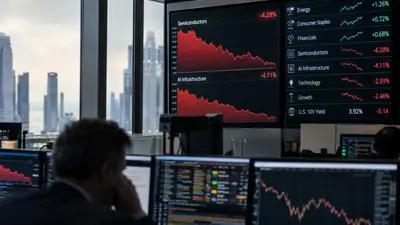
Stocks Rose, but the Market's Insides Told a Different Story
A 5.24% 10-year yield, bank earnings on Oct. 13 and September CPI on Oct. 14 are the first tests for a market that closed the week higher but narrowly.

Weekly U.S. market check, part 2
- Stocks rebounded, but the inside of the market was mixed. On Oct. 9 the Dow rose 0.83%, the S&P 500 0.59% and the Nasdaq 0.64%. The Russell 2000 fell for the week, and telecom stocks dropped on news of SpaceX's spectrum purchase.
- A 5.24% yield is pressuring the market. The Fed raised rates in September, and inflation and oil prices remain uncertain. Next week's CPI is an important test for growth-stock valuations.
- Tesla closed at $382.70. It gained about 3.27% for the week. Ahead of earnings on Oct. 21, the key items are auto profitability and real progress in AI businesses.
1. Oct. 9: Indexes rose, but not every stock did
| Index | Close | Change |
|---|---|---|
| S&P 500 | 7,811.51 | +0.59% |
| Nasdaq | 27,366.17 | +0.64% |
| Dow | 51,654.95 | +0.83% |
All three major U.S. indexes posted weekly gains. The S&P 500 set a record close on Oct. 6 and stayed near those levels after some swings.
The strength did not spread across the whole market. The Russell 2000 fell over the week. On Oct. 9, T-Mobile, AT&T and Verizon dropped sharply after SpaceX announced a deal to acquire mobile spectrum. The three fell roughly 8.8% to 13.3% that day.
Apple also slid 1.1% that day on reports of reduced iPhone component production.
This was a week when the stocks that failed to rise mattered more than the fact that the market rose.
2. Next week's first test is banks, not Nvidia
Wall Street now enters third-quarter earnings season. According to LSEG, combined third-quarter net income for S&P 500 companies is expected to rise about 30.6% from a year earlier.
Tech companies are forecast to grow earnings 66.5% and energy companies 123%. These are market estimates, not confirmed results.
But the first test comes from the big U.S. banks, not AI chipmakers.
JPMorgan, Goldman Sachs, Citigroup and Wells Fargo are scheduled to report on Oct. 13. Morgan Stanley and Bank of America follow on the 14th.
For banks, EPS alone is not the point. Investors need to weigh loan-loss provisions, corporate loan demand, credit card delinquencies, net interest income and investment banking fees together.
Even without a recession, if high rates have begun to strain households and businesses, the first traces may show up in bank credit metrics. The S&P 500 banks index fell about 7.5% in the month through Oct. 9.
Healthy profits and solid credit quality would be a positive for the market. If instead bad loans rise and loan demand weakens, expectations for the economy could soften regardless of tech earnings.
3. Why CPI matters with the 10-year at 5.24%
On Sept. 16 the Fed raised its benchmark rate by 25 basis points to a target range of 3.75% to 4.00%. The official rationale was that inflation remains elevated.
On Oct. 9 the 10-year Treasury yield was about 5.24%. Higher long-term yields weigh especially on growth stocks, whose value rests more on distant cash flows.
For September CPI, due Oct. 14, a Reuters poll expects headline inflation of 3.7% from a year earlier and core CPI of 2.5%.
Investors need to separate temporary price increases driven by oil from persistent gains in services prices.
Even if oil falls, worries about Fed tightening may not fade easily if services inflation does not cool. If core inflation steadies and bank earnings hold up, the case for the market's strength despite high rates could be reinforced.
4. Tesla at $382.70: time to look at business metrics
$382.70 Up 2.05% on the day | about +3.27% for the week
Tesla rose about 3.27% for the week, from a $370.59 close on Oct. 2 to $382.70 on Oct. 9. In after-hours trading on the 9th it was at $382.73, essentially flat.
A single week of gains is hardly enough to say FSD or robotaxi value has been re-rated.
The $4.05 billion in deferred revenue Tesla disclosed at the end of June covers several items, including internet connectivity, free Supercharging and software updates, as well as FSD-related features. The full amount should not be read as FSD revenue or FSD bookings.
In the Oct. 21 results, the priorities are auto gross margin, profitability in the energy segment and operating cash flow.
For robotaxi, the size of actual paid operations, service areas and safety data matter. For Optimus, investors need official figures that verify production processes and commercial use. There is no reason to dismiss future potential, but demonstrations and results should be kept apart.
5. AI infrastructure and SpaceX: the companies to watch are shifting
In AI data center investment, power, transmission, cooling and optical networking now matter as much as securing GPUs.
If construction is delayed or grid connections come late, even costly accelerators may be slow to run and generate revenue. That is why the question is shifting from the scale of AI capital spending to when the equipment goes live and what it earns.
SpaceX brought a more direct change in competitive structure. After the company announced a deal to acquire nationwide low-band mobile spectrum assets, shares of the three incumbent carriers plunged.
The possibility that a satellite internet provider could expand into mobile service has now entered valuations in earnest. Still, buying spectrum does not mean immediately replacing existing networks. Regulatory approval, service quality, network investment and profitability must follow.
Both AI and space communications have large growth potential, but the time and capital needed to build out the businesses differ.
The week's message
Expectations for AI growth held. But the market now wants to see how long the economy can support that investment.
Next week, signals from bank earnings, inflation and Treasury yields deserve more attention than a single day's index move.
Insight Times Editorial Desk