[Weekly Check] AI Held Up Even at 5% Rates - Now the Market Wants Cash, Not Just GPUs
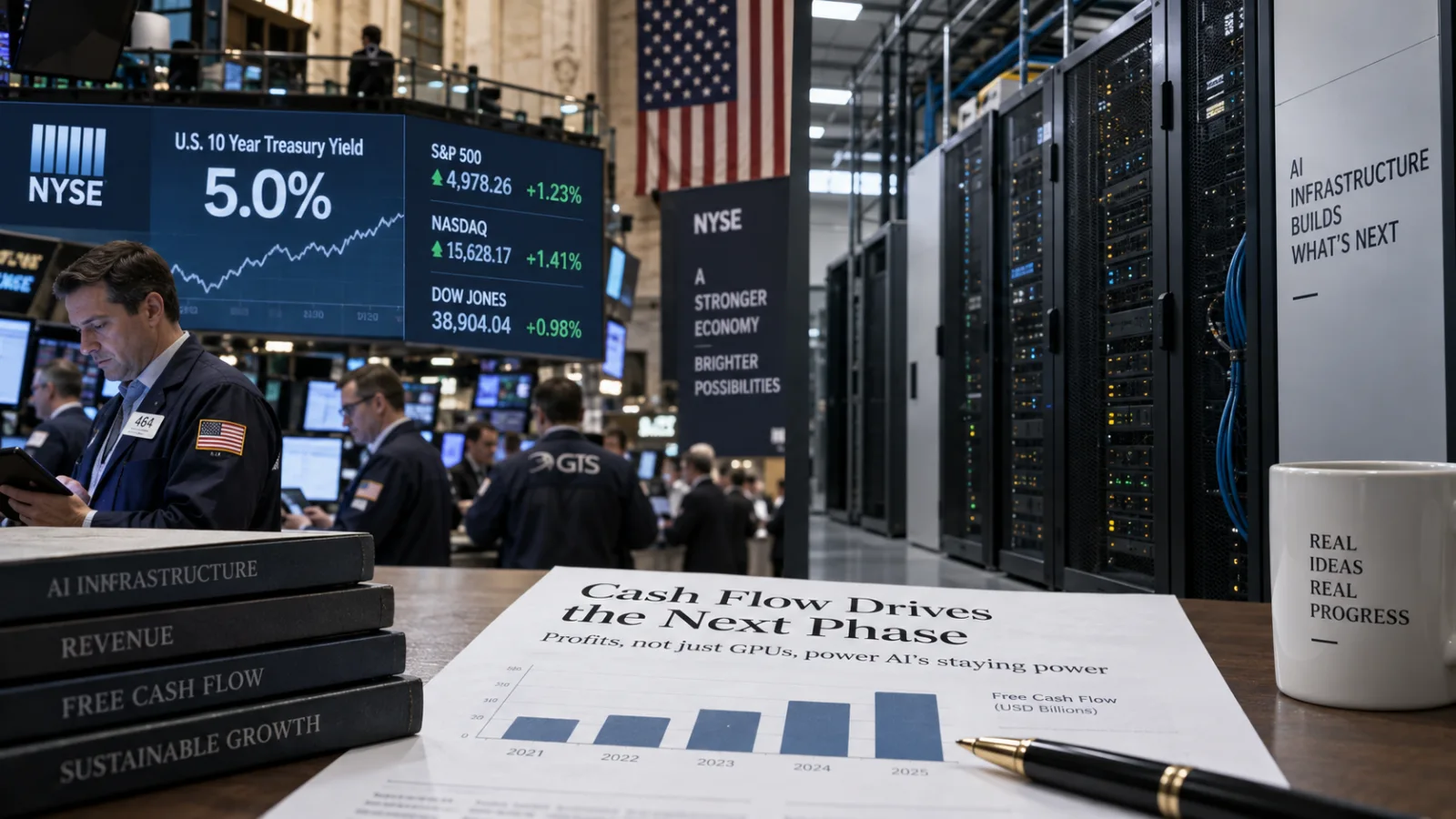
The Fed actually raised rates, and the 10-year is back above 5%. But the Nasdaq did not crack. This week's real story is not the end of the AI rally, but a shift in how the market grades it.
1. The biggest shift this week - AI earnings absorbed the rate shock
At the September 16 FOMC meeting, the Fed raised its benchmark rate by 25 basis points to 3.75-4.00%. The vote was 12-0. The Fed's September median projections point to 2.3% real GDP growth in 2026, a 4.1% unemployment rate, 3.7% PCE inflation, and a year-end policy rate of 4.1%. Since the midpoint of the current range is 3.875%, the Fed's baseline path still leaves room for another hike before year-end.
Inflation is not fully comfortable either. August CPI rose 0.4% month over month and 3.4% year over year, while core CPI, which strips out food and energy, rose 0.3% and 2.4% respectively. Nonfarm payrolls added 162,000 jobs that month, with unemployment at 4.1%. This is not an environment where the Fed is cutting rates because of a recession.
3.75-4.00% — the fed funds target range after the September FOMC 5%+ — the 10-year Treasury yield, back above this level this week $103.87 — Brent crude's close on September 18, still above $100
Yet on September 18, the S&P 500 rose 0.17% and the Nasdaq rose 0.40%. Tech stocks held up the indexes even as the 10-year topped 5% and Brent settled at $103.87 a barrel. That matters. It is not that the market is ignoring rates. It looks more like investors judging that AI-driven earnings growth is still strong enough to offset a higher discount rate.
2. The AI bottleneck is shifting from compute to data movement and power management
On September 17, Marvell and GlobalFoundries announced a multi-year deal to expand production capacity for SiGe chips used in high-speed optical links inside AI data centers. The deal covers pluggable optical transceivers as well as Near-Packaged Optics and Co-Packaged Optics.
Once a data center scales to hundreds of thousands of GPUs, the speed of a single chip stops explaining system performance. The bottleneck becomes how fast, and how efficiently, data moves between GPUs. That is why the center of gravity in the AI supply chain keeps expanding: GPU → HBM → servers → power → networking and optics.
A similar shift is starting in power. The AI Energy Management Alliance, launched with Google, Nvidia and Emerald AI among its backers, is pushing data centers to flex their power draw in step with grid conditions. Until now the answer was "build more power plants." Now the industry is moving toward treating the data center itself as a large, adjustable load on the grid.
That direction lines up with Vertiv's acquisition of the UtilityInnovation Group. Vertiv is paying $1.45 billion in cash plus up to $1.15 billion in earnouts to gain microgrid control, on-site generation and switchgear capabilities. It is a signal that data center power is moving from single reliance on the grid toward a hybrid mix of grid power, on-site generation, batteries and microgrids.
Goldman Sachs Research expects global data center power demand to rise roughly 170% from 2025 to 2030, with grid interconnection wait times in some parts of the US reaching as long as seven years. GPU supply can scale up as fabs expand, but transmission lines and generation capacity do not scale at the same speed. Power remains the least elastic input in the AI cycle.
3. Why Nvidia bought Hugging Face - a chip company reaching down into the developer platform
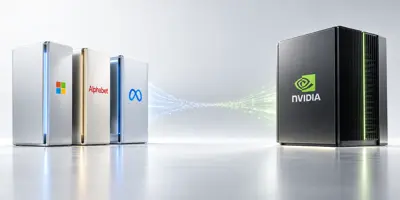
On September 3, Nvidia agreed to acquire Hugging Face for $12.9303 billion. Hugging Face is an open AI platform used by more than 18 million developers and researchers.
The point of the deal is not a few extra points of revenue. Nvidia's strategy keeps stretching outward from GPUs into CUDA, networking, AI Enterprise software, models and now the developer platform itself. If Nvidia sits at the point where developers first find, evaluate and deploy models, that can build a stronger ecosystem lock-in than hardware share alone.
There is a paradox here too. The more layers of the AI stack Nvidia controls, the stronger the incentive for customers to look harder at alternative suppliers and their own custom chips. Nvidia's moat is widening, but so is customers' motivation to reduce their reliance on it. Long-term investors need to weigh both forces together.
4. This week's most important warning - capex can keep rising while stocks rise less
Goldman Sachs's numbers are still strong. Consensus capex among the large hyperscalers is $754 billion for 2026 and $905 billion for 2027, an 83% increase for 2026 over the prior year. Goldman expects companies that benefit from this spending to account for roughly half of S&P 500 earnings growth this year.
But the latest debate has moved a step further. Even if capex keeps climbing, its growth rate is slowing. As chip supply catches up and prices and margins normalize, the lift that AI gives to index-level earnings growth could weaken.
| Market question | 2024-2026 | From here |
|---|---|---|
| AI investment | How much is being spent | How long can the growth rate hold |
| Semiconductors | How tight is supply | Can ASPs and margins hold |
| Hyperscalers | How many GPUs are they buying | How much revenue and free cash flow do those GPUs generate |
| Stock prices | Exposure to AI or not | Balance between AI ROI and valuation |
This is not a call that AI is collapsing. It is the natural second-derivative problem that shows up as any industry scales. Spending growing from 700 to 900 is powerful. But when it grows from 900 to 950, the absolute number is still bigger while the growth rate is lower. Equity markets typically react to the rate of change before they react to the absolute level.
5. Market breadth has narrowed - the index is strong, but the internals are less comfortable
Another signal this week is fund flows. In the week through September 18, US equity funds saw $31.44 billion in net outflows, a fourth straight week of outflows. Large-cap funds alone lost $28.71 billion. Sector funds, by contrast, took in $2.29 billion, and small caps pulled in $568 million.
Reading this simply as money leaving US stocks misses the point. It looks more like money leaving broad index exposure and compressing into areas where earnings are visible. The higher rates go, the more the market demands actual earnings visibility over a good story.
That is why industry peak and stock-price peak need to be treated separately right now. Demand evidence for the AI industry is still strong. But valuations do not need to keep expanding at the same pace. Continued industry growth and rising stock volatility can happen at the same time.
6. Robotics and space - structural growth signals are strong, but proof still costs money
Lucid and Bolt announced a partnership to deploy at least 25,000 autonomous Lucid vehicles across major European cities. The vehicles use Nvidia's Hyperion technology, and Bolt is targeting a 100,000-vehicle autonomous platform by 2035. Moving from pilots of a few dozen or a few hundred robotaxis to supply contracts for tens of thousands of vehicles is a clear shift.
Tesla's Cybercab, on the other hand, still has regulatory scrutiny ahead of it. The NHTSA has asked Tesla to submit documentation by September 30 regarding its self-certification approach for the Cybercab. Going forward, the numbers that matter for Tesla's robotaxi business are production volume, regulatory approval, actual fleet size, paid miles driven and revenue per vehicle, not FSD version names.
For SpaceX, capital allocation after its IPO matters more than the listing itself. Following its June IPO, SpaceX secured its first European customer for Starfall, a business that returns materials manufactured or tested in orbit back to Earth. A 2028 mission is planned to recover up to one metric ton of cargo using Starship and Starfall. It is an early signal that the space industry is expanding beyond launch vehicles and satellite communications into orbital manufacturing and logistics.
Insight Times Editorial Desk