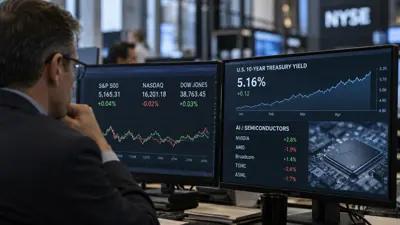
10-Year Yield Hits 5.11% as Growth Stocks Get Hit First
A hot PMI print and Brent crude back above $100 a barrel sparked a discount-rate shock that punished growth and small-cap names hardest.
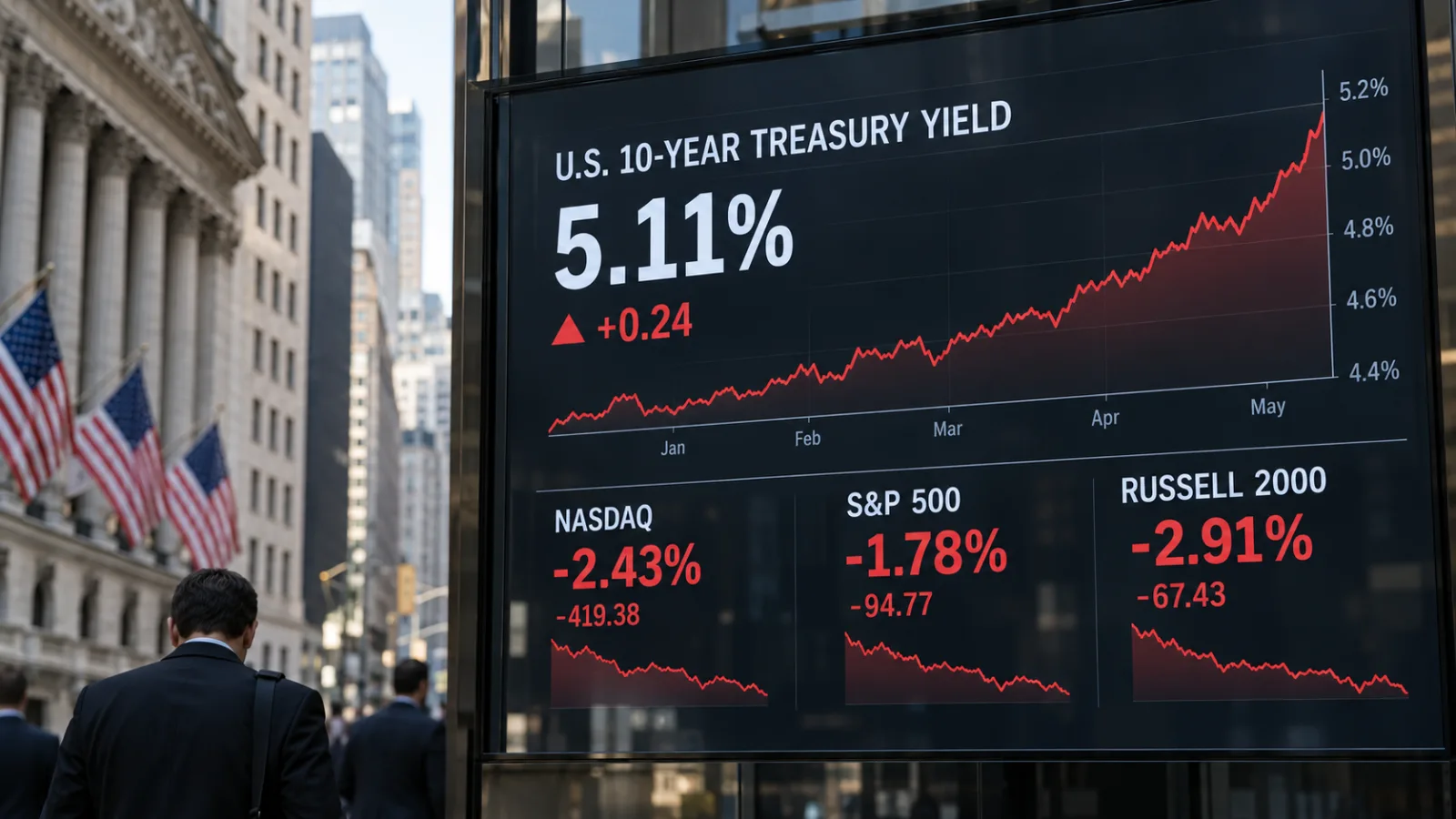
Stocks fell in order of rate sensitivity
The S&P 500 dropped 0.75% to 7,706.03. The Nasdaq fell 1.13% to 26,936.04. The Dow slipped 0.68%, and the Russell 2000 lost 1.77% to close at 2,838.66.
- Russell 2000: -1.77% — small caps most exposed to borrowing costs
- Nasdaq: -1.13% — growth stocks with heavy weighting toward future earnings
- S&P 500: -0.75% — a broader multiple reset across large caps
- Dow: -0.68% — relatively lower rate sensitivity
The sequence matters. Small caps fell hardest, followed by the Nasdaq, then the S&P 500, then the Dow. That is not a sign that corporate earnings suddenly worsened. It looks more like a repricing that started with the assets most vulnerable to higher rates.
The paradox: a stronger economy made stocks harder to hold
The S&P Global US Composite PMI for September came in at 58.4, up from 56.0 in August, the highest reading since July 2021. New orders were strong and hiring picked up. The problem is cost. Energy, transportation and wage pressures all rose together, pushing input-price inflation higher for businesses.
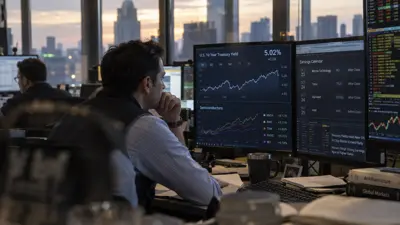
Bond markets read that less as good news about growth and more as a sign inflation may not cool as easily as hoped. The 10-year Treasury yield jumped to 5.11% from roughly 4.9% the day before. The level itself is a burden, but the nearly 15 basis-point move in a single day was the bigger shock.
Strong PMI → inflation worries → fading rate-cut hopes → 10-year yield at 5.11% → higher discount rates for growth stocks
Growth-stock valuations rest on discounting distant future cash flows back to the present. When the discount rate rises, the multiple applied to a stock can fall even if earnings estimates stay unchanged. That is how an AI bellwether like Nvidia can wobble without any bad news about its actual business.
Oil crossed back above $100
Energy markets moved sharply too. Brent crude fell to the $97 range intraday before reversing on hawkish comments from Iran's president and renewed concern about Middle East supply, closing up 3.86% at $103.08 a barrel. WTI rose 1.81% to $92.16.
The combination on the day is more troubling than "strong growth plus high oil" alone. It is strong growth plus oil back above $100. When demand stays firm and energy costs climb at the same time, the case for the Fed to cut rates quickly gets weaker. That is why the market's central question has become whether a 5% long-term yield is a temporary spike or a new trading range.
AI chips didn't collapse, the price tag changed
Nvidia fell 1.47% to $225.51. Alphabet dropped 3.58% to $334.98. Meta, Microsoft, Tesla and Palantir all closed higher. Palantir gained 3.68% to $191.79.
That split matters. If AI demand itself had suddenly cracked, the whole sector would likely have sold off together. Instead, the market traded selectively, separating high-multiple names, recent high-flyers, and stocks with individual momentum.
For Tesla, a positive was news that ZET SCALE selected Tesla as a primary supplier in a plan to procure roughly 2,500 electric Class 8 trucks. That does not mean all 2,500 trucks will be Tesla Semis. Kenworth, Volvo and RIDE were also named as secondary suppliers, and the exact volume allocated to Tesla has not been disclosed. The actual allocation, production ramp and delivery schedule matter more than the order headline.
The Trump-Xi summit looks more like a volatility risk than an upside catalyst
The next event on the calendar is a Trump-Xi summit in Washington on September 24. Trade, AI, advanced technology and security are expected to headline the agenda. Expectations for major economic breakthroughs are muted even before the meeting starts.
The South China Morning Post reported that plans for a Chinese business delegation are wavering amid disagreement over announcements of Chinese investment in the US. CEOs of DeepSeek and Moonshot AI were reportedly absent from the disclosed expected attendee list. That underscores how AI and advanced technology remain both a cooperation topic and a sensitive competitive issue between the two countries.
For investors, what matters is not the political rhetoric from the summit but whether actual language changes on semiconductor export controls, tariffs, critical minerals, or AI-related rules. Without concrete policy shifts, any market reaction is unlikely to last.
Yesterday's session looks less like the day AI cracked and more like the day interest rates reclaimed pricing power.
Insight Times Editorial Desk