Why Nvidia may give AI away: the real money is in the hardware that runs it
Nvidia is weighing a deal for open-model developer Reflection AI. If the strategy works, the gains may reach beyond Nvidia to the companies that connect AI chips inside data centers.
Nvidia is considering buying a startup that builds AI models. At first glance, that looks odd. Why would the world's leading AI chip company want a maker of ChatGPT-style AI?
There is a calculation behind it.
Spread the AI itself cheaply and widely, then sell the chips and equipment needed to run it.
If the strategy works, other companies could profit alongside Nvidia. They are the networking equipment makers that link huge numbers of AI chips together.
1. Think of a printer business where the ink is the profit
Some businesses sell the printer cheaply and make their money on ink. Nvidia's strategy can be understood in a similar way.
Two approaches now compete in the AI market.
One is to use an AI run by another company over the internet, as with ChatGPT. The other is to download an AI model and run it on your own company's computers.
What makes the second approach possible is open-weight AI. The core numbers an AI learned in training are published, so other companies can install the model and modify it to fit their needs.
Say a bank wants to analyze sensitive customer financial data with AI on its own servers, without sending it to an outside service. An open-weight model offers that option. Actual security, of course, depends on how the system is run.
This is where Nvidia's opportunity comes in.
Once banks, hospitals and manufacturers start running their own AI, they need chips and servers to run it on.
Nvidia does not have to collect every dollar of AI model usage fees. It can grow an ecosystem in which many companies use AI, and sell the equipment they need along the way.
Open models do not run only on Nvidia chips. They can run on rival products too. Nvidia's real edge, then, lies in making AI easier, faster and more efficient to run on its own chips.
2. That is why Nvidia is eyeing Reflection AI
On Oct. 10 (U.S. time), media reports said Nvidia is discussing taking a larger stake in Reflection AI or acquiring the company.
Nvidia has reportedly already invested about $800 million in the company. An additional investment or acquisition has not been confirmed.
Reflection AI matters because of an AI model called Beam, which it released on Oct. 5.
The model is designed to handle complex tasks such as software development while using computing resources efficiently. The company also published coding benchmark results that look competitive. These are the company's own results, however, and cost and performance still need to be verified in real customer environments.
For Nvidia, something else matters more.
It could let companies around the world freely use a competitive AI model developed by a U.S. company.
With open models such as China's DeepSeek gaining ground, the move also fits a push to secure a strong American alternative.
3. But more AI chips create another problem
This is where the investment angle gets interesting.
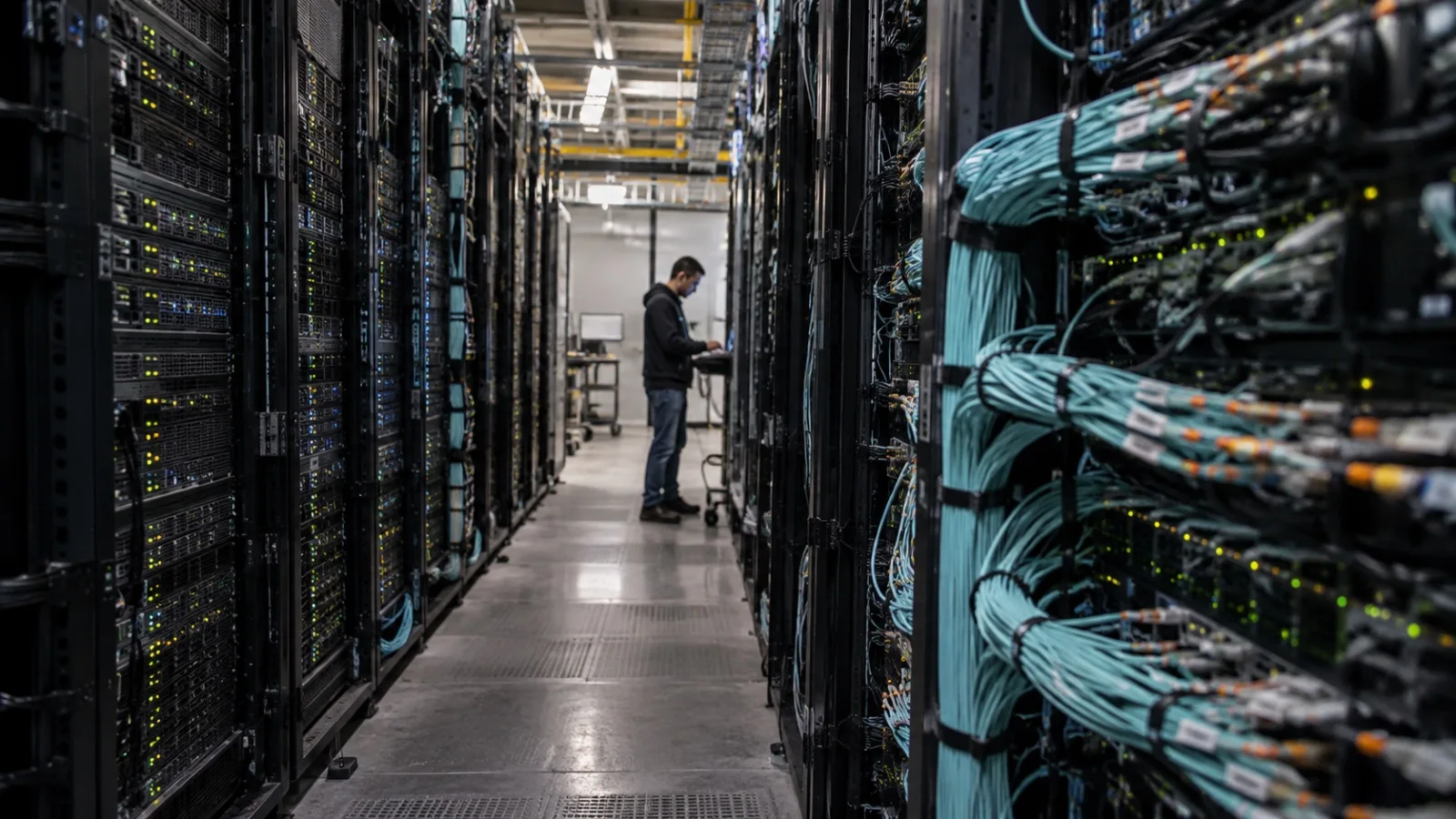
Picture an AI data center as the office of a giant company.
Nvidia GPUs are the tens of thousands of employees doing the work. No matter how smart and fast they are, overall productivity suffers if they cannot pass materials to one another.
The same is true in an AI data center.
Thousands or tens of thousands of chips exchange data and work together. When data transfer slows, even expensive GPUs have to wait for their next task.
So an AI data center needs equipment that matters almost as much as the chips themselves.
Ultra-high-speed networking gear that connects the chips.
As AI data centers get larger, the performance and power efficiency of this connective equipment will likely matter even more.
AI data center at a glance
- Nvidia GPU: the brain that does the AI computation
- Connected by four kinds of equipment:
- High-speed switches: direct data traffic
- Optical communications: carry information as light
- Connectivity chips: keep signals accurate
- High-speed cables: efficient links over short distances
4. Five companies worth watching after Nvidia
They do not all do the same business. Each plays a different role in the data center.
Celestica (CLS). The traffic cop of the data center. It designs and builds switches that move the data sent by many GPUs quickly to its destination. In April 2026 it announced that its next-generation 1.6Tb products were available for early orders.
Ciena (CIEN). The highways between data centers. It supplies technology that links large, distant data centers over optical networks. The opportunity could grow as data centers spread across more regions.
Lumentum (LITE). A key supplier of parts that send data as light. As chips need to pass more information faster, optical technology becomes more important.
Marvell Technology (MRVL). The quality control for data signals. It makes communications chips that help keep fast-moving information intact, and it also runs a custom AI chip business.
Credo Technology (CRDO). Fast, economical links over short distances. It improves the performance of high-speed copper cables and connectivity chips inside the data center.
One important point: none of these five is an exclusive Nvidia supplier. Their customer mix and competitive position differ, and they may compete or cooperate with Nvidia's own networking business.
5. Should investors buy these stocks right now?
Not blindly.
A company in a good industry is not automatically a good investment. If high growth expectations for AI are already priced in, a stock may not rise as much as hoped even when earnings improve.
Investors need to separate three questions.
First, is AI data center investment really continuing to rise?
Second, how much of that spending is going to networking equipment?
Third, is the company turning revenue growth into actual profit and cash flow?
Optical and high-speed networking markets in particular change technology quickly. If customers change how they connect systems, or competitors cut prices, expected profitability could be shaken.
Insight Times Editorial Desk