Why Is Nvidia Becoming a Shareholder in Healthcare and Robotics Startups?
Nvidia, long the seller of GPUs, has started investing in companies that use AI. The question is where growth comes from after the data center.
20-second briefing
- Nvidia widens its bets on European AI startups. Nvidia is making strategic investments in Doctolib, a healthcare AI company, and Genesis AI, a robotics AI company. French media also reported investments in Pigment and Entalpic.
- A second engine for AI growth. Until now, the companies building AI data centers were Nvidia's core customers. Companies that actually use AI in healthcare, robotics and manufacturing may create a new source of computing demand.
- What investors should check. Whether rising use of AI services turns into real revenue and profit, and whether that in turn feeds demand for Nvidia's GPUs and software.
Nvidia sells GPUs well. Why become a startup shareholder?
Nvidia earns enormous profits from selling chips alone. Yet the investments confirmed on Oct. 13 are not in chipmakers. One is a health-tech company that automates hospital work. Another is a startup building AI for robots.
Doctolib and Genesis AI confirmed Nvidia's planned minority stake in Doctolib and its strategic investment in Genesis AI. The Pigment and Entalpic investments came out through a report in the French business daily Les Echos. At the time of Reuters' report, neither company had confirmed them. Individual investment amounts and ownership stakes were not disclosed.
| Company | What it does | Status |
|---|---|---|
| Doctolib | Healthcare AI, medical records and hospital administration | Planned minority stake confirmed |
| Genesis AI | Robotics AI, automating physical tasks | Strategic investment confirmed |
| Pigment | Corporate financial planning and management software | Reported by French media |
| Entalpic | AI-based chemistry and materials research | Reported by French media |
None of these companies makes GPUs. They apply AI that runs on GPUs to healthcare, robotics, corporate management and materials research.
That is a clue to Nvidia's longer-term strategy.
From building AI to using AI
So far, data centers have been the center of the AI investment boom. Microsoft, Amazon, Google and Meta built huge GPU clusters and drove Nvidia's growth.
But a data center is not the final destination. Spending lasts only if the AI running inside produces productivity gains and customers are willing to pay for it.
How AI demand could broaden
- Stage 1, AI infrastructure: Big Tech data center spending leads to GPU purchases.
- Stage 2, AI services spread across industries: healthcare, robotics, manufacturing, enterprise software.
- Stage 3, ongoing compute demand: more service usage means more inference, which may mean more infrastructure reinvestment.
This is a conceptual map of how industry demand could connect to hardware spending. It does not guarantee GPU purchases or revenue growth.
Nvidia's startup investments can be read as a strategy to support growth in these application markets while expanding its own computing platform.
If it works, Nvidia could see two economic effects: GPU sales and a rise in the value of its stakes. But an equity investment is not an exclusive GPU supply contract. A successful portfolio company is not guaranteed to buy Nvidia products.
Where AI is actually used in hospitals
Doctolib is an especially interesting case.
The company builds AI tools that record clinicians' consultations and handle administrative work tied to care. According to the company, its AI consultation-recording tool has already been used to document more than 12 million patient visits.
More than 12 million: patient visits documented by Doctolib's AI consultation-recording tool, per the company.
The figure is evidence that medical AI has moved out of the lab and into real work.
It does not mean that 12 million visits were paid usage, or that the computing was done on Nvidia GPUs. For investors, paid-customer retention, cost per processed visit and the cost savings at medical institutions matter more than adoption numbers.
If AI saves clinicians' time and cuts hospital operating costs, healthcare could become an industry that generates steady inference demand.
How far can robots widen GPU demand?
The Genesis AI investment points in another direction.
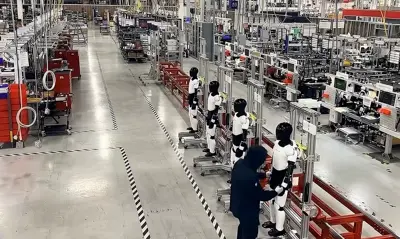
Chatbots mostly operate in digital space. Robots must perceive real objects, people and spaces, and actually move.
Building a robot requires simulation in virtual environments, sensor data processing, action planning and verification in real settings.
Nvidia provides AI computing and robotics development platforms that can be used in this process.
A successful robotics industry could expand not only training and simulation demand in data centers but also computing demand in devices deployed in the field.
However, not all robot computing runs on high-priced Nvidia GPUs. In the field, cost and power efficiency may lead buyers to choose dedicated chips or competitors' products.
So growth in robot shipments should not be equated with growth in Nvidia's revenue.
Bottom line
Nvidia's next growth driver depends not only on its ability to make more GPUs, but on how widely the economic activity that needs those GPUs spreads.
The investments in healthcare and robotics startups are a signal of that possibility. But the process of turning the signal into earnings still has to be verified.
Insight Times Editorial Desk