The Fed Hit the Brakes. The Bond Market Hit the Gas.
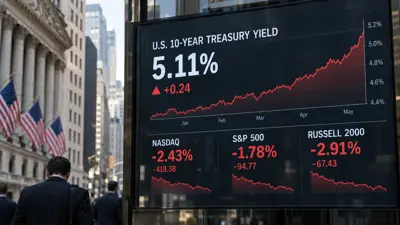
September's jobs shock cut the odds of an October hike, yet the 10-year yield climbed back to 5.28%. This week's key drivers are Treasury supply, oil and inflation expectations, not the Fed.

Jobs cooled. Why is the 10-year rising?
September nonfarm payrolls rose just 29,000, far below expectations. The unemployment rate rose to 4.2%. Average hourly earnings gained 0.1% on the month and 3.0% on the year. There were no mass layoffs, though. The labor force participation rate rose to 61.8%, and the job market looks more like "low hiring, low firing."
The data weakens the case for another Fed hike in October. Long-term yields moved the other way. The 10-year Treasury yield closed Friday at about 5.28%, after touching 5.34%, its highest level in more than two decades.
At the September FOMC meeting, the Fed raised its benchmark rate by 25 basis points to 3.75% to 4.00%. The median dot put the end-2026 rate at 4.1%, leaving room for one more hike this year. Even so, a 10-year yield above 5% reflects a mix of Treasury supply from the deficit, high oil prices, inflation expectations and the term premium. The old rule that long-term yields fall once the Fed stops is not working well right now.
The new test for the AI rally: quality of funding, not growth rate
AI fundamentals remain strong. Micron reported fiscal fourth-quarter revenue of $54.23 billion and full-year revenue of $133.19 billion. Quarterly operating cash flow was $43.97 billion. A company whose demand turns into actual cash has a better case for holding up at yields above 5%.
On the other side is AI expansion that comes with financing. According to Anthropic's IPO filing, Broadcom has agreed to lend up to $42 billion to support its TPU compute leases. Anthropic's long-term infrastructure obligations total at least $518 billion. When a supplier finances its customer's purchases, revenue grows. Credit risk and conflicts of interest grow too.
- 5.28%: U.S. 10-year Treasury yield, Friday (approximate)
- $54.23B: Micron fiscal Q4 revenue
- $42B: Broadcom's maximum loan commitment to Anthropic
That makes it harder to treat AI stocks as one group. Investors need to separate growth proven by cash flow from growth pulled forward with debt and leases. The higher yields go, the faster that gap is likely to show up in share prices.
Tesla: one good number, two open questions
Tesla delivered 486,532 vehicles in the third quarter, about 22,000 more than the 464,391 it produced. Energy storage deployments came to 13.7 GWh. Falling inventory is a positive, but it does not confirm a recovery in auto profitability.
Two things to check in the Oct. 21 earnings report: automotive gross margin and free cash flow. The first question is whether deliveries were driven by price incentives or by a genuine recovery in demand. The second is how much cash AI, robotaxi and Optimus spending is consuming. With long-term yields above 5%, companies that rely heavily on distant profits are more sensitive to changes in the discount rate.
This week: read the bond market's reaction more than the data
| Zone | 10-year yield | Market reading | Positioning |
|---|---|---|---|
| Easing | 5.10% or lower | AI leadership could broaden to software and small- and mid-cap growth | Hold current leaders, add gradually on pullbacks |
| Base case | 5.15% to 5.35% | Indexes range near highs, stock-level dispersion continues | Scale in rather than chase, keep cash available |
| Renewed shock | Breaks above 5.35% | Pressure on multiples for high-valuation growth and debt-reliant AI infrastructure | Cut leverage, recheck cash generation |
Insight Times Editorial Desk