The industry wins, the shareholder loses: AI's most awkward scenario
The biggest risk in AI is not that the technology fails. It is that AI works, spreads through the economy, and still destroys returns because too much capacity gets built. The internet succeeded. Plenty of dot-com investors did not.
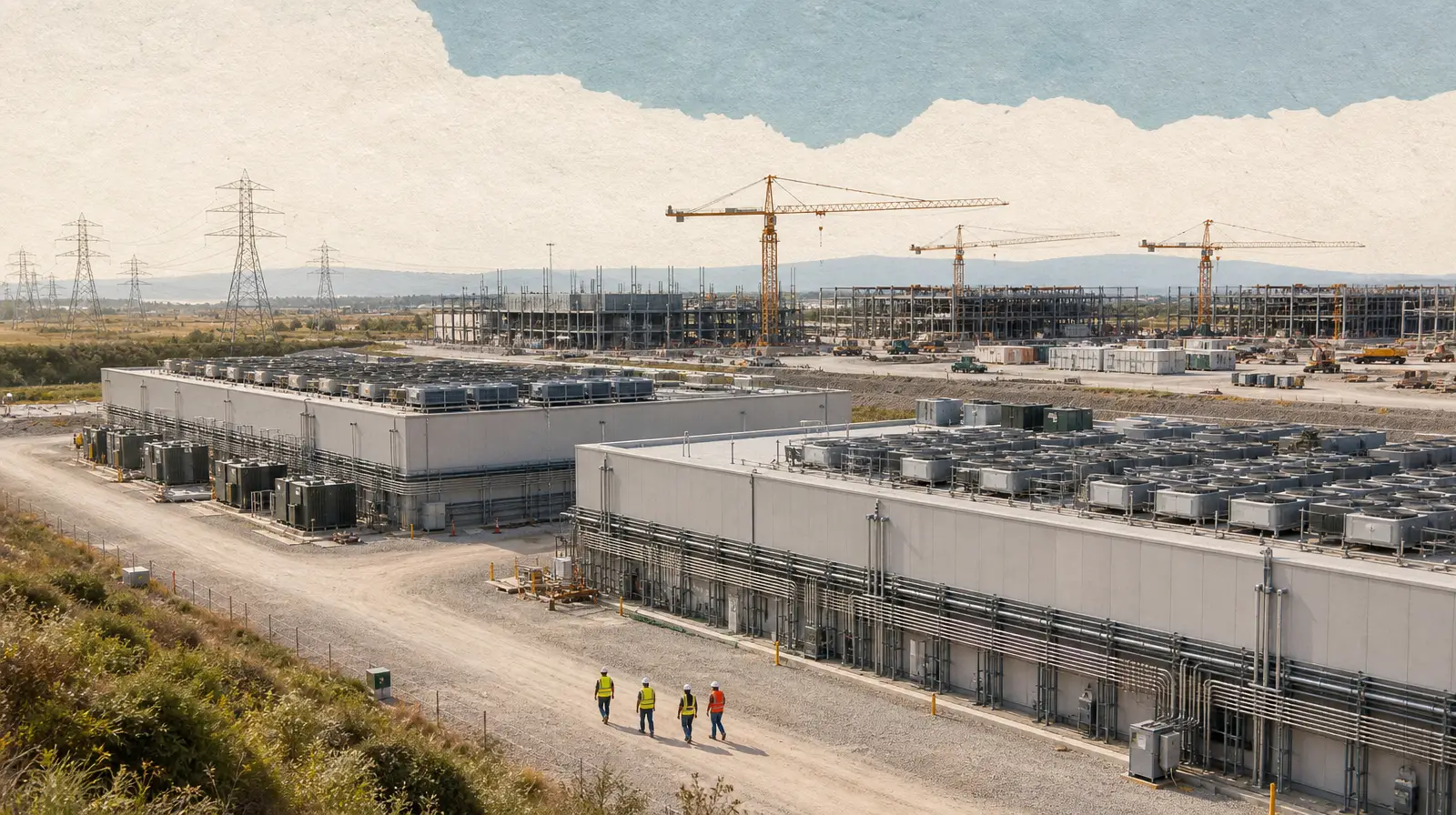
The dangerous scenario is not that AI turns out to be useless
The argument about AI investment keeps running to the extremes.
One side says AI will change everything.
The other side says the entire data center build is a bubble.
For investors, the scenario that matters most sits in the middle.
AI actually succeeds.
Companies use it.
It goes into search, coding, advertising, call centers, workflow automation, robots.
Productivity rises.
And still, too much compute and too many data centers get built to supply it.
Supply grows faster than demand.
Token prices fall.
Pricing power weakens at GPU, memory, networking, power and cooling vendors.
Depreciation at the hyperscalers keeps climbing.
The industry grows and the return on investment falls.
That is the hardest scenario in AI investing.
We are not yet at the stage of building data centers nobody uses
The disclosed numbers show, at minimum, that AI demand is converting into real usage and real revenue.
Microsoft's Azure and other cloud growth in fiscal fourth quarter 2026 was 43%.
Microsoft Cloud revenue was $59.3 billion, and the company said customer demand still exceeds the compute capacity it can supply.
Alphabet's Google Cloud revenue in the second quarter of 2026 was $24.8 billion, up 82% year over year.
Amazon's AWS revenue in the same quarter was $42.2 billion, growing 37%.
NVIDIA's data center revenue in fiscal second quarter 2027 was $89.0 billion, up 117%.
Read those numbers alone and it is hard to conclude that the industry is blindly building AI infrastructure nobody uses.
The problem is the next step.
Can that growth keep pace with the growth in investment?
The capex numbers have already changed the scale of the industry
AI capex in 2026 is no longer something you can call a research and development budget.
Microsoft's capex in fiscal fourth quarter 2026 was $41.0 billion.
Roughly two thirds went into relatively short-lived assets such as CPUs and GPUs.
The company described its expectation for calendar 2026 capex at about $175 billion.
Alphabet's capex in the second quarter of 2026 was $44.9 billion.
Amazon's cash capex in the same quarter was $53.1 billion. Amazon said most of it was technology infrastructure investment, much of it supporting AWS growth.
Meta guides 2026 capex to $130 billion to $145 billion.
At that scale, AI is not a project at a handful of technology companies.
It is a vast reallocation of industrial capital moving through data centers, semiconductors, power, real estate, cooling, networks and generation equipment.
So is this a bubble?
It could be.
But concluding bubble purely because capex is large is too simple an analysis.
Most large infrastructure revolutions came with overinvestment from the start.
Railways.
Power grids.
Telecom networks.
The internet.
When a new industry appears, market participants look at future demand first and build capacity against it.
The problem is that nobody can forecast future demand precisely.
The stronger the optimism, the more companies expand at the same time.
The result is that the economy is left with useful infrastructure while the companies and investors who built it have no guarantee of high returns.
The same thing can happen in AI.
Separate the success of the industry from the success of the stock
The internet succeeded.
E-commerce succeeded.
Search succeeded.
Fiber optic networks did end up carrying enormous volumes of data.
That does not mean every company that appeared in the early internet era was a good investment.
You can get the long-term direction of a technology exactly right and still lose money in the stock.
You may have paid too high a price.
Supply may have expanded too far.
Competition may have erased the margin.
The winner may have been a different company.
It may simply have taken too long.
AI is no different.
"Will AI change the world?"
and
"Is this AI stock, at today's price, a good investment?"
are entirely different questions.
The real warning sign in AI capex is not the amount, it is the payback
$100 billion of capex is not automatically too much.
If that investment can generate $200 billion of additional cash flow on a durable basis, it can be a good investment.
Conversely, $10 billion of investment that produces only $2 billion of additional economic value can be a bad one.
So when you look at AI capex, look at the ratio rather than the absolute number.
Take a very simple example.
In year one you invest 100 and create 40 of new AI revenue.
The next year you invest 150 and create 70.
The year after that you invest 200 and create 120.
Economic value is still growing faster than investment.
Then the next year you invest 300 and the incremental AI revenue rises by only 80.
From that moment the structure has changed.
The technology did not fail.
Capital efficiency deteriorated.
Depreciation is a bill that arrives a few years late
There is a timing gap built into AI capex.
The cash goes out first.
The data center gets built.
The GPUs get installed.
The assets go into service.
And the depreciation flows into the income statement over several years.
So in the early phase, when cloud revenue is climbing fast, the economics can look very good.
But a few years later, depreciation on the data centers built in the past and capex on the data centers being built now start to overlap.
Microsoft Cloud gross margin coming down to 65% in fiscal fourth quarter 2026 shows that AI infrastructure investment and rising usage are already working through the cost structure.
That is not necessarily a bad signal.
The same company posted 43% Azure growth.
What matters is how quickly future revenue growth outruns the growth in depreciation and operating costs.
Better AI efficiency may not make the capex problem go away
There is a counterargument.
AI chips get more efficient fast.
Models get smaller.
Inference costs fall.
Doesn't that reduce the risk of overbuilding data centers?
Not necessarily.
When costs fall, usage can explode.
A single agent can generate far more inference than a single human.
If physical AI spreads, cars and robots run inference continuously.
Efficiency gains can lead to higher total usage rather than lower total demand.
Call it the Jevons paradox of AI.
So the mere fact that efficiency is improving tells you nothing about whether oversupply or demand explosion wins.
In the end you have to measure the growth rate of actual usage and actual economic value.
The first thing to break may be pricing power, not revenue
When AI supply starts catching up with demand, industry revenue does not necessarily fall right away.
Demand can keep rising.
Price moves first.
The GPU premium narrows.
HBM average selling prices stabilize or fall.
Cloud AI token prices come down fast.
Competition in networking equipment intensifies.
Margins in the power and cooling backlog normalize.
In other words, the industry keeps growing while profitability peaks first.
That is why you cannot find the top of the AI supercycle by looking at revenue growth alone.
Gross margin.
ASP.
Cloud gross margin.
Backlog margin.
Free cash flow conversion.
These are the numbers that may signal first.
NVIDIA can grow 30% and AI investors can still be nervous
Suppose that in some future year NVIDIA revenue grows 30%.
For a traditional semiconductor company that is a very high growth rate.
Now suppose gross margin falls quickly from 75% to 60% at the same time.
Hyperscalers expand their own ASICs.
Customers negotiate harder on price.
The AI industry keeps growing, and the economic share NVIDIA captures shrinks.
The reverse case: NVIDIA growth slows to 20% but gross margin holds in the 70s, and the AI return on investment for cloud customers keeps improving. That is a far healthier normalization.
This is why industry growth and company economics have to be looked at separately.
For big tech, there comes a moment when free cash flow matters more than cloud growth
Microsoft, Alphabet, Amazon and Meta are the largest buyers of AI infrastructure.
Early on, what mattered was cloud growth rates and AI user counts.
From here, the numbers one step further down matter more.
Operating cash flow.
Free cash flow.
Depreciation.
Cloud gross margin.
Incremental revenue per unit of capex.
AI service ARPU.
Actual revenue conversion of contracted backlog.
Data center utilization.
AI customer retention.
These need to improve together.
Alphabet spent $44.9 billion of capex in the second quarter of 2026 and grew Google Cloud 82%.
Amazon posted $53.1 billion of quarterly cash capex alongside 37% AWS growth.
For now, investment and demand are rising together.
The real test begins when the two start moving in different directions.
The AI supply chain faces the same test
This is not only NVIDIA's problem.
Micron currently enjoys high margins from the scarcity of HBM.
If competitors add capacity faster, prices can fall.
Arista is growing as AI networking becomes more important.
But in-house designs at the hyperscalers and sharper competition can weaken its pricing power.
Vertiv benefits from the power and cooling bottleneck.
But capacity expansion and project delays can bring margins down.
The same law applies everywhere in the AI value chain.
Bottlenecks create high returns.
High returns attract supply.
Supply clears the bottleneck.
When the bottleneck clears, margins normalize.
An industrial revolution does not abolish the cycle.
It can create a bigger one.
The number to track to the end is the value of AI divided by the cost of AI
The whole AI industry can be compressed into one expression.
The economic value AI creates, divided by the capital put in to build and run it.
If that ratio rises, good.
More work automated with less capital.
Advertising efficiency improves.
Cloud revenue grows.
Robotaxis drive more paid miles.
Robots work more cheaply than people.
If that ratio starts to fall, it is dangerous.
More GPUs bought.
Bigger data centers built.
Power and cooling bills rising.
And what customers pay, and the actual productivity value, are not rising to match.
At that moment the question in the AI investment cycle shifts from technology to finance.
Not how smart it is, but how much is left over.
The conclusion comes down to three sentences
The AI story keeps getting bigger.
AGI.
Robotaxis.
Humanoids.
Nuclear power.
Hyperscale data centers.
The investor's question has to get simpler.
Who pays?
Why do they keep paying?
Is that money sufficiently larger than the money invested?
Answer those three and there is an economic case for long-term growth in the AI industry.
Fail to answer them and shareholder returns can be weak no matter how astonishing the technology is.
The next decade of AI is not only a race to build bigger models.
It is a race to secure power.
To produce intelligence cheaply.
To embed it in corporate work.
To deploy it in the physical world.
To make it run repeatedly without accidents.
And, at the end, to leave cash behind.
The real industrialization of AI is completed at that last step.
Sources
- Microsoft FY2026 Q4 Earnings Call
- Alphabet Q2 2026 Form 10-Q
- Amazon Q2 2026 Form 10-Q
- Meta Q2 2026 Results
- NVIDIA FY2027 Q2 Results
Insight Times Editorial Desk