AI Is Not One Wave. It Is Five, and They Do Not Peak Together
Treating AI as a single chip cycle hides the important part. Training, inference, infrastructure, agents and physical AI run on different clocks and different revenue models, which is why slower growth at Nvidia and the end of the AI supercycle are not the same sentence.
Read AI off one chart and you will read it wrong
The more experience an investor has with AI, the easier it is to fall into one trap.
Treating it like a semiconductor cycle.
Demand explodes. Supply runs short. Companies raise capex. Supply catches up. Growth slows. Margins bend. The cycle ends.
That picture is familiar from memory, servers and PCs.
So when Nvidia's growth rate eventually falls from 100% to 50% and then to 20%, plenty of investors will say the AI cycle is over too.
AI works a little differently.
Several distinct industries sit stacked inside it.
Model training. Inference. Cloud. Agents. Networking. Power and cooling. Edge AI. Autonomous driving. Robotics.
They do not grow at the same speed.
One of them can pass its growth peak in the same year another one enters mass deployment for the first time.
Draw AI as a single curve and you lose the structure.
The first wave was training
Since 2023 the first wave of the AI investment boom has been unmistakable.
Training.
Bigger models required more GPUs.
More GPUs made HBM scarce.
Wiring tens of thousands of GPUs together made networking critical.
Power density and cooling followed.
The questions in that period were simple.
How many GPUs have you secured?
How large a model can you train?
Who is ahead in the frontier model race?
Nvidia was the most direct beneficiary.
In its FY2027 second quarter, Nvidia posted revenue of $96.2 billion and data center revenue of $89 billion, up 106% and 117% year over year.
Those numbers say the training wave has not gone anywhere.
They also make it harder to explain AI's next decade with training alone.
There is a ceiling on how many companies in the world train frontier models.
The second wave is the economics of using the model
Training builds a model. Inference uses it.
Economically these are different animals.
Training is a large project.
Inference is repeat consumption.
Every search. Every document summarized. Every line of code written. Every ad recommended. Every customer service ticket handled.
The model gets called again.
As users grow and usage frequency rises, inference keeps compounding.
So the center of gravity in the industry shifts from "how large a model did you train" to "how many useful tokens can you produce, and how cheaply."
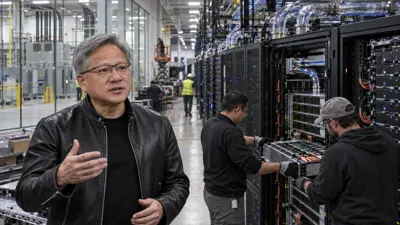
On his recent earnings call, Nvidia chief executive Jensen Huang said AI is doing useful work and put it as "compute is revenue."
The meaning is plain.
Compute is no longer a research expense. It is becoming equipment that produces revenue.
Agents scale the inference wave again
This is where agents enter.
A chatbot answers once when a person asks.
An agent takes on the job.
It searches.
It reads documents.
It runs tools.
It calls the model again.
It verifies.
It retries if it has to.
A single user request can turn into dozens or hundreds of inference calls.
Microsoft's FY2026 fourth quarter results signal how fast this is moving inside enterprise software.
Microsoft said roughly 40 million agents have been registered on Agent 365.
Foundry reached 100,000 customers, and the number of Foundry customers consuming more than a trillion tokens on an annualized basis rose fourfold year over year.
Paid seats for Microsoft 365 Copilot passed 30 million.
The headline is not the user count.
It is that the unit of AI demand is shifting from the number of human questions to the number of enterprise business processes.
If that continues, inference has a real chance of becoming a larger compute market over the long run than training.
The third wave is the physical bottleneck AI created
As AI compute scaled, another industry started moving.
Power and cooling.
The stronger the GPU, the higher the power density per rack.
Deploying more servers requires transformers, switchgear, UPS systems, liquid cooling and high-voltage distribution.
Rising GPU investment triggers a chain of capex in an entirely different form.
This wave runs on a different clock from chips.
GPU generations turn over in one to two years.
Data centers take a few years.
Substations and transmission networks take longer still.
So even at the point where Nvidia's growth rate slows, investment in Vertiv, Eaton, the grid and cooling infrastructure can keep arriving late.
One AI wave becomes the cause of the next.
The fourth wave is monetizing cloud and agents
Build a lot of infrastructure and eventually you have to make money on top of it.
That raises the role of the cloud companies: Microsoft, Amazon, Alphabet.
Microsoft's Azure annual revenue passed $100 billion for the first time, and Azure grew 43% in the most recent quarter.
AWS revenue was $42.2 billion in the second quarter of 2026, up about 37% year over year.
Microsoft's recently disclosed quarterly Azure revenue was $29.4 billion.
These figures mark an important handoff.
For the first few years, the number that mattered most to an AI investor was GPU orders.
From here, cloud AI revenue, AI seats, agent usage, token consumption and cloud gross margin matter more.
Those are the numbers that show whether AI capex is coming back as actual cash flow.
The next leadership in AI will not necessarily be the company selling the most GPUs.
It may be the company that converts the most enterprise work to AI and earns recurring revenue doing it.
The fifth wave is physical AI
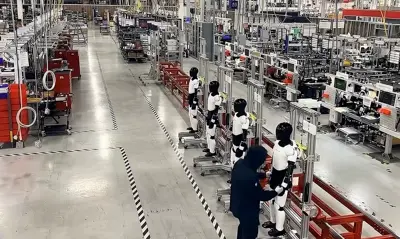
And AI starts leaving the screen for the real world.
Autonomous vehicles. Robots. Drones. Industrial equipment. Logistics systems.
Physical AI carries more commercialization uncertainty than training or cloud AI today.
If it works, the market is far larger in character.
Digital AI automates part of knowledge work.
Physical AI touches human physical labor, movement, manufacturing and logistics.
The crux of this wave is not model performance.
It is deployability.
Safety. Utilization. Maintenance. Cost per task. Reorders.
When physical AI moves from factory pilots to reorders, the industry generates another round of capex and compute demand.
More robots mean more edge computing.
Data generated at the edge flows back into cloud training.
New models get deployed back to the robots.
At that point the waves are independent and mutually reinforcing at the same time.
The waves do not arrive in order
One misreading to avoid here.
Inference does not begin after training ends, and physical AI does not begin after inference ends.
The waves overlap.
Training continues.
Inference grows alongside it.
As inference grows, data center investment grows.
The power bottleneck widens.
Agents proliferate.
Meanwhile physical AI commercializes in a few industries.
That makes it hard to mark any single year as "phase one over, phase two begins."
The more accurate picture is several overlapping S-curves.
As one matures, another accelerates.
If that overlap holds for a long stretch, the AI supercycle can run far longer than a traditional semiconductor cycle.
Why slower growth at Nvidia is not the end of AI
Nvidia's current growth rate is abnormally high.
Revenue rising 106% year over year cannot last forever.
As the base effect builds, the growth rate comes down naturally.
The issue is not that it comes down.
It is why.
Does growth slow because supply normalizes?
Or because customers' return on AI investment deteriorates and orders shrink?
The first is normalization.
The second is damage to the cycle.
Suppose Nvidia's growth falls to 25% while AI usage on Azure, AWS and Google Cloud climbs hard, agent token consumption rises, power and cooling backlogs hold and physical AI crosses into reorders. The industry as a whole would still be expanding.
Now suppose Nvidia grows 50% while hyperscaler cloud gross margins fall sharply, AI customers' ROI worsens and cloud usage growth slows. That is the more dangerous signal.
Where the real top would show up
To judge the peak of the AI supercycle, watch for weakness appearing in several waves at once rather than in one number.
Hyperscaler capex growth stays high while cloud growth slows.
GPU lead times normalize but order growth does not follow.
HBM prices fall.
Power and cooling backlogs decelerate.
Cloud gross margin keeps eroding.
Enterprise agent usage stops rising.
Physical AI pilots do not convert into reorders.
If those show up together, the story changes.
That would not be normalization in one industry. It would be the economic return on AI as a whole coming down.
The top of this cycle has to be judged by deteriorating capital recovery in several places along the value chain at once, not by a single Nvidia chart.
The signals that the supercycle is running longer
The opposite scenario is just as legible.
Azure, AWS and Google Cloud sustain high growth rates.
Agent registrations and actual work usage keep climbing.
More enterprise customers cross a trillion annualized tokens.
The cost to outcome of AI models keeps falling.
Demand grows for custom AI silicon from the likes of Broadcom, not just Nvidia.
Power and cooling backlogs stay elevated.
Physical AI moves from pilot to reorder.
In that case AI is not a GPU buying boom.
It is closer to compute spreading through the whole economy as a new factor of production.
Industrial shifts of that kind do not end with one or two semiconductor downcycles.
Each wave demands a different investment question
In training, GPU and HBM supply matter.
In inference, cost per token and server utilization matter.
In agents, cost per task and customer ROI matter.
In AI infrastructure, power, cooling and backlog matter.
In physical AI, uptime, intervention rate and cost per task matter.
Same label, completely different KPIs.
Which is why the phrase "AI stock" is losing its meaning.
Which wave is the company riding?
Is that wave early, accelerating or mature?
How much of the economic value of that growth does the company keep?
Those are three separate questions.
The most dangerous mistake in AI investing is not believing in the industry. It is believing every AI company will make money in the same way at the same time.
Insight Times Editorial Desk