Nvidia and Palantir Put AI Inside the Supply Chain - The Real Shift Is That It's Learning Judgment
A single Vera Rubin rack holds 1.3 million parts. The real breakthrough in Nvidia and Palantir's new supply chain AI isn't automating that complexity, it's capturing the judgment calls that used to live only in planners' heads.
Harder Than 1.3 Million Parts: Human Judgment
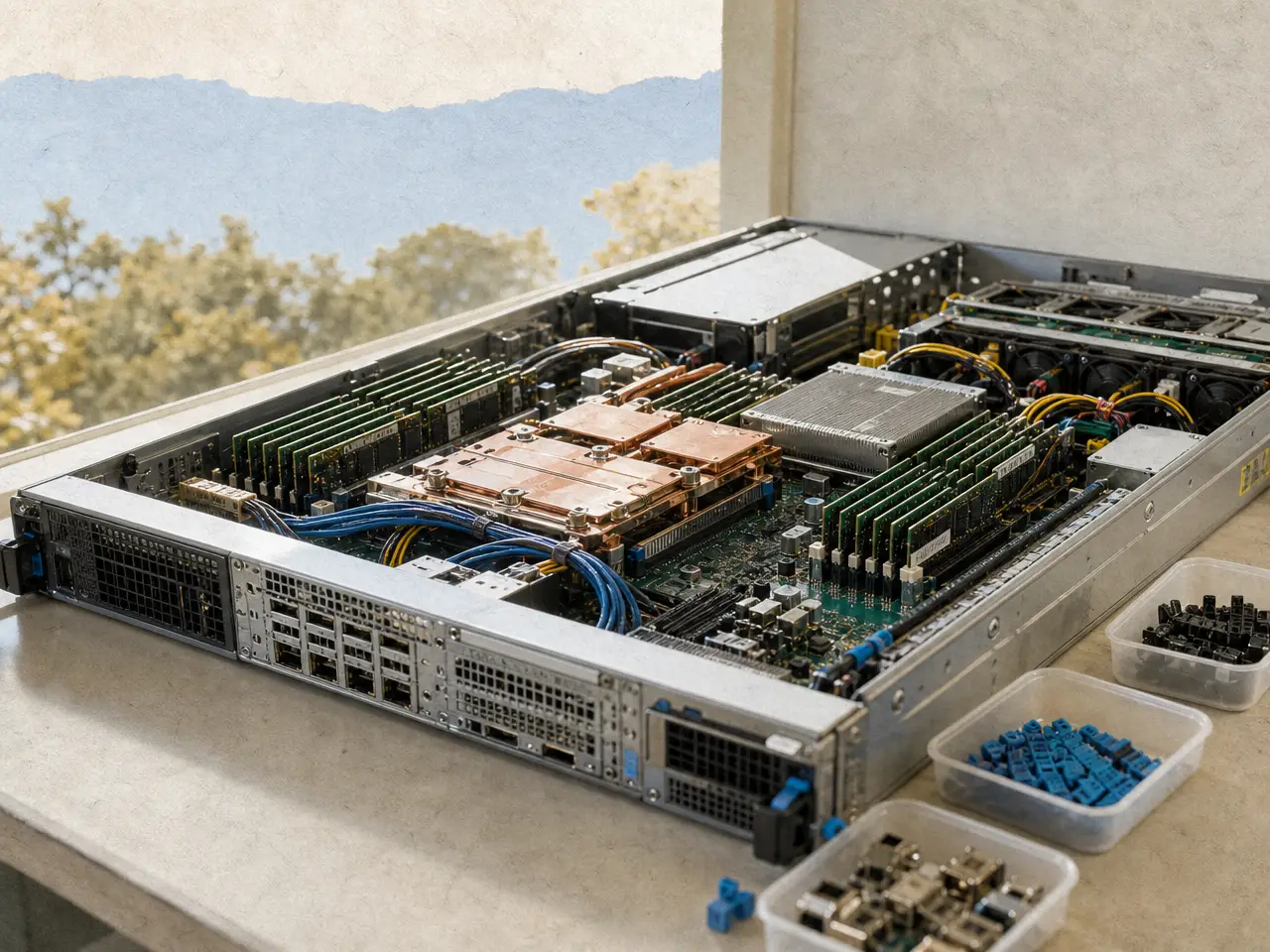
Nvidia's next-generation Vera Rubin rack contains roughly 1.3 million individual parts. It's not just a matter of matching GPUs, CPUs and HBM memory. Networking, power, cooling and mechanical components all have to arrive on time for a single rack to come together. According to Nvidia, the Vera Rubin supply chain is twice the size of Grace Blackwell's.
In that kind of environment, the hard question isn't "how much inventory do we have." It's closer to "which manufacturing site should get a scarce part first so total production moves fastest." Nvidia recalculates that materials-allocation problem every week.
Traditional optimization software can handle a version of this. Nvidia's cuOpt solves mixed-integer linear programming problems with thousands of variables and constraints, and it can identify which part is the actual bottleneck. The problem is that math alone can't see everything happening on the ground.
In backtests run by Nvidia and Palantir, human planners who used this kind of qualitative information sometimes made better calls than the math model did. The core of the new system is capturing that human tacit knowledge as data.
Palantir's Ontology Isn't a Database. It's a Map of How the Company Runs
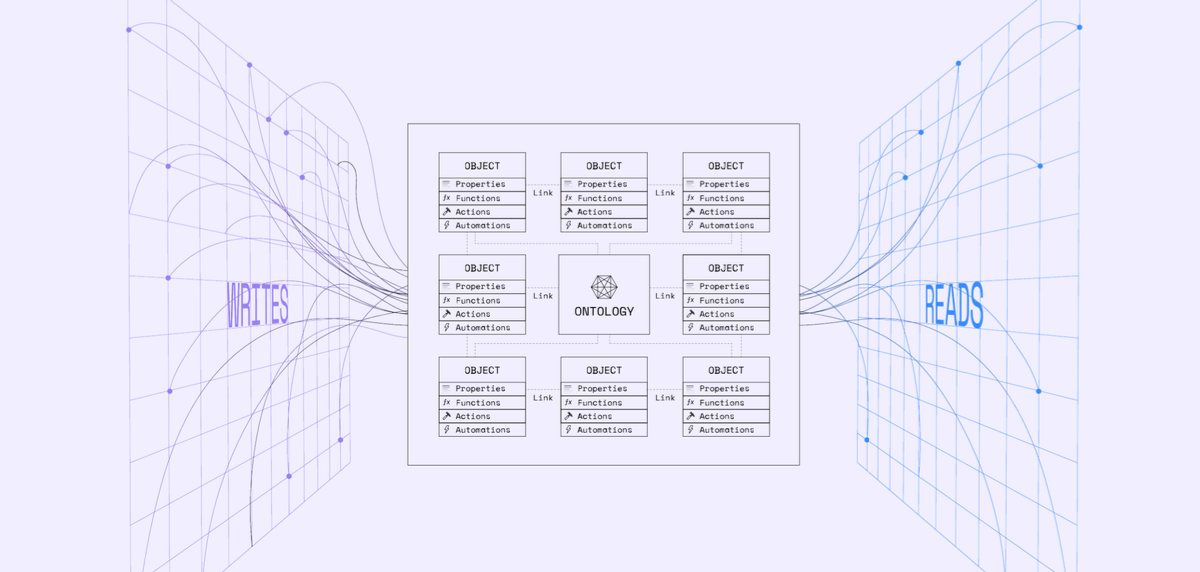
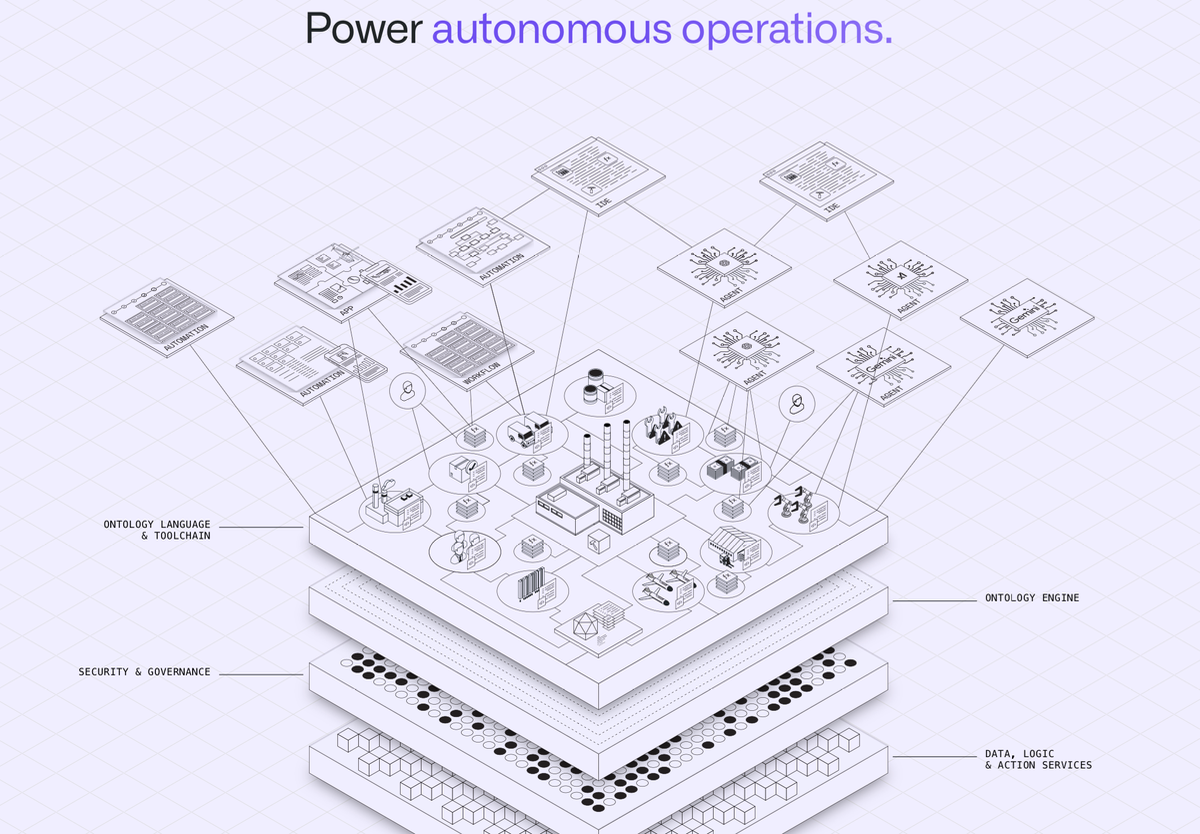
Understanding Palantir's Ontology is key to seeing why this partnership isn't just another LLM rollout. A normal database stores inventory, factories and orders as separate tables. Ontology represents them instead as connected objects and relationships: part, factory, production capacity, customer commitment, actual output, all linked together.
On top of that structure, the AI isn't just reading documents. It can reason, in operational context, about questions like "if this part is delayed, which production line and which customer delivery gets hit." Nvidia built its Digital Supply Chain Intelligence command center inside Palantir Foundry on top of this.
cuOpt handles the quantitative side. Nemotron handles the qualitative side. Every time a planner approves, edits or rejects an AI recommendation, and every actual production outcome, flows back into Ontology. Crucially, the model doesn't retrain itself on the fly in production. Once enough data accumulates, it goes through a separate, controlled retraining process.
What 86.7% Means: A Smaller Model That Learned the Company's Work Beat a Bigger One
Materials-allocation accuracy on internal Nvidia benchmarks:
- 86.7% - Nemotron 3.5 Lightning, after post-training on Nvidia's own allocation history
- 55.5% - the larger, general-purpose Nemotron 3 Ultra on the same task
- 17.5% - Nemotron 3.5 Lightning base model, before training
The most interesting number here isn't model size. Nemotron 3.5 Lightning, a roughly 30-billion-parameter model, was post-trained on Nvidia's own past allocation decisions, the reasoning behind them, and the outcomes. Accuracy on an internal development benchmark jumped from 17.5% to 86.7%, surpassing the 55.5% posted by the much larger, roughly 550-billion-parameter Nemotron 3 Ultra.
That number shouldn't be read as "the small model got smarter than the giant one." Nvidia itself notes that this result came from a specific, well-bounded materials-allocation task. Other problems, like predicting production risk, remained difficult even after fine-tuning.
The real lesson for investors lies elsewhere. In enterprise AI, competitiveness doesn't end with buying the largest model available. How well a company structures its own decision records, and how repeatedly it feeds that data into a smaller model, may drive both cost and performance at the same time.
This Isn't the End of ERP. It's a Contest Over the Judgment Layer Above ERP
There's no need to inflate this announcement into "Palantir and Nvidia are replacing SAP or Oracle." Real factories still run orders, inventory and production through existing systems like ERP, MES and MRP. The new AI stack sits above those systems. It connects scattered data, calculates the available options, and hands humans an execution recommendation, more of a judgment layer than a replacement system.
| Existing Enterprise Systems | New AI Operating Layer | |
|---|---|---|
| Primary role | Record transactions, inventory, production | Interpret situations, optimize, recommend |
| Core data | Mostly structured data | Structured data plus emails, meetings, external risk |
| Decision-making | Humans query the system and decide | AI generates alternatives, humans give final approval |
| Learning | Centered on process rules | Judgments, edits and outcomes accumulate as retraining data |
Seen this way, Palantir's most important asset isn't a chatbot. It's Ontology. And Nvidia's most important role isn't limited to selling GPUs either. Between cuOpt, Nemotron and the NeMo toolchain, the goal is to get a company's entire operational AI stack running on Nvidia's own computing ecosystem.
Insight Times Editorial Desk