Your Car Is Starting to Understand You: Tesla, Grok, and the Next Phase of AI
The breakthrough is not that a Tesla can answer questions. It is that AI is beginning to turn natural conversation into useful action, in a place where speed and attention matter.
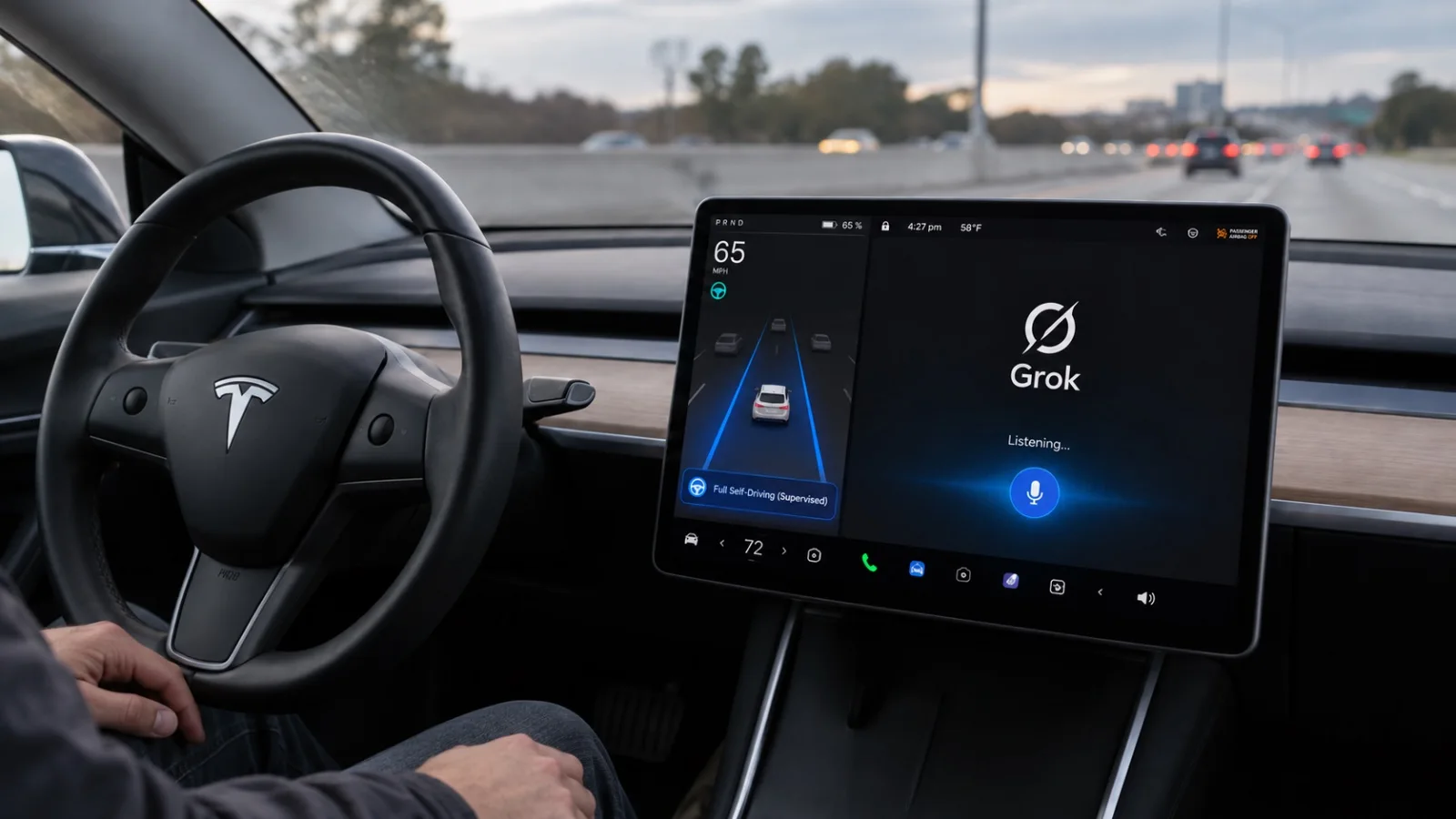
The 20-Second Brief
- A more conversational car. In supported Tesla vehicles, Grok can respond to spoken requests and, in Assistant mode, access functions such as navigation, climate controls, calls, and media.
- Speed changes the experience. xAI reported a 0.70-second time to first audio for Grok Voice 2.0 in a benchmark. That is not a measured guarantee of in-car response time.
- A larger transition. AI is moving from a tool that explains things on a screen toward an interface that helps people operate the physical world.
The Interesting Part Isn't the Car Brand
“Hey Grok.”
Imagine saying those two words while driving, then asking a question the way you would ask a passenger. You don't have to construct a perfect search query or memorize an exact command. The ambition is for the system to understand ordinary speech, respond naturally, and help with the task at hand.
This is striking even if you have never owned a Tesla and have no intention of buying one. For years, talking to a car meant issuing narrowly defined commands. Modern AI assistants are beginning to make the interaction feel like a conversation rather than a test of whether the driver knows the right phrase.
That doesn't mean Grok is faster or more accurate than ChatGPT, Siri, or every other assistant in every situation. There is no single independent, apples-to-apples test establishing that claim across phones, computers, and cars. The point is more specific: low-latency voice AI can make a machine feel responsive enough to fit the rhythm of everyday life.
Why a Fraction of a Second Matters
Traditional voice systems often followed a sequence: capture speech, transcribe it, process the request, generate an answer, and read it aloud. Newer speech-to-speech systems integrate these stages more tightly and can overlap parts of the work.
In July 2026, xAI reported that Grok Voice 2.0 achieved 0.70 seconds to first audio in a comparison attributed to Artificial Analysis, versus 1.25 seconds for Grok Voice 1.0 and 2.98 seconds for a compared Gemini model. The figure measures when an answer begins, not when a complete answer finishes. Crucially, the published result concerns the voice model, not an independent road test inside a Model Y.
The same xAI announcement reported better transcription results in its multilingual testing and an especially large advantage over selected transcription models under noisy conditions. That finding is relevant to cars, where road, wind, music, and passengers compete with a driver's voice. But it should not be converted into a promise that every Tesla recognizes speech ten times more accurately.
These distinctions matter. A compelling demo is evidence of what technology may enable, not proof that every driver will receive identical performance on every network and software version.
When an Answer Becomes an Action
The more important step is what happens after the AI understands the request.
Tesla's Model Y owner's manual describes Grok as a beta feature. With the Assistant personality selected, supported capabilities include navigation, phone calls, texting in applicable configurations, media, climate adjustments, seat heating or cooling, finding vehicle settings, and answering questions using the owner's manual. Availability varies by vehicle, software, and region.
Consider the difference between two requests:
- “What temperature is comfortable on a cold morning?” asks an AI to provide information.
- “Set the cabin to 72 degrees and turn on my seat heater” asks it to do something useful.
This is the shift from answer engine to action interface. Instead of learning the menu structure of each device, people can increasingly describe the outcome they want.
That is not unlimited autonomy. A car's supported commands are specific, some requests still require the touchscreen, and multi-step tasks may fail or need confirmation. Claims that the in-car assistant can automatically reschedule meetings, send emails, or place shopping orders should not be treated as standard Tesla capabilities without confirmation of supported integrations.
How to Try It Without the Hype
For drivers whose vehicle supports Grok, Tesla documents launching it through the app, by holding the right steering-wheel scroll button, or by saying “Hey Grok” where the wake word is enabled. Vehicle commands require the Assistant personality. Grok also requires Premium Connectivity or a Wi-Fi connection, and usage limits may apply.
Start small: ask about an unfamiliar dashboard setting, request a destination, adjust climate, or search for music. Then check whether the intended action actually occurred. Keep attention on the road, and never assume an AI response replaces the driver's judgment.
This is a practical way to evaluate progress: not by asking whether the assistant sounds human, but by asking whether it saves effort without creating new errors or distractions.
FAQ
Is Grok faster than ChatGPT or other voice assistants?
Not necessarily. The reported 0.70-second benchmark measures time to first audio for a particular voice model. It does not establish superiority across every task, product, network condition, or measure of accuracy.
Can Grok control everything in a Tesla?
No. Tesla documents particular supported functions, and capabilities vary by software, vehicle, and region. Grok remains labeled beta in the owner's manual.
Is Grok the same as Tesla's Full Self-Driving (Supervised)?
No. Grok is an AI assistant for conversation and supported interactions. FSD (Supervised) is a separate driver-assistance feature, and the driver remains responsible for the vehicle.
Why should someone who doesn't drive a Tesla care?
Because the underlying change is much bigger than one vehicle. When voice AI becomes fast, context-aware, and connected to real tools, interacting with technology may increasingly begin with a spoken intention rather than a screen full of menus.
Tesla deserves credit for pursuing a tightly integrated software experience, and xAI's advances in voice technology help illustrate how quickly that experience can evolve.
But this is not a story about one automaker having already solved AI.
Other automakers, smartphone platforms, and technology companies are pursuing their own voice and agent systems.
The competitive question is changing.
Model intelligence still matters, but so do response time, access to the right tools, reliability, safety, privacy, and the ability to operate within a specific product.
A powerful AI that cannot perform a useful action may be less valuable in daily life than a narrower system that consistently completes one.
Cars make the stakes unusually clear. A voice assistant that reduces the need to touch a screen could be beneficial.
One that misunderstands a command or pulls the driver's attention away could do the opposite.
Faster is not automatically safer, and more conversational is not automatically more trustworthy.
The deeper signal is that AI is leaving the chat window. The next test is whether it can act appropriately in the environments where people actually live: cars, homes, offices, and eventually robots.
체크 포인트
Sources
Insight Times Editorial Desk