Two Companies Drive 34% of S&P 500 Earnings Growth as AI Pays Sellers First
Nvidia and Micron generate a third of expected earnings growth in US large caps. Apollo says the financial effect of AI is not yet visible in the S&P 493.
MARKETS · AI EARNINGS
Nvidia and Micron are producing a third of the earnings growth in US large caps. Apollo, meanwhile, says the financial effect of AI is not yet visible in the S&P 493, the index without the Magnificent 7. The next phase of the AI bull market is likely to be confirmed not by more GPU sales, but by margin gains at the companies that bought those GPUs.
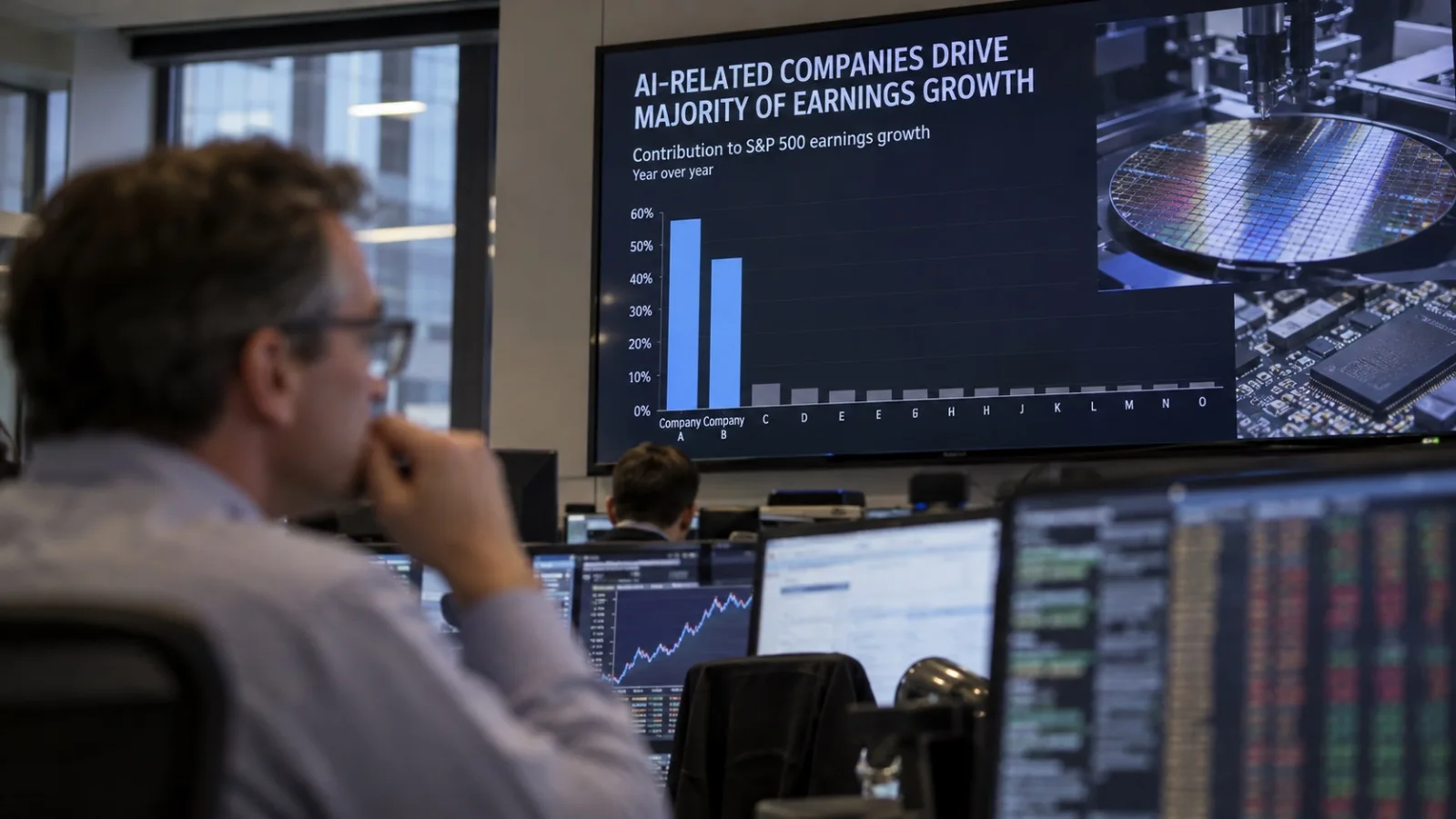
The number that matters more than 30% growth is 34%
US corporate earnings are strong. According to FactSet, third-quarter earnings for S&P 500 companies are expected to rise about 30% from a year earlier. The question is who is producing that increase.
In a Dow Jones Market Data analysis, Nvidia and Micron together account for 34% of total earnings growth. Widen the group to the top 10 companies, including Broadcom and Meta, and the share rises to about two-thirds. Micron's net income last quarter was already up 1,078% from a year earlier, and FactSet expects Nvidia's net income to grow about 90%.
- 30%: expected S&P 500 third-quarter earnings growth
- 34%: Nvidia and Micron's contribution to total earnings growth
- About 2/3: the top 10 companies' contribution to total earnings growth
It would be an overreading to say the other 490 companies are struggling. Excluding the top 10, earnings for the rest of the S&P 500 are still expected to grow about 10%. The breadth is narrow, but this is not a market with a collapsing floor. The risk looks less like a recession-style earnings decline and more like growth that leans too heavily on a handful of AI suppliers.
AI's money still piles up on the selling side
Torsten Slok, chief economist at Apollo Global Management, looked at the issue from another angle. He noted that revenue per employee and profit margins have not clearly improved in the S&P 493, and that AI's effect is not yet visible in total factor productivity across the US economy.
In Apollo's charts, inflation-adjusted revenue per employee at the Magnificent 7 rose from roughly $550,000 in 2022 to close to $800,000 recently. The rest of the index stalled near $550,000. Margins tell a similar story. Large tech companies moved higher, while the S&P 493 stayed generally near 10%.
There is an important limit. Apollo's analysis compares trends across groups of companies. It is an observation, not a causal experiment showing AI adoption has no effect. Companies that adopt AI must change workflows, adjust staffing and product pricing, and wait for the results to reach their financial statements, so a lag is possible.
The risk is not that Nvidia earns too much
What investors should watch is less Nvidia's growth rate itself than the economics of the customers who support that growth. An AI infrastructure company's revenue is ultimately another company's cost. If that spending does not come back as productivity, higher sales or lower labor costs, customers will at some point stop asking "how much more should we spend?" and start asking "why are we paying this price?"
- Stage 1: Surge in GPU, HBM and data center investment
- Stage 2: Rising cloud and software usage
- Stage 3: Better sales, margins and productivity at ordinary companies
The market has seen very strong numbers in Stage 1. Stage 2 is moving quickly. Stage 3 is still unclear. That gap is why concentrated AI earnings are a risk factor. If guidance from one or two suppliers weakens, it could lower not only those stocks' EPS but also the index's earnings growth and the valuation case at the same time.
This week's Big Tech earnings test whether AI is spreading
Alphabet and Microsoft report on Oct. 28, and Amazon on Oct. 29. The point is not whether AI-related revenue grew. The key is how quickly AI capital spending is turning into cloud revenue and operating profit, and whether enterprise customers are actually expanding usage.
If cloud growth and margins improve together, that would be evidence AI profits are spreading from semiconductors to the services layer. If instead capex rises fast while revenue per customer, usage and renewal rates fall short of expectations, the high growth already priced into Nvidia and the memory makers could become harder to carry.
Insight Times Editorial Desk