Nvidia's New GPU Is 3.7x Faster, But the Number That Matters Is 99%
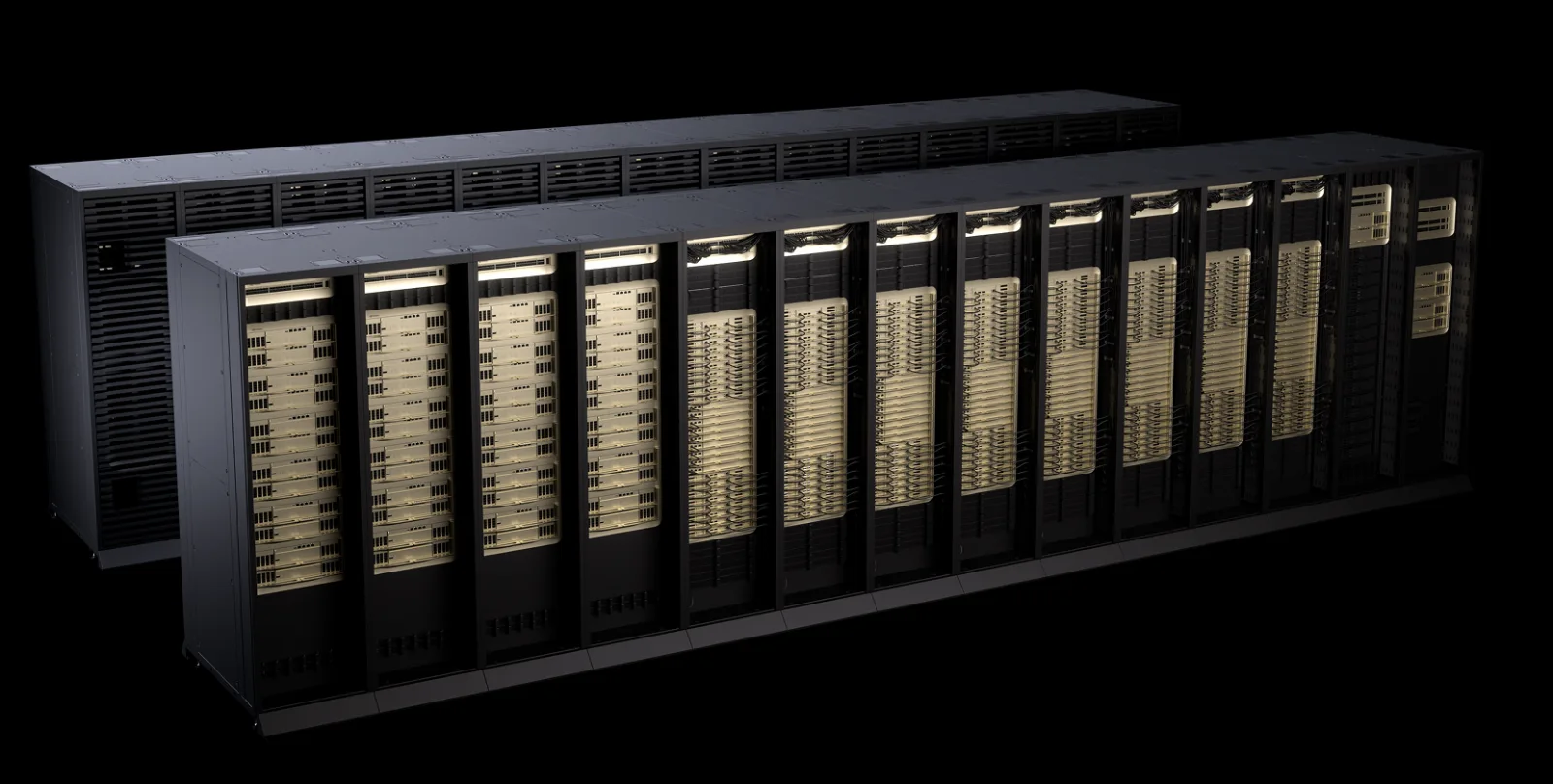
Nvidia quadrupled the GPU count from 72 to 288 and throughput scaled almost fourfold with it. That number signals AI data center competition is no longer just about who builds the fastest chip.
Buying four times the GPUs doesn't mean four times the AI speed
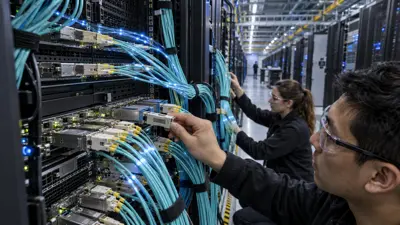
Think of an AI server cluster like a set of Lego bricks. One GPU working well does not guarantee that hundreds of them, wired together, all stay busy at once. Some GPUs sit idle waiting for others to finish a calculation. Some stall waiting on data. When the network gets congested, an entire rack of expensive compute lines up and waits.
That is why large-scale AI systems live and die by a number called scaling efficiency: how much of the theoretical throughput gain actually shows up when you add more hardware.
72 GPUs → 288 GPUs = 4x the hardware
99% scaling → roughly 3.96x the throughput
That means the system came within a hair of the ideal fourfold gain. It is a different measure from GPU utilization, which tracks how busy each chip is, not how well the system scales as you add more of them.
Ideal scaling: 100% — Actual: 99%
In MLPerf Inference v6.1 results Nvidia published, the GB300 NVL72 held 99% scaling efficiency on the DeepSeek-R1 offline scenario as the cluster grew from a single 72-GPU rack to four racks totaling 288 GPUs. In other words, Nvidia quadrupled the number of racks installed while losing almost none of the performance that scale should have delivered.
The reason this matters is straightforward. GPUs are among the most expensive assets in an AI data center. Every minute a GPU spends waiting on another GPU is a minute a company is paying for compute it isn't using. The more GPUs sit idle waiting on each other, the more hardware and capital a company needs to deliver the same amount of AI service.
The real output of an AI factory isn't GPUs. It's tokens.
A car factory's productivity gets measured in cars produced. A generative AI data center's productivity, in the end, comes down to how many inference results it produces in a given stretch of time. For large language models, that number simplifies to token throughput.
Tokens per GPU — output generated by a single chip. The more tokens produced with the same GPU count, the better the return on hardware spending.
Tokens per watt — output per unit of power. As power becomes the binding constraint on AI data centers, this metric may matter more than raw speed.
Tokens per dollar — output per dollar of capital. This is closest to the final scorecard, once chips, networking, power, cooling and software are all added up.
Seen this way, "how many times faster is Rubin than Blackwell" is only half the question. The more important one is how many paying inference requests a single dollar of AI capex can generate.
Why 1.6x might matter more than 3.7x
Vera Rubin's headline gain, up to 3.7x, is the number that grabs attention. But there's a second fact that matters just as much to data center operators: the same GB300 hardware got faster purely through a software update.
According to Nvidia, the GB300 NVL72 delivered up to 1.6x higher performance on Qwen3-VL in MLPerf v6.1 compared with v6.0. The gains came from reduced KV cache precision, kernel fusion, kernel-level improvements, and a serving approach that separates the prefill and decode stages of inference.
In plain terms: No new factory was built. No machines were swapped out. Daily output rose because the production software got better.
That isn't literally "free capex." Software development has its own cost, and real-world service conditions can produce different gains than a benchmark. But the effect is real: it extends the useful economic life of GPUs already installed and raises the return on that investment.
This is where Nvidia's economics start to diverge from a traditional chipmaker's. A GPU sold once can keep doing more work over time through software improvements in CUDA, TensorRT-LLM, Dynamo, vLLM integration and network optimization.
Why this looks less like a chip company and more like an AI-factory company
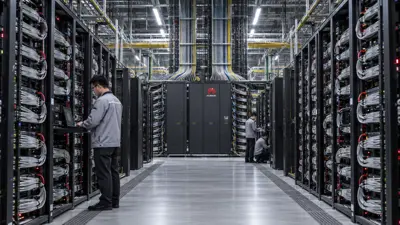
At large scale, inference isn't won by the single fastest GPU. The network binding hundreds of GPUs together, memory movement, rack design, compilers, the inference engine, model-specific tuning and workload distribution all have to line up at once.
| Competitive layer | What it has to solve | Effect on economics |
|---|---|---|
| GPU | Fast matrix operations and inference itself | Base production capacity |
| HBM / memory | Feeding the model and KV cache quickly | Less GPU idle time |
| NVLink / networking | Fast data movement between GPUs and racks | Efficiency at large scale |
| Inference software | Batching requests, splitting models, scheduling prefill/decode | More throughput from the same hardware |
| Rack, power, cooling | Running high-density systems reliably in a real data center | Output per watt, per square foot |
The unit of competition has grown from "one GPU" to "the entire AI factory." Explaining Nvidia's strength through silicon speed alone misses this part of the story.
99% isn't proof of a Nvidia-only trick
A word of caution is warranted here. This 99% figure comes from one specific MLPerf DeepSeek-R1 offline test. Real cloud services vary in request size, latency requirements, model type, network congestion and power constraints. A 99% benchmark score does not automatically translate into 99% efficiency across every data center.
The broader MLPerf v6.1 results also show rivals closing the gap on large-scale efficiency fast. This round included systems using up to 512 accelerators, and MangoBoost reported 97% scaling efficiency on a system that tied together four geographically separate regions as if they were a single endpoint. The shift of AI inference toward a scale-out discipline is not a story unique to Nvidia.
</markdown>
Insight Times Editorial Desk