Who Becomes the Windows of the Self-Driving Era?
Hyundai just pushed back its own autonomous driving timeline and turned to Nvidia first. The real story is not the delay, it is Nvidia's bid to become a common platform across the entire auto industry, not just a chip supplier.
What matters more than Hyundai's two-year delay
Hyundai Motor Group unveiled its autonomous driving roadmap on September 13, saying it would begin mass production of L2++ vehicles built on its own Atria AI in the second half of 2029. That is roughly two years later than originally planned.
But Hyundai is not waiting until then. In the first half of 2028, it plans to mass produce L2+ vehicles based on Nvidia's platform, followed by L2++ vehicles in the second half of that year. The foundation is Nvidia DRIVE Hyperion 10.
The important fact here is not that Hyundai is using Nvidia chips. Hyperion 10 is not simply an automotive GPU. It bundles Blackwell-based DRIVE AGX Thor computing, DriveOS, a validated sensor suite covering cameras, radar and lidar, and DRIVE AV software into a single reference platform. It lets an automaker start building an autonomous driving system without designing every layer of the stack from scratch.
Nvidia has run this playbook before, in the data center
Nvidia never just sold GPUs in the data center either. It locked in developers with CUDA, connected chips with NVLink, and extended into networking and server reference designs, turning "how you use a GPU" into a platform in its own right.
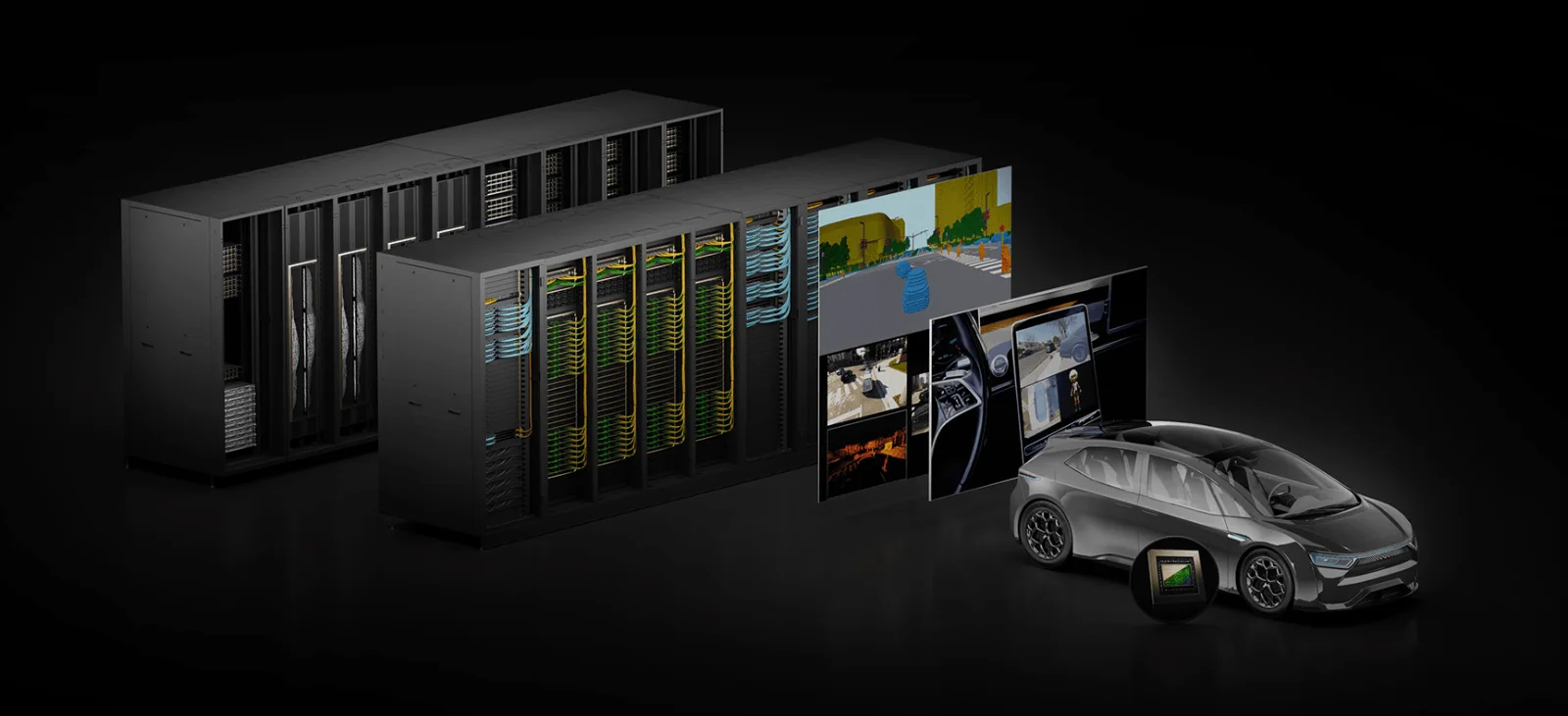
The same picture is emerging in cars. Inside the vehicle, DRIVE AGX, DriveOS, the sensor suite and DRIVE AV do the work. Outside it, DGX systems train the models while Omniverse and Cosmos handle simulation and validation. The bigger goal is not chip revenue per vehicle. It is putting the entire workflow of developing, training, validating and deploying autonomous driving on top of Nvidia.
BYD, Geely, Nissan, Mercedes-Benz, Lucid and Stellantis have already joined the DRIVE Hyperion ecosystem. Hyundai's full-scale entry raises the odds that Nvidia becomes not "a supplier to one automaker" but a shared foundation cutting across manufacturers.
So the "Windows" comparison is only half right
The comparison to Windows in the self-driving era is intuitive, but taken literally it overstates the case. Cars are far more complex than PCs. Sensor configurations differ, regulations differ by country, and there are liability and safety-certification questions the moment something goes wrong. Automakers are unlikely to hand over the entire user experience and vehicle control to Nvidia.
So the position Nvidia is really after looks less like Windows alone and more like Wintel and CUDA combined into a single foundational layer. Each automaker keeps its own brand and app experience, while the AI compute, safety-critical OS, sensor standards and development tools underneath converge toward Nvidia.
If that structure takes hold, Nvidia's Automotive business becomes hard to evaluate on chip volume alone. Nvidia's Automotive revenue in fiscal 2026 was 2.3 billion dollars, small next to its data center business at the time. But once the platform becomes standard, the revenue touchpoints expand beyond in-vehicle compute to training GPUs, simulation and software. That is a possibility for now, not a confirmed revenue model.
What Hyundai actually wants is not Nvidia. It is data.
The most important word in Hyundai's announcement is not GPU. It is Data Flywheel.
Hyundai and Kia sell more than 7 million vehicles a year across roughly 190 countries and regions. If that scale can be converted into autonomous-driving data collection, it becomes a powerful weapon even for a company playing catch-up. Hyundai has set a goal of overtaking competitors in cumulative autonomous driving data volume by 2033.
That makes it reasonable to read the Nvidia adoption not as giving up on in-house technology, but as a strategy to buy time. Hyundai first gains mass-production experience and real-world driving data on the Nvidia platform, then feeds that data back into training Atria AI. Nvidia may not be Hyundai's final destination. It could be a launchpad to spin the data flywheel faster.
What this means for Tesla
Tesla stands almost at the opposite pole. The company has built its edge by keeping vehicles, the autonomous driving computer, AI software, over-the-air updates, data collection and robotaxi service connected internally as much as possible, a vertically integrated model.
In smartphone terms, Tesla looks like Apple: one company optimizes hardware and software together. Nvidia is moving in the direction of an Android-like ecosystem, where multiple manufacturers share a common computing foundation. The difference is that Nvidia is not just selling an OS. It supplies the chips and development tools too, holding pieces of both Qualcomm's and Android's roles at once.
Tesla's advantage is fast integration and a large stock of real-world driving data already collected. The advantage of the Nvidia camp is the ability to pool scale across multiple automakers. Hyundai alone sells more than 7 million vehicles a year. Add expanding Hyperion adoption from BYD, Mercedes-Benz, Nissan and others, and a contest begins between "one company's fleet" and "a platform shared by many companies."
Even so, Nvidia cannot freely merge each automaker's data into one shared dataset. Data ownership, privacy, and rivalry between competing manufacturers get in the way. A larger vehicle count inside the Nvidia ecosystem does not automatically translate into a stronger training-data advantage than Tesla's.
INSIGHT TIMES VIEW
What matters more from this announcement is not Hyundai's schedule slip itself. It is that the unit of competition in autonomous driving is shifting from "who built the better model" to "who can spin the loop of vehicle, data, training and deployment faster."
That shift favors Nvidia. Most automakers cannot build everything in-house, from chips to AI models to cloud training infrastructure, the way Tesla has. Nvidia can fill that gap with a common platform.
It is still too early to declare that "Android for cars" has been decided in Nvidia's favor. Automakers will not easily hand over control of core software, Chinese manufacturers are strengthening their own chips and autonomous driving stacks, and Mobileye, Qualcomm and in-house SoC camps remain in the race.
What investors should track is not the headline number of Hyperion adoption announcements, but how much actual mass-production volume grows, how deep into the stack Nvidia's software gets monetized, and whether automakers stay on the platform instead of defecting to their own stacks. That is when Automotive could be re-rated from a chip business into a platform business.
What to Watch
Hyundai's Nvidia-based L2+ and L2++ vehicles need to reach mass production on schedule for the platform strategy to turn from a lab experiment into revenue.
If vehicle shipments rise but revenue stays confined to chip sales, the evidence for a platform economy stays weak. The software and services share matters.
Actual shipment volume matters more than the number of partners announced. Network effects only appear once multiple manufacturers start using the same foundation at scale.
Watch whether the number of data-collecting vehicles, the reach of OTA updates, sensor standardization and Atria AI performance improvements actually follow through.
If Tesla keeps delivering strong autonomous driving performance with fewer sensors and its own compute, the economics of the vertically integrated model keep getting stronger.
FAQ
Not yet. Hyperion is a strong candidate for a common platform, but sensors, regulation, safety liability and brand experience differ enough across automakers that a single OS dominating the market the way it did with PCs looks harder to achieve.
Closer to the opposite. Hyundai is running a two-track strategy: mass-produce Nvidia-based vehicles first to secure data and experience, then feed that back into training and validating its own Atria AI.
The short-term impact is likely limited. Automotive is still much smaller than data center in Nvidia's total revenue. What matters is how much actual mass-production scale and software revenue attach after 2028.
Long-term competitive pressure is rising, because established automakers can use Nvidia to cut development time. Still, Tesla already runs a vertically integrated structure across vehicles, AI, data and robotaxis, so a simple comparison of vehicle counts is not enough to judge who comes out ahead.
Insight Times Editorial Desk