SpaceX AI Revenue Jumps 830%, but Starlink Still Earns the Real Money

In its first quarter as a public company, SpaceX turned profitable and guided to as much as $40 billion in fourth-quarter capex. A possible Tesla merger adds another question for investors.
SpaceX

Is SpaceX now an AI infrastructure company?

SpaceX once launched rockets and sold satellite internet. Now its biggest revenue line is AI computing.

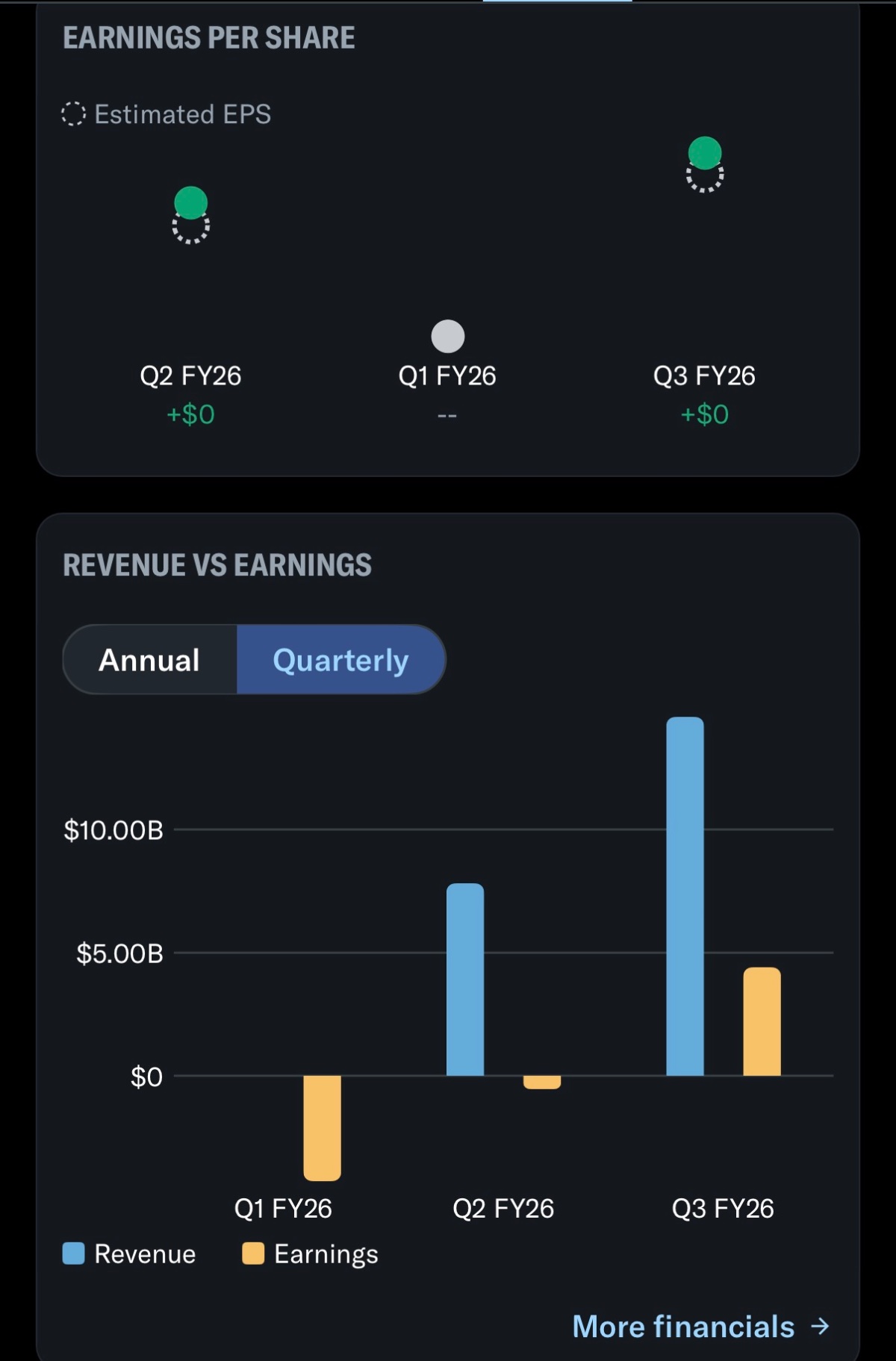
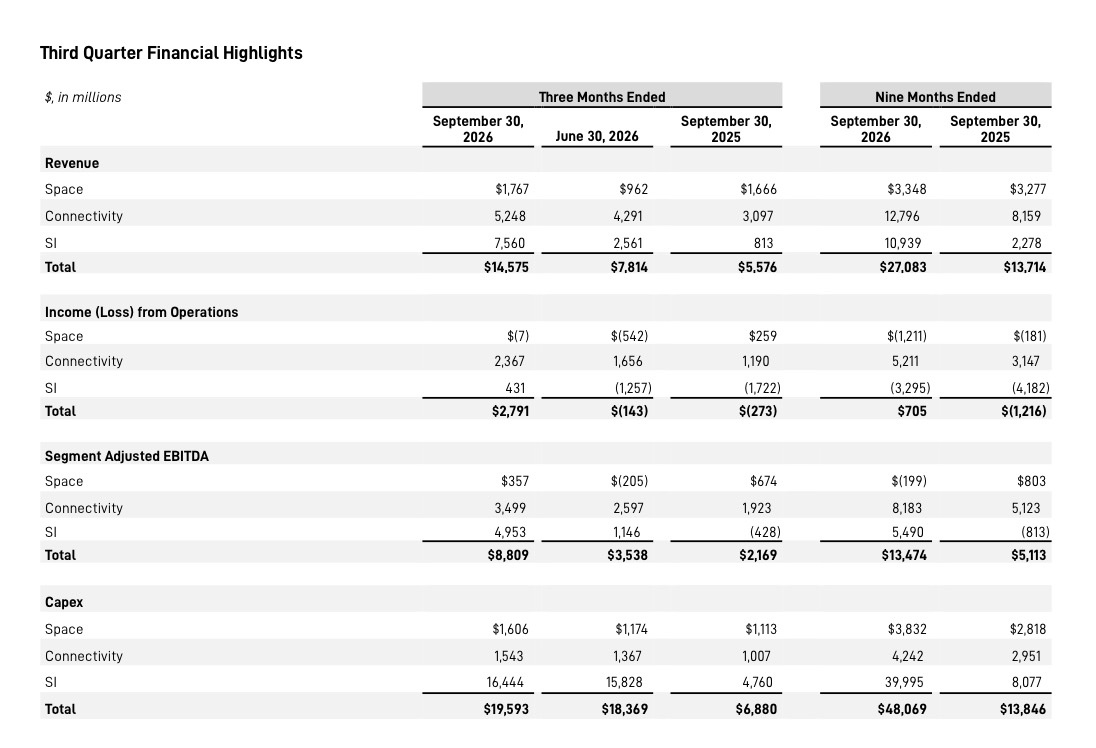
Third-quarter 2026 results, released Oct. 20, showed revenue of $14.575 billion and net income of $4.404 billion. A year earlier the company posted a net loss of $1.054 billion. Adjusted earnings per share of $0.45 far exceeded the $0.13 analysts expected.

Split by segment, the picture changes.

SegmentQ3 revenueOperating margin
Super Intelligence$7.56 billion5.7%
Connectivity$5.25 billion45.1%
Space$1.77 billion-0.4%

SpaceX Q3 2026 segment results. Operating margin is segment operating income divided by revenue.

Revenue at the AI business, Super Intelligence, jumped from $813 million a year earlier to $7.56 billion. Its operating income was $431 million. Connectivity earned $2.367 billion in operating income.

The AI unit has more revenue, but Connectivity produced about 5.5 times as much operating profit.

That is why SpaceX's growth business and its profit business need to be evaluated separately.

Who is the AI business's real customer?

Reading the AI growth only as a Grok success misses the point.

A large share of the revenue increase came from leasing data center computing capacity to companies such as Anthropic, Google and Reflection AI. SpaceX is becoming both an AI model developer and an infrastructure provider to other AI firms.

Cursor, the AI coding tool SpaceX acquired in August, added about $608 million in revenue through the end of September. Acquired revenue should be separated from organic growth. The AI segment also absorbed about $1.2 billion in stock-based compensation tied to the Cursor deal.

To judge SpaceX as a computing supplier, utilization rates, customer contract length, lease pricing and equipment replacement costs are more useful than the number of GPUs it has secured.

Starlink: profitability matters more than growth

Starlink has 13.6 million consumer subscribers, up 1.6 million from the prior quarter. Average monthly revenue per user (ARPU) is $69. That is below $83 a year earlier but up from $66 last quarter.

As expansion into new regions adds lower-priced plans, ARPU can fall. What matters is how far subscriber growth and larger business and government customers offset that.

Connectivity revenue rose 69% year over year while operating income rose about 99%. That is a positive sign that margins improve with scale.

Cash profitability, once satellite construction, launch and replacement costs are counted, should be judged separately from segment operating income.
SpaceX

A $4.4 billion profit, yet $35 billion of cash shortfall over nine months

Capital spending is the number that deserves the most caution in this report.

  • Q3 capex: $19.59 billion, up about 185% year over year
  • AI share of Q3 capex: 83.9%

Cash flow and capex, January to September 2026

  • Operating cash flow: +$13.097 billion
  • Capital expenditure: -$48.069 billion
  • Simple cash flow after capex: -$34.972 billion

Based on the SEC cash flow statement. This is operating cash flow minus purchases of property and equipment, not an adjusted free cash flow measure disclosed by the company.

The return to profit is real, but it does not mean cash generation has caught up with the pace of investment. Fourth-quarter capex is guided higher, to $35 billion to $40 billion.

There is no need to read this as an immediate liquidity problem. At the end of September SpaceX held about $51.3 billion in cash and equivalents and about $38.6 billion in marketable securities. Proceeds from the public listing also strengthened its balance sheet.

The question for investors is less the cash burn itself than when, and how much, this heavy upfront spending turns into recurring cash earnings.

Starship's success is not the same as the value of future businesses

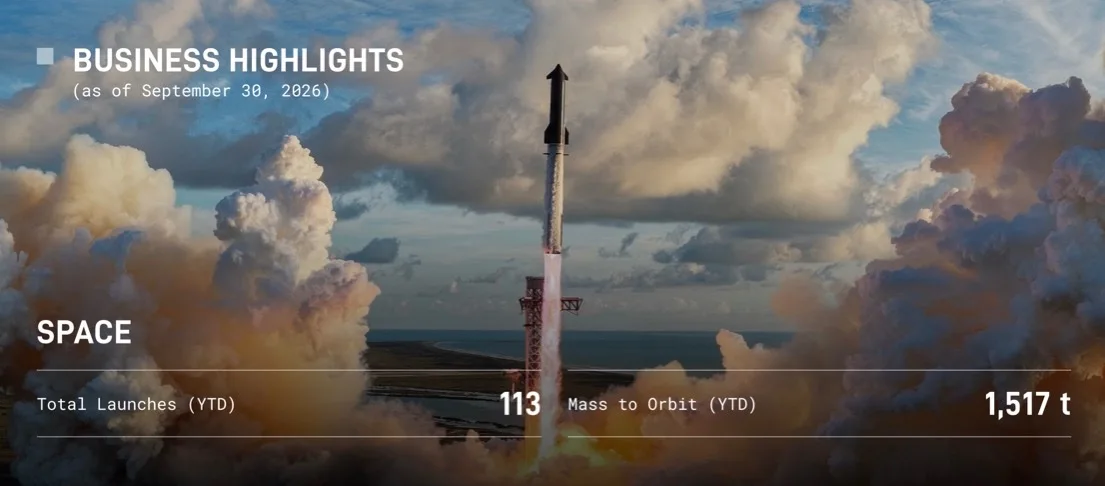
SpaceX said Starship's 14th flight placed 26 Starlink V3 satellites in orbit. As a revenue-generating mission, it is meaningful technical progress.

Repeat launches, full reuse and stable operating costs have not been proven, however. The same goes for the space data center concept: technical feasibility and commercial viability are different things.

It is important not to stack the value of future businesses on top of results already confirmed.

A Tesla-SpaceX merger: who benefits?

Elon Musk said a special committee from both companies is reviewing a possible merger. A deal is not confirmed, and neither a valuation nor an exchange ratio has been announced.

SpaceX's growth could appeal to Tesla shareholders, since the two could cooperate on AI computing, autonomous driving, robotics and communications infrastructure.

But potential synergies do not guarantee higher value per share.

The outcome could disappoint if Tesla pays too high a price, issues large amounts of new stock that dilutes existing holders, or takes on SpaceX's AI investment burden.

Conversely, with a reasonable exchange ratio and clear financial responsibility, cost savings and business expansion could create value.

So the question for Tesla investors is not whether SpaceX is a good company. It is at what price and on what terms a combination raises Tesla's value per share.

AI is SpaceX's biggest revenue line, but Starlink generates the operating profit, and heavy capex means cash burn continues.

Insight Times Editorial Desk

More by topic

Starting with this story's topics, then what readers are following now

Investor psychology, decision-making and books on investing

CapEx

This story's topic60 storiesSee all →

Money a company spends on things it will use for years — plants, equipment, bu…

Why the White House Swapped "AI" for "Super Intelligence"

Executive Order 14434 renames AI across the federal government without defining a new technology. The real story is about roughly $700 billion in capex, free cash flow and electricity.

Tech

Memory Chip Supercycle: Not at Peak Yet, But 5 of 6 Warning Signs Are Flashing

Memory prices are still climbing, but the pace is slowing and PC and smartphone demand is starting to crack under the weight of higher chip costs. This looks less like a price peak and more like a profit plateau building toward the next supply cycle.

Investing

AI Needs to Find $1 Trillion a Year From Somewhere to Pay Back Its Capex

Saying AI capex is big is no longer the point. The harder question is what end users have to pay for the buildout to pencil out, and Goldman Sachs puts that number at roughly $1 trillion a year.

Tech

Meta's Muse Wonder Is a Bid for the AI Operating System, Not Just a Model

An AI agent that remembers, decides and acts is Meta's next platform bet. Whether it pays off depends on user trust and sustainable profit, not just model quality.

Tech

AI Can Lift More Than Stocks: It May Push Long-Term Yields Higher Too

The AI boom can grow the numerator of corporate earnings while also growing the denominator of the discount rate. Investors watching long-term Treasury yields now need to add "AI capital demand" to the Fed, inflation and the deficit.

Tech

Why Tesla Lined Up $30 Billion in Credit It Says It Won't Use This Year

Tesla's 2026 capex is set to nearly triple. The question is less about debt than about when spending on AI, robotaxis, chips and energy turns into cash flow.

Tech

The AI Bubble Question Has Changed: By Late 2026, It's ROIC Over GPUs

There is no sign yet that AI investment is slowing. If anything, hyperscaler spending forecasts keep climbing. But as the scale of that capital has grown, the market's question has shifted from "is AI growing" to "when, and how much, does this capital come back as cash."

Tech

Earnings Report

This story's topic22 storiesSee all →

Tesla Energy's 13.7GWh Paradox: Expectations Ran Faster Than Deployments

Q2 deployments recovered but margins collapsed. Q3 set a record for deployments and still missed estimates. The issue is not the size of AI power demand but how fast it converts into Tesla revenue and profit.

Tech

If GPUs Are the Muscle, the Network Is the Nervous System

AI data centers do not get faster just by buying more GPUs. When thousands of accelerators cannot exchange data on time, the most expensive asset in the building sits idle. That is the whole investment case for Arista.

Investing

TSMC Proved the AI Chip Boom Again. So Why Did the Stock Fall?

Third-quarter results beat expectations and fourth-quarter growth is guided higher. Investors should separate the substance of the AI investment cycle from market anxiety.

Investing

ASML Is Discussing 2030 Orders. How Long Can the AI Chip Supercycle Last?

Despite bubble worries, ASML sees equipment shortages through 2028. Investors should watch future production capacity, not just today's orders.

Tech

Will the Bull Market Last Into 2027? Earnings Now Matter More Than AI

The S&P 500 has topped 7,800 even with the 10-year Treasury yield at 5.24%. Corporate profits are carrying the market, but the test is likely to shift from AI spending to AI returns.

Investing

Samsung Posts 107 Trillion Won Profit, TSMC Sales Jump 50%. Why Did the Shares Fall?

The AI chip supercycle has not ended. But the market's question has changed: not how fast earnings grow, but how long today's enormous margins can last.

Tech

Investing Mindset Part 6: The Goal of Homework Isn't Conviction, It's Knowing When to Change Your Mind

To hold a position for years, you need to know in advance what you will not tolerate holding through.

Tech

A building that houses servers and networking gear and supplies them with powe…

US AI Data Centers Are Headed for 90GW. Gigawatts Now Matter More Than Dollars

Goldman Sachs expects US data center capacity to grow from 64GW at the end of 2026 to 90GW at the end of 2027. The AI race is moving from buying GPUs to building power plants and transmission lines alongside them.

Tech

Why Nvidia Is Happy to Help Make AI Models Nearly Free

Falling model prices can squeeze model makers. For Nvidia, the number that matters is the total volume of tokens generated worldwide and the compute that produces them.

Tech

Nvidia Put $2 Billion Into Lumentum. Optics May Be the Next Bottleneck, but the Stock Has Already Run

Optical networking is emerging as the next constraint on AI data centers. Investors need to separate the industry's growth potential from the price they are already paying for it.

Tech

Nvidia's Next Target After GPUs: Controlling What AI Agents Are Allowed to Do

OpenShell and Sentry are not about policing what an AI says. They are about controlling, at the server infrastructure level, which files and APIs an AI can touch, what it can execute, and who can actually pull the plug when something goes wrong.

Tech

Nvidia's $500 Billion Experiment: Wall Street Asks Who Backs the GPU, Not Just the Chip

The real issue in Nvidia's financing platform is not chip sales. It is how far Wall Street will trust GPU resale prices and rental income three to four years out.

Tech

2027 Investing Needs Alignment, Not Prediction

A new investing book argues the hard part was never picking the next winner. It's staying aligned with where value and bottlenecks are moving while keeping old human weaknesses in check.

Investor Mind

What Jensen Huang sold at the G20 was not GPUs. It was national infrastructure

Nvidia's message is that AI should be laid down like electricity, roads and the internet. After the hyperscalers, the buyers are governments, telcos, regional clouds and industrial data centers.

Tech

HBM

63 storiesSee all →

Memory stacked next to the GPU.

Has Memory Peaked? Prices Are Cooling, but the Shortage Looks Set to Run to 2028

Price growth has slowed and consumer demand is already breaking. Server and HBM supply remains short, and Micron says more than 75% of its 2027 volume is already committed to customers.

Tech

AI Chip Peak Check: Demand Still Rising, Risk Building in 2027-2029 Supply and Funding

DRAM and NAND contract prices are still climbing and HBM suppliers hold the edge. Power shortages, AI financing costs and simultaneous memory expansion are the risks for later years.

Investing

How Far Can China Push DRAM Without EUV

CXMT says it has shrunk DRAM features to 11.95nm using quadruple patterning instead of EUV lithography. The real question is not whether China caught up, but how much more it now costs China to get there.

Tech

The Real ASML Number Isn't the 3% Pop, It's the 30% Capacity Hike

ASML's rally isn't just an AI trade. Customers are already locking in 2027 tool slots, and ASML is raising Low-NA EUV capacity by roughly 30% to keep up.

Investing

2027 Isn't the End: Citi's Case for a Memory Supercycle Running to 2031

Citi says the memory shortage timeline is stretching again. If AI shifts from "train once" models to continual learning, HBM, server DRAM and enterprise SSDs could all fall short at the same time.

Tech

Samsung, SK Hynix Sold Off on AI Fears. The Orders Haven't Followed Yet

The selloff reflects a market recalculating AI capex speed and memory earnings expectations, not confirmed cancellations. So far, the data show a gap between fear and reality.

Investing

China's DRAM Push Tests the Memory Supercycle for SK hynix, Samsung and Micron

Memory looks tight through 2027, with oversupply a risk from 2028. Investors in AI chips need to keep the two timelines apart.

Tech