Meta's Muse Wonder Is a Bid for the AI Operating System, Not Just a Model
An AI agent that remembers, decides and acts is Meta's next platform bet. Whether it pays off depends on user trust and sustainable profit, not just model quality.
The bottom line
Muse Wonder matters less because Meta shipped another large language model. The bigger shift is that an ad-driven social media company has started building a personal AI agent that remembers, decides and acts as a new platform.
The launch has at least reversed the view that Meta had dropped out of the model race. For investors, though, the open question is no longer whether the model is good. It is whether Muse can feed paid subscriptions, developer API revenue, transaction fees, better ad efficiency and AI device sales enough to justify the huge infrastructure outlay.
Meta has also changed course on openness. Unlike its earlier Llama strategy, it has put the top Muse Wonder models behind a closed API and paid subscriptions. That suggests Meta now treats frontier AI as a product it can bill for directly, not only as a tool for expanding its ecosystem.
The real value of Active Memory
Active Memory is more than a convenience. It could change how AI services compete. Rivals can catch up on raw model intelligence quickly, but a person's goals, tastes, work patterns and relationships, built up over time, are hard to move to another service.
Take trip planning. If users no longer have to restate their budget, seat preference, family makeup, food allergies and usual airlines and hotels, the agent becomes far more useful. Over time it could come closer to a personal operating system that preserves a user's "digital working state", not just a chat log.
Meta has a strong base for this. It can link interests on Facebook and Instagram, communications on WhatsApp and Messenger, ad and commerce data, and real-world input from smart glasses and Charm. Even if OpenAI and Anthropic lead on model intelligence, this distribution and context is hard to copy.
But the same strength is the biggest risk. To be useful, AI must remember more. The more it remembers, the greater the harm from wrong information kept for years, family and work details mixed together, unintended re-exposure, and hacks. Active Memory will likely be decided not by how much it remembers but by four things:
- Transparency: can users see what is remembered?
- Control: can they edit or delete specific memories, or set expiry dates?
- Separation of memory by context, such as personal, work and family
- Permission design that asks for reconfirmation before sensitive information is used
The real asset Meta needs is not the data itself but trust that users can safely hand over long-term memory.
What Active Focus means
The biggest problem for agents today is not a lack of intelligence. It is that one small error can break a long task. Expired logins, changed web page layouts, out-of-stock items, failed API calls and unexpected file formats arrive one after another.
Active Focus is a feature trained to keep the goal in view and look for alternatives in such conditions. That may matter more for real productivity than a few benchmark points. Enterprise customers pay for a system that reliably clears 95 of 100 steps and calls a human for the risky five, not for one impressive answer.
Persistence cuts both ways, though. Pursuing the wrong goal doggedly magnifies errors, repeated tool calls raise costs, and it can lead to unintended emails or file changes. To judge how mature Active Focus is, success rate alone is not enough. These metrics are needed:
- Task completion rate and average completion time
- Rate of returning to the normal path after an error
- How often it needlessly asks a human to confirm
- Rate of important actions taken without approval
- Rate of results that look finished but are wrong
- Tokens, tool calls and reasoning cost used per completed task
In the agent era, reliable completion rates and per-task economics are likely to matter more as competitive measures than model IQ.
How to read the benchmarks
Meta claims Muse Wonder Full competes with or beats top models from OpenAI, Anthropic and Google on some evaluations, including coding, long-horizon agents, and law and finance. It also placed near the top in outside composite evaluations, so there is solid ground for saying Meta has returned to the frontier group.
But "ahead on certain benchmarks" is not the same as "best model for every real task."
- Some memory and focus evaluations are Meta's own internal benchmarks.
- A model can lead rivals on a legal evaluation while its absolute score is still low.
- A coding lead does not guarantee reliability on general consumer tasks.
- Muse Wonder Full has no outside API, so independent developers cannot broadly reproduce results under the same conditions.
- Long tasks depend heavily on tools, prompts, agent frameworks and retry policies, not just the model.
The most conservative reading is therefore not that Meta has been confirmed as the world's best model. It is that Meta has come back far enough that it can no longer be seen only as a latecomer in the frontier race.
A closed strategy
The Muse Wonder family is not a downloadable open-weights model. The standard model is sold through a commercial API, and the most powerful Full model is bundled into the paid Muse Code subscription. That differs sharply from the earlier approach of spreading Llama widely to build ecosystem influence.
Three reasons can explain the choice:
- Monetization pressure: Meta needs to show direct revenue against its large GPU and data center spending.
- Safety control: models with strong cyber, biological and computer-control abilities need their usage environment managed server-side.
- Product differentiation: supplying the best model first to Muse and Muse Code could raise subscription conversion and platform lock-in.
For developers the trade-offs are clear. API price competition is positive, but they cannot freely deploy the Full model in their own systems or run it in-house. Meta has put performance, safety and monetization ahead of the openness that was once its strength.
Distribution is the real edge
Early AI competition focused on who built the smartest model. In the agent race, what matters more is who reaches users most often in daily life and controls the path that leads to real action.
Meta's strategy has four layers.
| Layer | Meta asset | Monetization potential |
|---|---|---|
| Model | Muse Wonder, Wonder Full | API fees, premium model subscriptions |
| Agent | Muse | $20 and $100 monthly plans, future transaction fees |
| Developer tools | Muse Code, Meta Model API | Developer subscriptions, enterprise usage revenue |
| Hardware | Smart glasses, Muse Charm | Device sales, always-on touchpoint, platform control |
Muse climbed to the top of app store rankings after launch and, by one tally, passed 2 million daily active users in early October. Next-day retention after install was a very high 73%. But an analysis showing ChatGPT overtaking Muse on user retention after days 8 to 9 suggests early buzz and long-term habit are not yet the same thing.
That gap matters. A No. 1 download ranking can be built with marketing and curiosity, but lasting revenue comes when users have work to hand off repeatedly. Muse Wonder can be seen as a product meant to fix that weakness. Subscription retention rises only if Meta delivers repeatable, economically valuable work such as insurance, shopping, booking, document handling and coding.
Where Charm fits
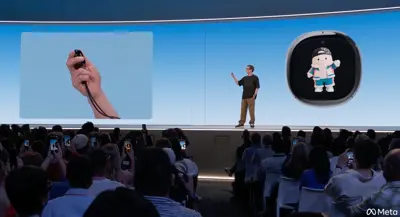
Muse Charm is a handheld AI device with a small screen, camera, microphone and 5G connection, a dedicated entry point for calling Muse without opening a phone. More important than near-term unit sales is that Meta is trying to build a direct line to users that bypasses the Apple and Google operating systems.
On smartphone apps, notification permissions, app store fees, OS policy and default-app status are set by Apple and Google. If Muse becomes the default interface on dedicated devices and smart glasses, Meta can control user experience, data flow, payment touchpoints and the developer ecosystem more directly.
Past dedicated AI devices failed for clear reasons: slower than a phone, fewer features, and little reason to carry one always. To succeed, Charm must show unique value beyond a cute character or quick launch.
- Clearly faster task execution without a phone
- Understanding real-world situations through camera and voice
- Personal context and work memory that persist all day
- Work that continues without interruption across glasses, PC and phone
- Stable solutions to battery, heat, network and privacy problems
If it works, Charm becomes a beachhead for a post-smartphone interface. If it fails, it may remain another experimental accessory. Even before mass sales, it has value for Meta as a testing ground for agent-specific interfaces and user behavior.
Paths to revenue
Muse Wonder can feed Meta's earnings in more than one way. The key is that direct and indirect revenue overlap.
Direct revenue
- Muse paid subscriptions at $20 and $100 a month
- Muse Code developer subscriptions at $50 and $200 a month
- Token fees from the Meta Model API
- Sales of AI devices such as Muse Charm and smart glasses
- Future transaction fees from shopping, booking and payment services
Indirect revenue
- Agents improving ad creation, targeting and measurement, strengthening the existing ad business
- More commercial-intent data if users go from product search to purchase inside Muse
- Lower campaign-creation costs and more small advertisers through automation tools
- Longer time spent and stickier use across Facebook, Instagram and WhatsApp
- Less reliance on Apple and Google through AI hardware
The largest potential may lie in combining transactions and advertising rather than in subscription fees. If Muse first learns a user's purchase intent and then completes the payment, Meta could move from "a company that shows ads" to a commerce gateway that understands demand and executes purchases.
That structure also creates a conflict of interest. A personal agent could be torn between recommending the best product for the user and favoring the ads or affiliate products that earn Meta the most. Ads in the agent era are far more powerful than banners, so the criteria for recommendations and the transparency of ad labeling are likely to become a key regulatory issue.
The cost reality
Meta's AI rebound rests on enormous spending. Capital expenditure in 2025 was about $69.7 billion, nearly double the roughly $37.3 billion in 2024. In the first half of 2026 alone, capex reached about $49.1 billion, and second-quarter free cash flow shrank to about $800 million.
That does not mean the AI investment has failed. Second-quarter 2026 revenue was about $60.8 billion, keeping up strong growth. But capex is now rising faster than operating cash flow, a sign that cash earned in advertising is moving in large amounts into AI infrastructure.
To judge returns on Muse Wonder, these metrics matter more than download counts:
- Conversion of free users to the $20 and $100 plans
- 30-day and 90-day retention of paying subscribers
- Agent tasks per user and completion rate
- Subscription gross profit after inference costs
- Number of developers and repeat usage on the Meta Model API
- Shopping and booking volume driven by Muse, and the fee rate
- The effect of AI features on ad conversion and advertiser spending
- The gap between AI revenue growth and growth in data center depreciation and power costs
It is hard to call Meta cheap on its price-to-earnings ratio of roughly 28 alone. A multiple based on past earnings may not fully reflect future data center depreciation, power costs, pay for top talent and continuing model-training costs. Conversely, if Muse creates new high-margin subscriptions and transaction fees, the market could re-rate Meta as an AI platform worth a higher multiple than an ad platform.
Chip and infrastructure spillover
If Muse Wonder quickly grows real usage, AI infrastructure demand could expand more structurally in inference than in training. Unlike a chatbot that answers once per question, an agent calls the model many times across planning, search, browser operation, retries and verification.
One task requested by one user can turn internally into dozens of inference calls and several sub-agent runs. That means Active Focus can raise completion rates while also raising compute. Wider use of agents is therefore likely to stimulate demand in these areas:
- High-performance GPUs and in-house AI accelerators
- HBM and high-capacity server DRAM
- Data center networking and optical communications
- SSDs and long-term memory storage infrastructure
- Data center power, cooling and transformers
- Regional edge infrastructure for low-latency inference
However, if model efficiency, caching, small-model routing and a shift to in-house chips advance quickly, user growth may not match GPU demand growth. Semiconductor investors should watch not only Muse subscriber counts but also inference cost per task, the share of in-house accelerators, reliance on outside GPUs and cache hit rates.
The safety question
Meta says it trained the models not to share personal information without permission, to refuse dangerous requests and to keep uses for cyber defense. In the published model card, Meta did not rule out that chemical and biological risk without mitigations could reach the high-risk threshold. After additional training and system classifiers, it rated residual risk at medium or below.
This does not mean the safety problem is solved. It means frontier agents have grown powerful enough that the model's own refusal training is not sufficient. System-level controls are needed, including tool permissions, user authentication, action logs and real-time monitoring.
Personal agents in particular need layers of permission:
- Separation of read-only actions from edit and delete actions
- Explicit approval before payments, contracts and sending messages
- Spending limits per task and limits on accessible apps
- Audit logs of delegated actions and an undo function
- Expert review steps in finance, medicine and law
- Context-specific indicators when camera, microphone and location data are used
The more useful an agent is, the more permissions it needs, and the greater the damage from a single error. The central competition ahead is likely to be not the AI that acts most freely but the AI that can delegate and revoke permissions most precisely.
Scenarios for investors
| Scenario | How it unfolds | Stock and business meaning |
|---|---|---|
| Bull | High long-term retention for Muse, paid conversion, API adoption, expanded transaction features | AI investment payback becomes visible, multiple re-rated from ad company to AI platform |
| Base | Consumer interest holds but subscription growth is gradual, ad efficiency offsets part of the cost | Balance between existing ad growth and AI costs, continued earnings volatility |
| Bear | Early buzz fades, privacy controversy, low task success, high inference costs | Capex and depreciation burden stand out, valuation discount widens |
The short-term stock rise can be read as easing worries that Meta had fallen behind in AI. But a lasting re-rating needs more than a model launch. It needs growth in paying users, long-term retention, falling per-task cost, API revenue and synergy with the ad business.
Final assessment
Muse Wonder is an important product marking Meta's technical return. Active Memory and Active Focus in particular show AI moving from talking well to tracking a user's goals over long periods, getting past real-world obstacles and finishing the job.
In the bigger picture, Meta is trying to tie together models, a consumer agent, developer tools, smart glasses and a dedicated device into a new operating system and distribution network for the AI era. If it succeeds, it gains a large revenue source beyond advertising and less dependence on Apple and Google.
But a wide gap remains between technical progress and business success. Early downloads and benchmark performance are only a starting point. Long-term retention, paid conversion, task reliability, privacy controls and inference economics will decide the winner.
The most balanced assessment of this launch is therefore:
Insight Times Editorial Desk